| Author |
 Replies: 70 / Views: 6,392 Replies: 70 / Views: 6,392 |
|
|
|
Pillar Of The Community
1375 Posts |
|
|
Maybe you can give some links to stamps showing this clearly, I don't find any.
About your image: you should learn to make and upload high resolution images, if anybody should be able to tell you anything about this. Your image shows a lot of JPG artefacts, so you have to make the detail section before saving and then save without JPG compression. |
Send note to Staff 
|
|
|
Valued Member
United Kingdom
299 Posts |
|
|
Stamperix, at this point I believe you should simply post a list of a step-by-step high resolution making 'how to'. You know, 'put your money where your mouth is...'  |
|
Send note to Staff
|
|
|
Valued Member
United Kingdom
299 Posts |
|
|
Pillar Of The Community
1375 Posts |
|
|
Well, I made the description above, it has to be a bit generic as everybody uses different scanner and image processing software. you just have to check all settings about JPG compression (for scanning and for editing/saving). and make the detail section as a first step (see all above...).
And could you give some links to "good resolution" images from Siegel with stamps showing the mark? |
|
Send note to Staff
|
|
|
Valued Member
United Kingdom
299 Posts |
|
|
Valued Member
United Kingdom
299 Posts |
|
|
Stamperix, to make things clear:
my hypothesis is that at a certain point towards the end of 1879 issues or beginning of the 1880 Special Printings the plate started presenting this particular feature - on one or multiple positions.
The above is sustained by evidence I found on several stamps!
Everybody is welcome to contribute with EVIDENCE for or against my hypothesis. Anything unsustained by such evidence is just out of the topic, in my opinion. |
|
Send note to Staff
|
| Edited by aug-stamps - 02/27/2018 3:52 pm |
|
|
Pillar Of The Community
1375 Posts |
|
|
I like looking at stamps' details, too. But you need better images. Your links (and Siegel) don't show high resolution images, they are also about 800 pixels high which is not much for such a detail. Just look into the link above with essayk's explanations and scans as a comparison for high resolution images. But maybe you start at your own stamp with a high resolution scan (or perhaps even better a photo under magnification) without those artefacts. |
|
Send note to Staff
|
|
|
Pillar Of The Community
United States
1946 Posts |
|
|
Sorry for the delay in getting back. I had to attend to part of the Kelleher sale for today. Here's blowup of the UL corner of the 193 at the Swedish Angel site. 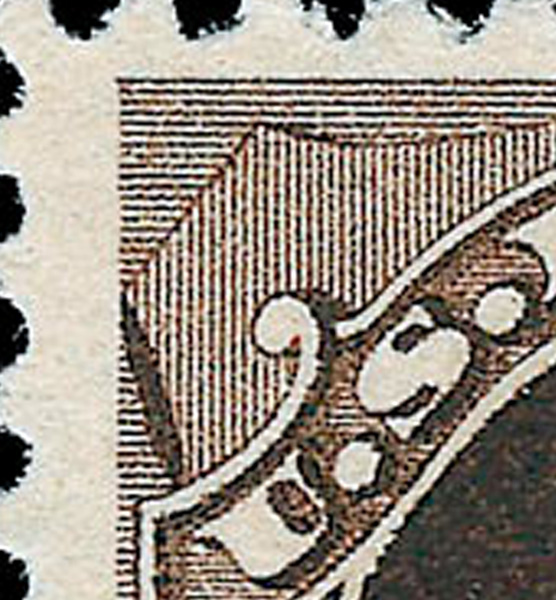 I see the anomaly to which you are in reference. Can you prove to me that it is not just an artifact of the screen resolution? Given the size of the actual lines in the stamps, I would need to see a real closeup, and not merely an extrapolation from a smaller image. But let me ask, are you saying this is a kind of "fingerprint" for a 193? That all examples of 193 should show something like this? You are contending that this anomaly is due to plate wear, is that correct? So the plate wore the same way and to the same extent over its entire surface? I think we can test that. |
|
Send note to Staff
|
| Edited by essayk - 02/27/2018 4:07 pm |
|
|
Bedrock Of The Community
12734 Posts |
|
|
Valued Member
United Kingdom
299 Posts |
|
|
My stamp is now with Royal Philatelic Society for expertize. Once I get it back - and especially if it comes as #193  - I will scan it at the highest resolution allowed by my scanner. ... and I will send it to PF as well, of course. If my hypothesis is correct, then all future expertizations will benefit from it. If my hypothesis is wrong, then, at least, the well walked traditional path will be proven right, once more. So, win-win situation for me  |
|
Send note to Staff
|
|
|
Pillar Of The Community
United States
1946 Posts |
|
|
Here are blowups without artifacts of the PF and Siegel images you provided: This is the PF image: 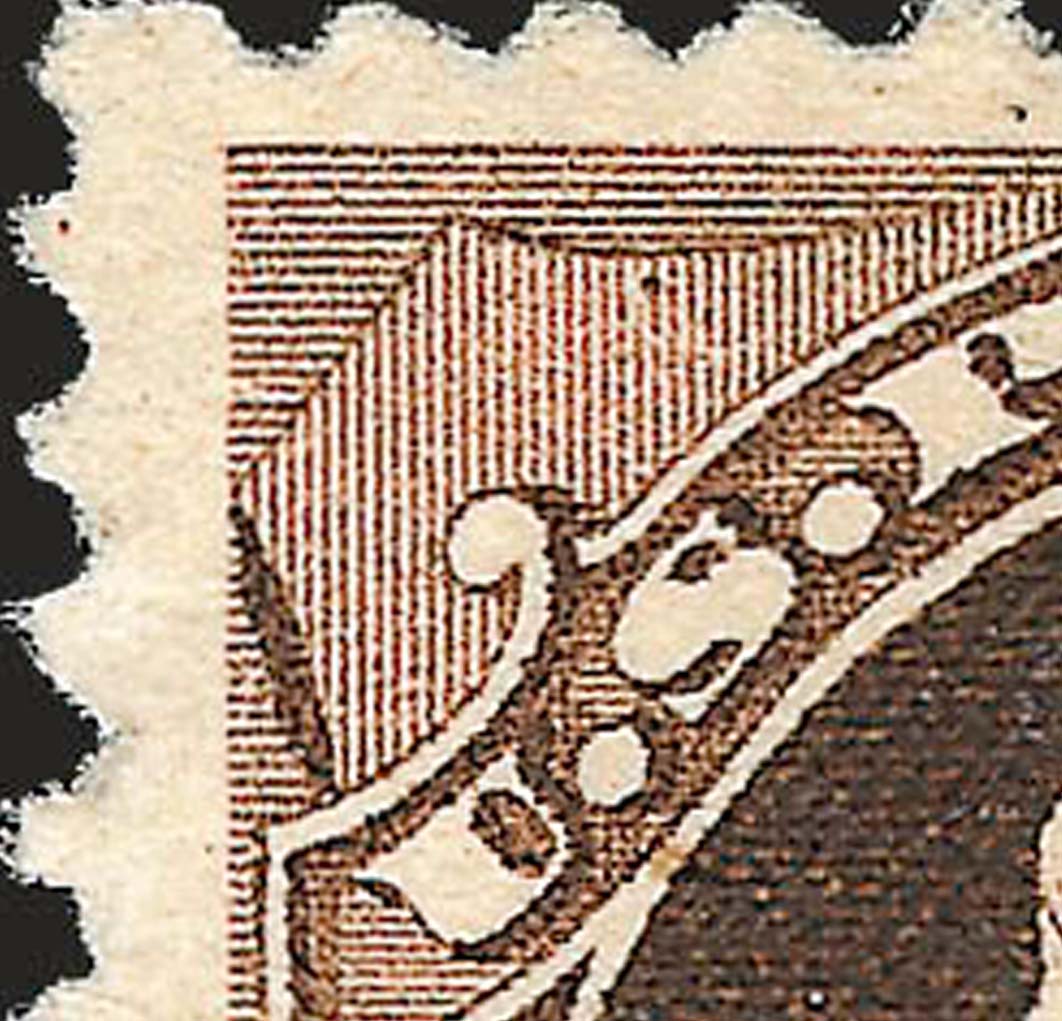 This is the Siegel image: 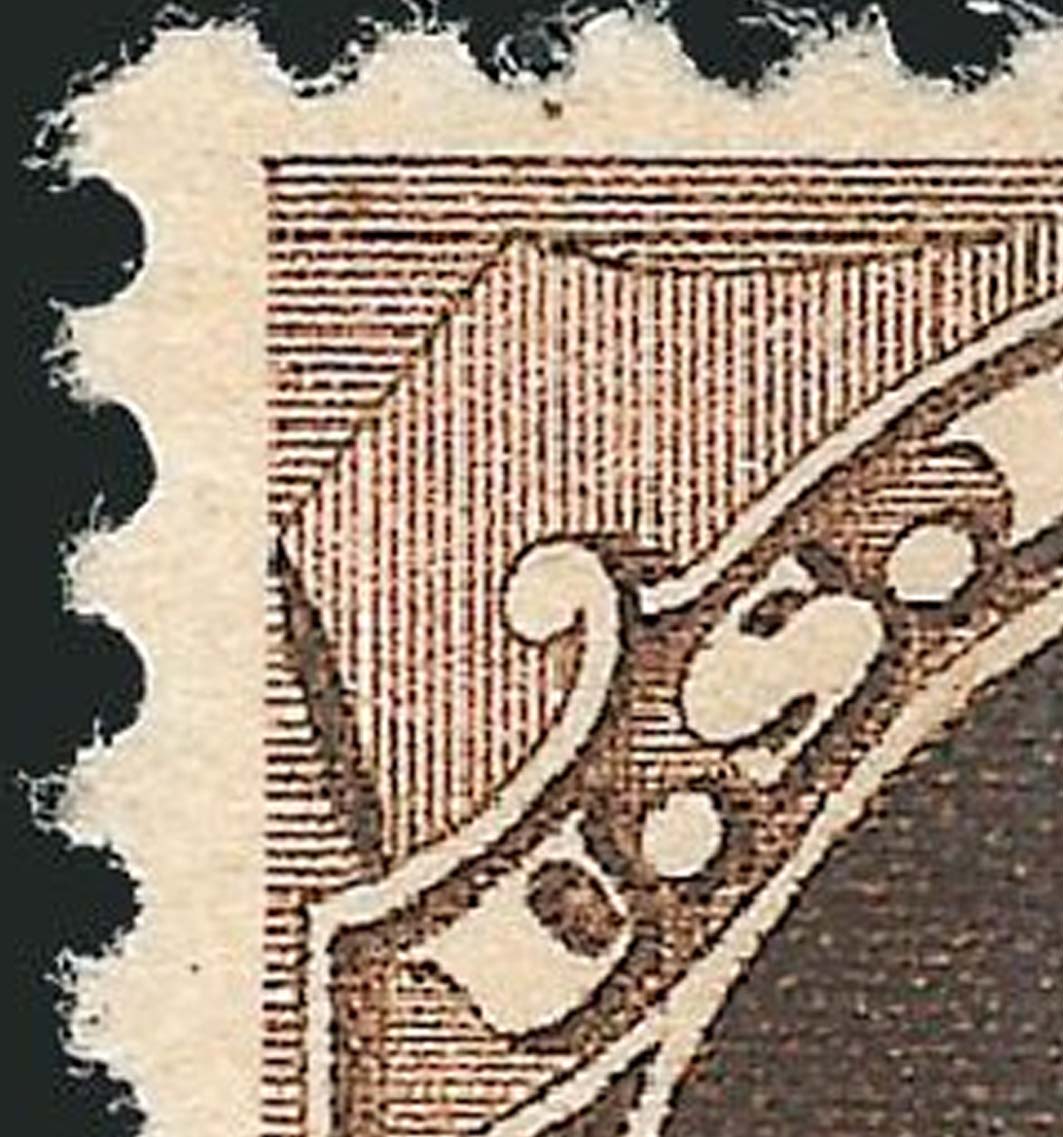 Comparing these to the image from Swede I gave above, we see that no two are alike insofar as the anomaly you were pointing at is concerned. They all exhibit the normal closure of the corner as is typical of a #157. Did you expect them to all be the same? |
|
Send note to Staff
|
|
|
Valued Member
United Kingdom
299 Posts |
|
|
Essayk, I am pretty comfortable with the variation - both of them have the first line under left scroll ending in a diagonal line, towards the point of junction of the scroll lines.
If you look carefully at the magnified image where I show the mark on my stamp then you can see right under the mark a faint line going in the same direction (parallel with my mark) and joining the same point of the two scroll lines. |
|
Send note to Staff
|
| Edited by aug-stamps - 02/27/2018 4:50 pm |
|
|
Valued Member
United Kingdom
299 Posts |
|
|
Anyone had the time or curiosity to check his A45 and A45a stamps, please? |
|
Send note to Staff
|
| Edited by aug-stamps - 02/27/2018 4:50 pm |
|
|
Valued Member
United Kingdom
299 Posts |
|
|
So far, if the mark was not intentional then I believe the explanation offered by Brookman - natural plate wearing - is the most likely explanation. Either way, it is there, whatever the cause of it.  |
|
Send note to Staff
|
|
|
Pillar Of The Community
United States
3528 Posts |
|
|
Quote:
So the plate wore the same way and to the same extent over its entire surface? I'm not a Banknote expert, but I am a plater. Am I understanding this argument correctly, in that it is being stipulated that all plate positions on a plate wore exactly uniformly in this minute detail such that all positions from a point in time now show this mark? This, being distinct from a die marking of course. Is this really what is being stipulated here? I just want to make sure I'm following this correctly, thanks. |
|
Send note to Staff
|
|
|
Replies: 70 / Views: 6,392 |
|



 Posted 02/27/2018 3:22 pm


