Stamp Community Family of Web Sites
Thousands of stamps, consistently graded, competitively priced and hundreds of in-depth blog posts to read


Stamp Community Forum
 
Username:
Password:
Save Password
Forgot your Password?

This page may contain links that result in small commissions to keep this free site up and running.

Welcome Guest! Registering and/or logging in will remove the anchor (bottom) ads. It's Free!

Any Other 30c Greenish Black Design A53 On Hard Paper Other Than Scott#176, Please?

Next Page    
 
To participate in the forum you must log in or register.
Author Previous TopicReplies: 17 / Views: 4,410Next Topic
Page: of 2
Valued Member

United Kingdom
299 Posts
Posted 03/15/2018   2:05 pm  Show Profile Bookmark this topic Add aug-stamps to your friends list Get a Link to this Message
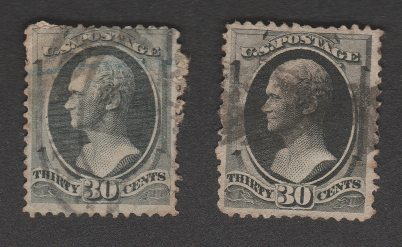
Does anyone know of any other hard paper 30c greenish black Hamilton apart from Scott#176, please?
The stamp on the left is on hard paper, the one on the right is on soft paper.


Send note to Staff

Pillar Of The Community
United States
1414 Posts
Posted 03/15/2018   3:10 pm  Show Profile Bookmark this reply Add cfrphoto to your friends list  Get a Link to this Reply
Scott 165, the ordinary Continental Bank Note Company Printing. Please read the description of the "special printings" in the Scott US Specialized catalog. Aside from no used examples of 176 being recorded, the paper would be white compared to the regular issue printed on a slightly yellowish paper. Also, the special printing stamps were cut apart with scissors, leaving mutilated perforations.

It is time to stop giving free advice to the OP.
Send note to Staff  Go to Top of Page
Edited by cfrphoto - 03/15/2018 3:12 pm
Valued Member
United Kingdom
299 Posts
Posted 03/15/2018   3:39 pm  Show Profile Bookmark this reply Add aug-stamps to your friends list  Get a Link to this Reply
If #165 was ever printed on hard paper, as well, then I completely agree. So, was it, Clark?
Send note to Staff  Go to Top of Page
Pillar Of The Community
674 Posts
Posted 03/15/2018   4:21 pm  Show Profile Bookmark this reply Add mdroth to your friends list  Get a Link to this Reply
That stamp pictured on the left looks very unique to me - I've never seen one like it. Is the remnant paper attached to the back of it hard paper or soft paper??

Send note to Staff  Go to Top of Page
Pillar Of The Community
United States
1414 Posts
Posted 03/15/2018   6:37 pm  Show Profile Bookmark this reply Add cfrphoto to your friends list  Get a Link to this Reply
Continental Bank Note printed stamps were, by the Scott Catalog definition, printed on hard paper. Scott 190, referred to as the American Bank Note printing, was printed on soft paper. Late printings on soft paper by the Continental Bank Note Company are considered to be Scott 190 unless canceled with a date from before Feb 4, 1879 when the consolidation occurred and American Bank Note Company assumed management control. The preferred way to separate National and Continental printings on hard paper is by color. In my experience National Bank Note printings in black have crisper impressions and better fine line detail than the gray black or greenish black Continental Bank Note printings.

Because nothing is ever that simple, the Continental Bank Note company also printed some stamps on double paper as an experiment to reduce fraudulent cancel removal. Although on hard paper, double paper has some of the visual characteristics of soft paper when held up to light, but without the characteristic basket weave pattern.

Much of this information is in the Scott US Specialized catalog. One way to profit as a stamp collector or dealer is to read the catalog from cover to cover or at least the sections of highest interest.
Send note to Staff  Go to Top of Page
Pillar Of The Community
Guatemala
1500 Posts
Posted 03/15/2018   6:46 pm  Show Profile Bookmark this reply Add quigngt to your friends list  Get a Link to this Reply
Yes, Scott 165 is hard paper. It is one of the 1873 Continentals printing. http://www.stampexpertizing.com/pdf...s_ver1.0.pdf

The following is quoted from the link:

"1851-77 ISSUES
All of these issues were printed on "hard white wove paper" so you can use a low-priced 3c 1861 used
stamp as your reference copy or any other pre-1877 stamp where because of the unique design, it
cannot be anything else but hard paper (nearly all pre-1870 stamps fit into this category)."
Send note to Staff  Go to Top of Page
Edited by quigngt - 03/15/2018 6:49 pm
Moderator
Learn More...
United States
12330 Posts
Posted 03/15/2018   7:11 pm  Show Profile Bookmark this reply Add 51studebaker to your friends list  Get a Link to this Reply
quigngt,
That link is to an older version of this article
http://stampsmarter.com/learning/Ma...SStamps.html

Don

***Link Fixed***
Send note to Staff  Go to Top of Page
Pillar Of The Community
United States
1808 Posts
Posted 03/15/2018   8:06 pm  Show Profile Bookmark this reply Add dudley to your friends list  Get a Link to this Reply
Don, that link leads to a 404 error.
Send note to Staff  Go to Top of Page
Pillar Of The Community
United States
3182 Posts
Posted 03/15/2018   9:14 pm  Show Profile Bookmark this reply Add littleriverphil to your friends list  Get a Link to this Reply
Aug, have you downloaded the Lester Brookman books from Don's site yet?

http://www.stampsmarter.com/learnin...me_USID.html

Specific information on the Special Printing may be found by accessing the USPCS resorce page Search the Cronicle for author Mooz, William.

https://www.uspcs.org/resource-cent...e-chronicle/
Send note to Staff  Go to Top of Page
Pillar Of The Community
1375 Posts
Posted 03/16/2018   03:28 am  Show Profile Bookmark this reply Add stamperix to your friends list  Get a Link to this Reply
cfrphoto, if I may ask something about the papers, as it is probably interesting for many here:

two questions.

- Siegel writes in its explanations of the 165 quite often that it can be distinguished by the shape of the perforations from the 154. But they don't say how exactly, so how do the perforations look different?
https://siegelauctions.com/lot_grd....emailflag=on

- I learned a few things now about the National, Continental, American and Intermediate paper. Interesting read is Landau's one about the papers and Scott's definition.
http://chronicle.uspcs.org/pdf/Chro...88/12124.pdf
Hes says alone the 6c stamp has about 12 different Continental papers known. What I would like to know here: where do the experienced collectors (and maybe Scott) put the border between Continental and American from the definition point of view for undated single stamps? Did American for example not use bleached paper at all, so that we can assume that a stamp on unbleached soft is to be seen as American? I know at the end we never know for sure if a stamp from the transition period is "officially" American or Continental. But collectors, Scott and auction houses have to make their definitions somehow.

thank you.
Send note to Staff  Go to Top of Page
Pillar Of The Community
United States
1944 Posts
Posted 03/17/2018   1:43 pm  Show Profile Bookmark this reply Add essayk to your friends list  Get a Link to this Reply

Quote:
Hes says alone the 6c stamp has about 12 different Continental papers known. What I would like to know here: where do the experienced collectors (and maybe Scott) put the border between Continental and American from the definition point of view for undated single stamps?


The late Eliot Landau was a personal friend of mine. We shared a love of the Bank Note issues which dominated many of our conversations. One of the joys of our relationship was that we could disagree, sometimes heatedly, and still come out as friends. However, his tendency to extrapolate beyond evidence to inferred conclusions and then fight for them tooth and nail was the very thing that kept him out of certain philatelic circles. Eliot was an attorney who tended to marshal his "evidence" into a plausible case, even when it lacked good scientific demonstration. Plausible and defensible are not always the same.

The Chronicle article to which you are pointing was written and published in 2000. Its understanding of the paper chemistry in operation for the Bank Notes was limited in critical ways. In particular, Eliot attributed certain characteristics to variations in "bleaching" that we now know are to be understood in other ways. He wrote:

Quote:
From mid-1876 through February 1879, CBNC used progressively softer papers with a variety of bleaching intensities. In late summer 1878, CBNC started using a relatively uniform, mildly bleached soft paper and all stamps were printed on it by CBNC and ABNC until the introduction of the unbleached newsprint in summer 1879.


Eliot assigned the label "newsprint" to a paper type based on the popular notion of what that term meant at the time, i.e. a weakly sized, wood pulp paper with a high lignin content. Subsequent research by John Barwis (under a grant in 2011; a simplified version of the study was published in 2014 here: http://chronicle.uspcs.org/PDF/Chro...43/21198.pdf ) demonstrated that in 1879 the paper being used by American was still a rag paper, as before, but now with a different sizing agent (rosin/alum) than used previously. Barwis further demonstrated that bleaching levels was not the variable that Landau had suggested as the marker for differentiation of varieties. That distinction belongs to the three principle paper sizing agents in use from 1873 to 1883: gelatin, rosin/alum, and starch.

In his exhibit of the 6c, Eliot had mounted face-down examples of his numerous varieties differentiated by bleaching. However, despite his claims that he had assistance from a research chemist at Argonne labs (a lady known to Chicago philatelists) beyond his exhibit I know of no published systematic work which substantiated his claims.


All of that is preamble to the response I wish to give to the question stamperix brought up: where ... put the border between Continental and American...for undated single stamps?

1. The point of distinction is not a matter of "definition" it is a matter of convention.

Until it can be determined exactly what change(s) American instituted in the production of the rosin/alum stamps introduced by Continental in early 1878 and continued after the merger Feb 4, 1879, undated soft paper stamps are all to be attributed to American. This follows the precedent introduced by Scott decades ago.

This approach recognizes that there was no difference in personnel, machinery, plates, or point of origin before or immediately after the date of merger for certain denominations of stamps.

Send note to Staff  Go to Top of Page
Pillar Of The Community
1375 Posts
Posted 03/17/2018   3:54 pm  Show Profile Bookmark this reply Add stamperix to your friends list  Get a Link to this Reply
thank you very much, essayk. As the article was published in the chronicles, and not 50 years ago, I indeed thought that the bleached vs. unbleached paper theory was some kind of convention. I also knew the article by Barwis, but thought that it would be just an additional, more detailed look into the topic. As far as I understand Barwis, he does not answer the question, how many and which types of paper there are, as he only defines subtypes. Is this the research you write about?
https://repository.si.edu/bitstream...eb_FINAL.pdf

It's not easy to understand as a non-native speaker, and I don't have access to the "easy version" in the chronicle. Still, may I ask two more questions about this?

- is the "intermediate paper" what Barwis calls "transitional paper"?
- is the transitional paper in his article (like in the table 6 on p.18) the paper Continental 1873 0.0030inch? Or the American 1879 0.0030inch?
(- if it's not listed in the table 6: why didn't Barwis take the well-known intermediate paper into his research?)

Send note to Staff  Go to Top of Page
Pillar Of The Community
United States
1944 Posts
Posted 03/18/2018   12:41 am  Show Profile Bookmark this reply Add essayk to your friends list  Get a Link to this Reply

Quote:
- is the "intermediate paper" what Barwis calls "transitional paper"?


Yes.


Quote:
- is the transitional paper in his article (like in the table 6 on p.18) the paper Continental 1873 0.0030inch? Or the American 1879 0.0030inch?


For this entire study, Barwis does not use Scott numbers to refer to particular stamp issues. So, table 6 is a bit confusing since the dates he gives are not actually year dates but shorthand references to the stamp issues as listed in Scott. He did not use the Scott numbers inasmuch as those are proprietary and he was publishing an independent technical report. He avoided the copyright issue entirely by referencing the issues by the year in which they commenced.

So then, on your second question, here is what Barwis says:
"Continental's thickest paper, the so-called "transitional paper" used in late 1878, was no doubt used by the American Bank Note Company in early 1879 until the supply was depleted. However, this .0030-inch-thick paper was made with different sizing than most paper of the same thickness also used by American."

What he is saying is this: Continental had introduced a thicker grade of their distinctive paper with a gelatin sizing agent in 1878 (table 6, type 5), and this continued in use by them up to the day of the merger with American. Then American continued to use the same paper until the supply was depleted. At that point, American provided a paper of the same thickness but with a different sizing agent (table 6, type 6). This he dates to some time in 1879.

The problem, of course, is that by using the stock of paper they inherited from Continental, American blurs the distinction between issues. For undated stamps on soft paper, there is no way to distinguish Continental late from earliest American as to printer, until American begins to use the rosin/alum paper.
Send note to Staff  Go to Top of Page
Pillar Of The Community
1375 Posts
Posted 03/18/2018   07:23 am  Show Profile Bookmark this reply Add stamperix to your friends list  Get a Link to this Reply
thank you again. Now I filled that gap for me.

You (and Scott in its definition) mention the "soft paper" as the paper which could be both Continental and American. After Barwis' results, also about the intermediate paper, why shouldn't we postulate that:
- a stamp that has soft paper (Barwis type 6: American 1879) is an American printing
- a stamp that has intermediate paper (Barwis type 5: Continental 1873) is a Continental or American printing

of course then the next step is to define intermediate paper. what I learned from the intermediate paper (simplified) is that it looks like hard paper in your hand, but has a bit mottled look before light and perforation fibers more similar to the soft paper, and the thickness is not as thick as the soft paper.
Send note to Staff  Go to Top of Page
Edited by stamperix - 03/18/2018 07:32 am
Pillar Of The Community
United States
1944 Posts
Posted 03/20/2018   01:10 am  Show Profile Bookmark this reply Add essayk to your friends list  Get a Link to this Reply

Quote:
of course then the next step is to define intermediate paper.


The parameters by which Barwis defines his paper types are not the same as the parameters used to discriminate paper types as noted in Scott. The problem at present is that we cannot yet say how much of a correlation there is between the visual characteristics noted in Scott for these papers, and the chemical and structural characteristics Barwis isolates and discriminates. Barwis is careful not to use the same language for his discrimination of papers as that used by Scott.


Quote:
mottled look before light and perforation fibers more similar to the soft paper, and the thickness is not as thick as the soft paper.


Presumably the first stamp paper American used was leftover from Continental's paper stock, and was gelatin sized at .0030-inch-thick. When this was done American used a rosin/alum sized paper of the same thickness. Question: Do these two papers have the same visual characteristics, even on trans-illumination? If not, then are the characteristics of the latter the same as "soft paper?" On the other hand, if they have the same visual characteristics and thickness, then is this second American paper also an "intermediate" paper prior to the advent of true "soft" paper with its starch sizing?

Do you see the problem?
Send note to Staff  Go to Top of Page
Edited by essayk - 03/20/2018 01:19 am
Pillar Of The Community
United States
1414 Posts
Posted 03/20/2018   02:39 am  Show Profile Bookmark this reply Add cfrphoto to your friends list  Get a Link to this Reply
Try strong long wave UV light on samples of each type of paper. It is clear that hard paper is bright and American soft paper is dead looking. Is there any correlation with the three types of sizing? Would sizing correlate with paper contracts?

Also, stamps on dated covers or having Bank Note Company logo capture need more study. While National Bank Note and Continental Bank Note logos may appear on stamps printed by American Bank Note Company, no ambiguity should exist if the stamp has American Bank Note logo capture. A few ABN logo stamps are known on a hard paper as documented by Ron Burns in a recently published an article in the USPCS Chronicle. This paper was reported almost 100 years ago in a pair of articles apparently overlooked for many years.
Send note to Staff  Go to Top of Page
Edited by cfrphoto - 03/20/2018 02:41 am
Page: of 2 Previous TopicReplies: 17 / Views: 4,410Next Topic  
Next Page
 
To participate in the forum you must log in or register.

Go to Top of Page

Disclaimer: While a tremendous amount of effort goes into ensuring the accuracy of the information contained in this site, Stamp Community assumes no liability for errors. Copyright 2005 - 2026 Stamp Community Family - All rights reserved worldwide. Use of any images or content on this website without prior written permission of Stamp Community or the original lender is strictly prohibited.
Privacy Policy / Terms of Use    Advertise Here
Stamp Community Forum © 2007 - 2026 Stamp Community Forums
It took 0.22 seconds to lick this stamp. Powered By: Snitz Forums 2000 Version 3.4.05