| Author |
 Replies: 40 / Views: 4,535 Replies: 40 / Views: 4,535 |
|
|
|
Moderator

United States
12330 Posts |
|
|
green + black = a shade of green
green + white = a tint of green
green + yellow = a hue
green + blue = a hue
You can do on online search for color theory to learn more on this.
Keep in mind that we perceive black as black because it absorbs all the visible light wavelengths and white as white because it reflects all visible light wavelengths.
Don |
Send note to Staff 
|
|
|
Pillar Of The Community
1375 Posts |
|
|
yes, but what do you use in your language to fill the gap in my example above? Is there no word? |
|
Send note to Staff
|
|
|
Moderator
United States
12330 Posts |
|
|
Most accurately you would say you have one shade of green and two hues. In a more general way you could say you have three different green colors.
Don |
|
Send note to Staff
|
|
|
Pillar Of The Community
1375 Posts |
|
|
Moderator
United States
12330 Posts |
|
|
It is this kind of thing that makes the English language difficult; I admire you for being bi-lingual and respect your request for clarification.
Don |
|
Send note to Staff
|
|
|
Valued Member
United States
46 Posts |
|
|
Moderator
United States
12330 Posts |
|
|
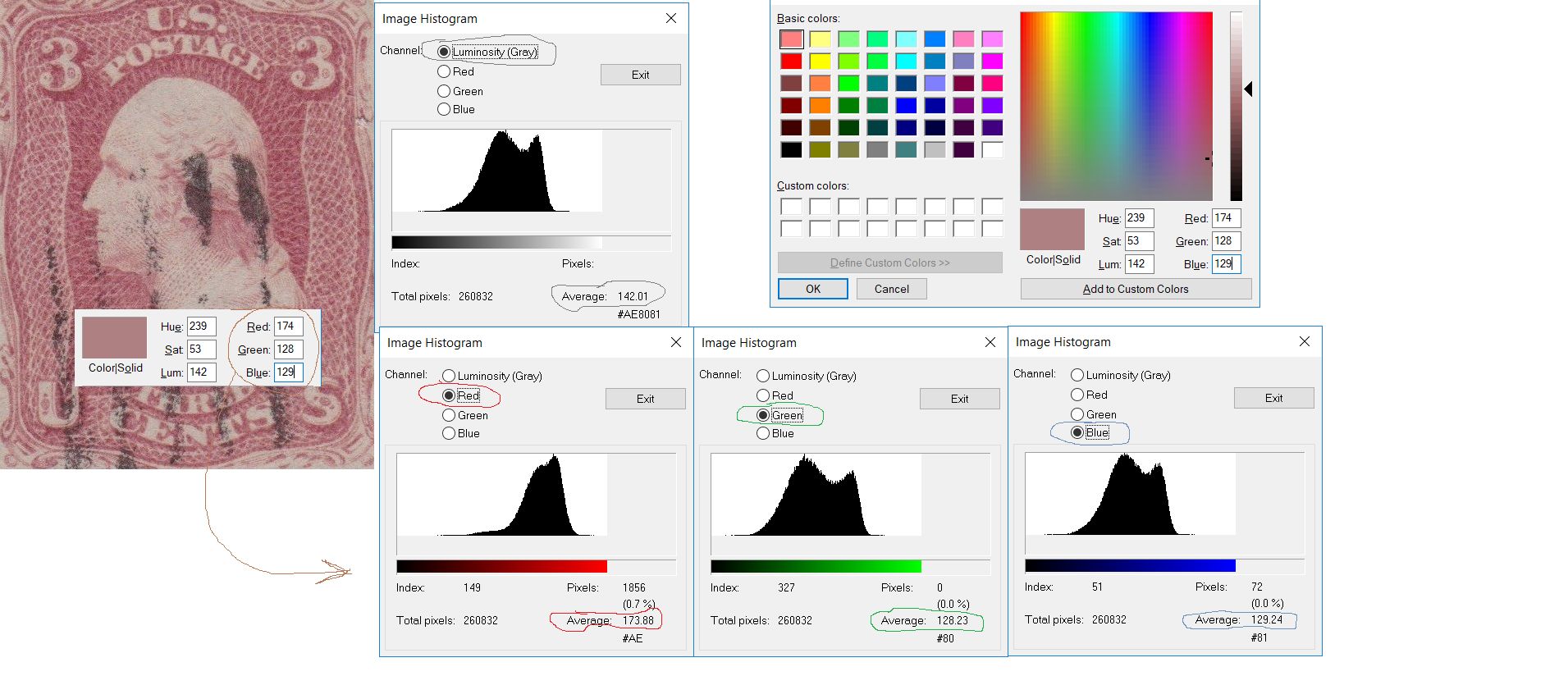
Do you know how the image was scanned? Did the user save the file as jpg (which compressed the file and rewrite all the color data to compress the file? Did the user also use the upload optimizer which again changes all the color data in an effort to reduce file size?
You have analyzed a modified image; the chances of a modified image accurately representing the actual stamp color is slim to none.
Additionally, using a color picker to ID the colors is impossible, move the color picker a few pixels away and you would see totally different RGB values.
Don |
|
Send note to Staff
|
|
|
Pillar Of The Community
1375 Posts |
|
|
Yes, in this case it's not a valid result, but you can do color analysis of stamps on your computer, of course. I didn't, but it would be great if anybody once could share his results in any article or also here in the forum.
It's not too difficult, you just need a calibrated system (scanner only in this case) and then you can use the large amount of tools in Photoshop. Don, you can also choose the color picker and set the area to more than 1px. Then you could choose a stamp and a stamp area which is good for this and try a certified pink vs. a certified rose.
But of course, about the 3c 1861 there is a totally different problem, as many stamps and paper have faded or changed their appearance, the Photoshop thing would only be an additional tool.
|
|
Send note to Staff
|
| Edited by stamperix - 07/20/2018 09:50 am |
|
|
Moderator
United States
12330 Posts |
|
|
It is a used stamp, no one knows what the stamp has seen environmentally over the decades.
And even if you used a large number of pixels there could still be a discrepancy cross the face of the stamp. (You would have to sample across the face of the stamp a number of times to come up with an average.) And viewing on a calibrate monitor does no good if the source image was not also done with the ambient lighting controlled and defined, calibrated equipment, saved in a uncompressed file format like TIFF, and not uploaded using any optimizer. For calibration to be meaningful, both the input and the output equipment HAVE to be in sync. Calibrating one side and not the other is meaningless. Keep in mind that calibration has to include the ambient lightning. You cannot calibrate your scanner with the lid closed and then scan with it open. And you cannot calibrate your monitor at night with your desk lamp on and then expect the calibration to be accurate during the day with your desk lamp off.
There is only one way to currently deal with stamp colors, build a large reference collection, develop a good eye, understand and control the ambient light environment. The process of scanning and posting images is wrought with introduced layers of color changing steps which makes it impossible to accurately ID colors. Stamps scanned together has a bit of limited value since we can make a relative comparison; but it still miles away from being definitive.
Don |
|
Send note to Staff
|
|
|
Valued Member
97 Posts |
|
|
Don: your definitions of hue, tint, tone and shade agree with what I was taught during my brief stint as an art major in college. Most of what I've read about colors of stamps unfortunately throws all that out the window.
I see some hope in relatively recent use of modern spectrum analysis tools to non-destructively identify the chemical composition of the pigments. The PF seems to be about one step away from doing a comprehensive chemical analysis of accepted color samples of some of these stamps.
Don't get me wrong; the well trained eye is a very good tool. But modern scientific tools can add reprodicible quantitative data to the field. I expect that such analysis will confirm a great majority of expert opinions. It would also allow the PF to provide facts about the colors of submitted stamps. When a subtle color difference can be worth thousands of dollars, facts are even better than opinions. |
|
Send note to Staff
|
|
|
Pillar Of The Community
United States
2555 Posts |
|
|
Quote:
Don't get me wrong; the well trained eye is a very good tool. I think it is essential and we must never move away from it. While I agree that there probably are some appropriate uses, reliance solely on chemical analysis of printing inks to determine color would almost immediately produce worse problems than we already have. Let's not go there! |
|
Send note to Staff
|
|
|
Moderator
United States
12330 Posts |
|
|
Chemical analysis of the ink is but one piece of this puzzle. Time, the paper, the printing processes, and the ambient lighting conditions are other factors which would influence the stamp colors.
So lets walk through what an ink chemistry analysis might provide us. Say we had the original ink chemistry formula in hand for a specific sheet of 1857 stamps. And we would also be able to reassemble that same exact sheet of stamps today and do another accurate ink analysis on each stamp in the sheet. First we would note that the reassembled sheet of stamp had stamps that were visibly different colors. The chemistry of the ink on each stamp would have changed from the original but would also have changed stamp to stamp.
This is because the chemical reaction is dependent upon the environmental conditions it was stored in for over 100 years. I do see value in studying ink chemistries but unless we can figure out all the possible environmental reactions that a stamp might have been exposed to over the years I am afraid that definitive answers would still be elusive.
Don
|
|
Send note to Staff
|
|
|
Pillar Of The Community

United States
1837 Posts |
|
|
It would be interesting to compare this result to the same analysis of the second image. That one was scanned on an Epson perfection 600 scanner with all optimizations turned off in "professional" mode. So at least it should be minimally processed. I guess the results would be quite different. |
|
Send note to Staff
|
|
|
Valued Member
97 Posts |
|
|
Don: If that sheet of stamps was printed with a primarily iron oxide pigment and another sheet was printed with a lead oxide pigment, then 160 years later, the first would still contain iron and the second would still contain lead. Chemical analysis would show the difference conclusively even though the stamps were all different colors now.
Of course it is just one piece of the puzzle, but I hope more such research is done. |
|
Send note to Staff
|
|
|
Moderator
United States
12330 Posts |
|
|
Hi Tim,
Understood, but the actual elements/chemistry can change over time. A chemical process such as reduction (a process that is opposite of rusting) can change the composition of the elements. So for example, iron oxide hematite (Fe2O3) transitions to iron oxide magnetite (Fe3O4) and then the iron oxide magnetite can transition to iron metal.
But I fully support continued discovery and effort into this kind research. It is important to understand color science and how it applies to our hobby.
Don
|
|
Send note to Staff
|
|
|
Replies: 40 / Views: 4,535 |
|




 Posted 07/20/2018 03:18 am