To participate in the forum you must log in or register.
| Author |
 Replies: 49 / Views: 6,248 Replies: 49 / Views: 6,248 |
|
|
|
Pillar Of The Community
United States
624 Posts |
|
|
Good thread. Parroting what several folks have already posted; but the key to really using catalogs in terms of value is really patience and experience, and experience. Yes, stated twice on purpose.
I would never not recommend to a new collector not to have a Scott, or other relevant catalog to help them identify their stamps though; they are in my opinion indispensable tools to simply identify what one might be looking at, and to at least be able to establish whether a stamp is in the $1 range or $500 range.
In terms of buying/selling though, the internet; which has indeed contributed to the decline of the stamp shows I knew as a kid is also a much more powerful resource I wish I'd had when I had a meager $16 or so to spend and every penny counted. On a purely economic level it is as close to a completely free market as one will find (good thing, IMO.) Here's where catalogs and technology merge; one can easily compare catalog value to many stamps for sale on most or a great many of stamps one may be interested in.
That, however takes experience and patience, i.e. creating true collectors and experts. Whatever genre or country or theme one collects, when you do it long enough, you learn where the market is in relation to Scott or whatever said catalog says. Sometimes a painful experience, but part of being a collector of anything.
There are a few stamps listed in Scott for $2 MNH that I'd gladly pay $4 for, and some listed as $4 for a set of 4 or 5 that I know I'll probably see in the next year for $2; but that's just a product of experience. Sure we all have those scenarios, but every catalog can't be prefect for every stamp every time (value-wise) but can be a good guide.
Catalogs are great; but only as good as the user. Much like most everything in life. |
Send note to Staff 
|
|
|
Pillar Of The Community
United States
2830 Posts |
|
|
Quote:
Stampworld has a free online catalog with its own numbering system, but the amount of technical information it contains is limited, with many minor varieties unmentioned. Still, one can get images and basic information for most commonly encountered stamps. I use it to see new issues that haven't made it into Scott or even Linn's updates yet, but use Scott for everything else. If expanded and enhanced, Stampworld could form the genesis of such a project as outlined in the OP. To a large degree, this comment reflects my feelings on this topic. This is a huge project and would benefit greatly from being staged. For example, it should not be an expectation to take one specific country, say US, and complete it end to end before taking on another country. In my view, universal interest would expand more quickly if "something" is done with many countries, even if only the most popularly collected areas. So for example, phase one would be agreeing on a numbering system for major and minor numbers. I'm a big believer in the concept that minor numbering systems are insanely counterintuitive. For example, an "a" number in Scott's can be an invert, a perf variety, a shade, a booklet pane, and any number of other things. In a universal catalog, minor varieties should be consistent- b = booklet pane c = color difference (shade) g= perf variety (gauge). Multiple varieties could be say ga, gb, gc.... or g1, g2, g3 ? = grill (gr?) i = invert error m = missing element error (or one letter can be used for all error types, for example "e") o = overprint variety p = paper variety s = specimen Formats for sets should be universal and consistent. Are long sets issued over many years listed together, or listed by the year(s) they were issued. Do new issue long sets issued over time stay together somehow, or no? Are airmails BOB (like Scott) or during year of issue (like Gibbons)? Are watermark changes major or minor numbers? Once these structures are decided upon, then numbering can take place, followed by images of stamps and overprints. Each major collector area would get the same schedule as above, to accelerate interest. Perhaps US, GB, Canada, France, Germany, China, Korea, Belgium, Switzerland, Australia, India, Russia, etc. Once the nuts and bolts are fastened in place, then pricing might be undertaken. How many columns?? Simple M and U? Or NH, LH, H, HR, NG, U, CTO, OC (on cover)? The prices are the diciest, and by far the most difficult to create and maintain. One proposal I would make is not to denominate stamp values. Instead, there should be one or just a few reference stamps given dollar values. I will make up a fictitious stamp - Franistaniland #100, with a street value of $100. If this is our reference stamp, then all other stamps pricing are based on this 1 stamp. So a value for a different may be given of 2x, meaning that it is worth twice what Franistaniland # 100 is worth ($200). If the value given is .25, the the stamp is worth $25. A stamp valued at .005 is worth 50 cents, and so on. This does multiple positive things. First, currency exchange no longer matters. All stamps are priced as a percentage of the reference stamp. If that price is in dollars, then the collector knows from the instructions to check the exchange rate on XE.com to convert to Euros, pounds, yen, pesos, etc etc. And pricing for the vast majority of stamps won't ever need to be changed, because realistically they are always worth the same approximate amount relative to the reference stamp. Frankly, this likely covers the entirety of classic philately and a good portion of mid-century and later stamps. And very cheap stamps need no attention at all- they are all assigned a notation that prices are a matter of pennies and negotiated with sellers based on volume and the seller's business policies. There will be examples where this pricing system won't work: 1- "Hot" or speculative philatelic areas 2- Countries losing an inordinate degree of interest compared to the reference stamp(s) 3- Newer issues with potential volatility based on unforeseen interest/lack of interest 4- Very rare items whose market prices can only be determined by auction or private treaty results So in these cases, pricing can be updated periodically just like in the major catalogs, to account for speculation and auction results. But this will apply to a small slice of the philatelic market, and frankly most more expensive items. So the workload can be VASTLY reduced by using formulas for most values. My two cents....... |
|
Send note to Staff
|
|
|
Pillar Of The Community
United States
721 Posts |
|
|
Why mess with success? As one person noted earlier, the major catalog companies that are out there have survived while taken on the world. These publishers have experience and don't just create listings willy-nilly. There will always be flaws in such huge undertakings, but at least the collective experience from millions of hours of collecting experience help us understand those flaws and work within the existing catalog systems. And, the existing companies revise and renew to add or correct information all the time.
I think those publishers are moving toward more effective digital publishing so future generations can have it their way. |
|
Send note to Staff
|
|
|
Bedrock Of The Community
12704 Posts |
|
|
It should be noted that a major factor in many catalog value vs actual sale value disparities is centering/condition. Catalog values, with few exceptions, are based upon sound stamps with VF centering. However, many sales that produce results that do not align well with published catalog values are not for stamps in said state. At the end though it seems to always circle back to the question of where the catalog value basis originates. It seems that even now dealer "price list" values are major components of the sausage making as opposed to online sales venue realizations. I make this assertion based upon the fact that we have not seen values adjust over time as major events took place such as the advent and subsequent dominance of ebay and the like as places that buyers purchase the majority of their stamps. |
|
Send note to Staff
|
|
|
Valued Member
189 Posts |
|
|
Quote:
Are airmails BOB (like Scott) or during year of issue (like Gibbons)? Having semipostals and airmails as BOB items is certainly an annoyance. I bet that, around 100 years ago when these things first started to exist, they thought, "Ooh! A new type of stamp! We'd better create a new section of the catalog!" Then here we are, present day, bemoaning the silliness of the publisher. But there's no going back. Scott cannot renumber. This sort of thing reminds me of mammals and their long laryngeal nerves, going from the brain to the aortic arch, then to the larynx, a path of up to 15 feet in giraffes! Why doesn't it just go right to the larynx? It would make more sense, and the larynx would work better. But given a slow and gradual evolution from the biology of a fish to the biology of a mammal, there is no way for the nerve to magically jump from one side of the aortic arch to the other. Evidence against intelligent design. Likewise, there is no way for the established catalog to magically jump from one numbering system to another. Evidence against intelligent design. |
|
Send note to Staff
|
|
|
Pillar Of The Community
Canada
1462 Posts |
|
|
And then there's Yvert, that lists airmail separately, but semi-postal as year of issue. And breaks out long-running sets, unlike Scott. Makes it a little challenging to cross-reference on occasion.
I think the ideal goal of a universal numbering system is noble, but unlikely to happen, as no major publisher or organization would actually gain by it, despite the obvious appeal to WW collectors. |
|
Send note to Staff
|
|
|
Pillar Of The Community
United States
2830 Posts |
|
|
I would not expect the traditional catalog makers to go along with this scheme. Don's point in his OP is this would be a new concept, executed independently and online-only. |
|
Send note to Staff
|
|
|
Pillar Of The Community

723 Posts |
|
|
My belief, and I believe I have said this before, is that any attempt to recreate the Scott's catalogs will fail with one exception.
That is, where the community owns the catalog. I think the only real way to do this would be using something like github to host it.
Folks running web servers, sql servers, and/or html/dynamic content on their own servers is simply a recreation of Scott on private servers that will inevitably fail when the host/operator and/or it's succession plan don't sustain.
git, which is typically used for source code control can be used to store a catalogs community and requires stewards for maintainership. If those fail, anyone can "fork" the code and continue on. The catalog would belong to the people.
If you want to make all the other catalog's irrelevant you have to be reinvent.
The question really becomes photo storage, and how to maintain that. While you can store photos in git, as its suboptimal. Keeping 1000s of photos secured in the public domain is non-trivial, and might need to be distributed among many mirrors or other hosting facility without "personal" funded ties. Often times, solutions like this require organizations to fund upkeep.
|
|
Send note to Staff
|
|
|
Moderator

United States
12330 Posts |
|
|
I find it hard to believe that folks would think that specialized hard copy catalog publishers will survive; many people are now calling the entire publishing industry an 'apocalypse'. Newspaper, book, and magazines publishing giants have fallen, the ones that remain are ALL in a state of decline and struggling. So while high volume publishers have fallen, I am hard pressed to believe that small publishers (with their much higher operating and material cost) will somehow fare better. As my first post mentioned, there are two primary purposes of a stamp catalog; identification and values. Identifying a stamp online is easy, fast, and FREE. And while some folks will argue that 'you can never nail down an exact value' this is not the objective of a catalog value. The objective of a catalog value is to get close, not to get it exactly right. Somehow experience hobbyists have worked out a method for best understanding actual values, there is no reason that these methods could be used to develop more accurate catalog values. But the existing publishers will never do this because it would crush their sales, hobbyists do not want see a drastic drop in catalog values. Showing value increases each year generate far more sales than showing a value drops each year. And a business plan which sounds something like, 'write and edit a catalog, cut down a bunch of trees, print the catalog, ship the heavy catalogs to distributers, charge hundreds of dollars for a basic set of catalogs, and then ship the heavy catalogs to the end users, is never going to be competitive in the digital age. Then we have the impact of the inane values that current catalogs reflect. There are literally thousands of posts in this forum alone where new folks are disappointed to find out that they have been misled. Suppose you develop an interest in collecting Widgets and start by buy a $800 set of Widget catalogs. After becoming familiar with the catalog values, you begin purchasing Widgets and feel positive about how sharp a buyer you are as you make purchases far under the catalog values. Then after dropping hundreds (or more) dollars on Widgets you come to find out that you have been grossly overpaying because Widgets are only actually worth 5%-10% of the catalog value. Will you stick with the widget hobby? And as anyone who follows this forum knows, the most common advice given about catalogs is 'go to your library' or 'buy a set of used ones'. This is good advice because it would be silly to tell a new hobbyists to invest significant money into something they may or may not stick with. But obviously this advice is not what catalog publishers want to hear, nor do they like seeing it being much easier to buy used catalogs than ever before. And finally there are a number of other issues which makes supporting catalog publishers difficult; ranging from 'how stamp varieties get listed' to 'copyright legal strong arming' there are some practices which are less than ideal. Looking in my crystal ball, I only see existing publishers who can successfully transition to digital as those who will survive. Of course I have warm fuzzy feelings about curling up with a hardcopy catalog, it is what I have done for 50+ years. But when I ask myself, "would I invest in a stamp hard copy catalog company right now" the answer is a huge NO. In the same way, imagine how hard it would be for an existing catalog company to get a bank loan in this day and age. It is hard to understand a private company's financial health but Stanley Gibbons is a public company. Here is their stock performance over the last 5 years. 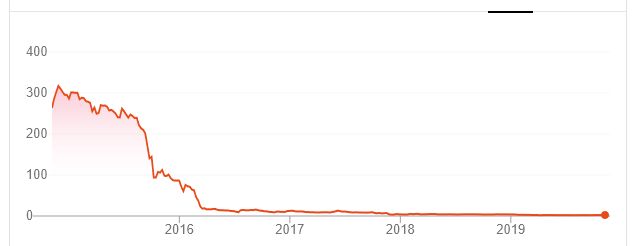 If folks who think that stamp catalog publishing will survive moving forward, then now is the PERFECT time to buy up some SG stock. Do not be concerned that it used to trade over $300 per share, snap it up now at $2 per share and ride it upwards. Don |
|
Send note to Staff
|
|
|
Pillar Of The Community
United States
1868 Posts |
|
|
Don,
This is your thread so your mind probably won't be changed by contrary views, but without disagreeing with your closing statement on investment in a catalog publisher, I feel you discount too much the value of hard copy catalogs to collectors with respect to scholarship and accessibility. By "scholarship" I mean that (a) your key attribute of "identification" can only be correct if the catalog represents the consensus of researchers, and (b) the catalog serves as a highly useful compilation of data about dates, printings, the interrelationship of one issue with another similar issue, and countless other facts that enrich the collector's knowledge and the utility of the catalog. Texts like the SG 2020 Commonwealth & British Empire Stamp Catalogue 1840-1970, or the Scott Specialized for the United States, are incredible in this respect. And by "accessibility" I mean that a well-bound, print catalog is simply faster and easier to use than any digital format yet developed. When I am identifying Washington-Franklins, for example, it is often necessary to flip rapidly among pages showing design details, perforation details and so forth. With a print catalog I can set up the catalog on my left and the stamp, lighting and magnification on the right and rapidly move between the two under similar viewing conditions. Looking at a screen and trying to navigate a PDF reader or other digital reader is simply cumbersome and slow. So for many of us print catalogs are not only highly useful, but things of beauty and respect concerning the knowledge they represent ... so we will continue to buy them. For these readers, "values" and "disappointment" are not part of the equation and I believe you discount this reader segment too much.
This does not mean that a publisher will survive without a viable digital product. I agree with that. But print products will continue because they have utility and therefore value that the digital media have been unable to replicate over 25+ years of development.
Chris |
|
Send note to Staff
|
|
|
Moderator
United States
12330 Posts |
|
|
Hi Chris,
No doubt my opinion above is over-stated, it is an overreaction to the mind numbing and robotic attachment I had for stamp catalogs for many decades.
My love for books is deep; it has only been in the last 8 years or so that I have slowly been emptying my library and replacing many references with digital copies**. Admittedly some of this was driven by the desire to reduce the disposition burden upon my family but some of it was also driven by efficiently and convenience. Unlike you, I find searching and finding information digitally faster than pulling books off the shelf.
I also think that digital distribution affords a far great 'reach' than a hard copy format. For catalogs, it is easy to retain 5 digital versions of the same catalog (different years) than it is to house them on multiple shelves. With hard copy catalogs, I would buy a newer version and always disposition the older version.
Additionally, many other philatelic books and magazines are rare and simply unavailable to those who desire the information they contain. I am currently in the middle of a project of digitizing the complete 50 year run of La Posta magazine. This is not an insignificant effort, it involves scanning well over 13,500 pages of postal history information. In the early years, fewer than 30-40 copies of the magazine were printed. I am only aware of one single, complete collection of these magazines. When this digitization is done, this incredible digital resource will be made freely available to all. Matched with the full searchable SQL online index, this represents a wealth of postal history information that would never have been attempted in a hard copy format. As a person who previous would manually try to dig out a piece of information, I cannot now imagine trying to go back to the 275+ hard copies to find something in the back issues. So here is an example where digital media has replicated something that hard copy publications will never achieve.
But I apologize for my overreaction; I find that anything that causes me to overreact often controls me.
Don
**Ditto for my large collection of vinyl which has now been replaced with digital music. I love spinning vinyl, I love the cover art. But it is far easier and more efficient to find and play an MP3. I can take my entire collection of music with me wherever I go; in the car, at dialysis, a hospital room, etc. |
|
Send note to Staff
|
|
|
Pillar Of The Community
Canada
3963 Posts |
|
|
Great post Don, a lot of relevant points. I purchased a Scott 2016 set a few years ago and this should do me for the remainder of my years.
I like having the catalogue on hand when organizing my collection and I learn a lot from it.
I do use online sources on occasion when I am having difficulty identifying certain stamps.
Again great post Don I enjoyed reading it. |
|
Send note to Staff
|
Don't grumble that the roses have thorns, be thankful that the thorns have roses |
|
|
Pillar Of The Community
United States
6466 Posts |
|
|
Quote:
I find it hard to believe that folks would think that specialized hard copy catalog publishers will survive... I am hard pressed to believe that small publishers (with their much higher operating and material cost) will somehow fare better. Don, I think the exact opposite is true. I think it is the monolith catalog publishers (Amos, Gibbons) that are in trouble, and small specialized catalog producers/publishers that operate and price on a print-on-demand model are the way moving forward. Catalogs that are produced as coil-bound digitally printed works rather than traditional hard-bound offset-printed works (which have massive upfront makeready costs and are only viable with large press runs). See, e.g., Jim Drummonds catalogs, the new Revenue Stamps of Iran catalog, and to a lesser extent the Barefoot catalogs. Yes, these are not high profit endeavors, but by crowdsourcing the editing rather than a "publishing company" doing it inhouse, and eliminating the upfront printing cost barrier associated with offset printing and case/perfect binding, the barriers to entry are much smaller than they used to be. Quote:
Identifying a stamp online is easy, fast, and FREE. If you are speaking about identifying stamps for beginners or general collectors, I would agree, but this is most definitely NOT the case the more advanced/specialized you become, or the more esoteric the material being discussed. Quote:
And while some folks will argue that 'you can never nail down an exact value' this is not the objective of a catalog value. The objective of a catalog value is to get close, not to get it exactly right. Somehow experience hobbyists have worked out a method for best understanding actual values, there is no reason that these methods could be used to develop more accurate catalog values. But this issue is going to persist regardless of whether the catalog is a traditional printed book or a wiki-like online catalog. The problem is foundational: that fallacy that there exists somewhere, somehow, a single valid catalog value for any given stamp. It doesn't exist. Period. Ever. Experienced collectors come to realize this. Newbies will never understand this right out of the gate. It requires learning. The entire notion that ANY catalog should provide "the correct real world value" is based upon a fundamental misunderstanding of what catalog values should be. They are not gospel. They represent one person's (or entity's) opinion captured at a point in time based upon a certain set of criteria/assumptions... and they are immediately wrong. For any catalog to be truly accurate in all cases, it would have to be so complicated that maintaining it would be untenable. In-person retail value in U.S. market for sound VF example Online retail value in U.S. market for sound VF example Wholesale value in U.S. market for sound VF example Online retail value in European market for sound VF example Online retail value in Asian market for sound VF example Online retail value in U.S. market for sound F example Online retail value in U.S. market for faulty VF-appearing example Online retail value in U.S. market for sound VF example with superlative qualifiers X, Y, and Z (color shade, cancel, usage, etc.) ... And the beat goes on. Too many variables. For every column of values or qualifiers you come up with, someone is going to have a scenario or set of criteria that doesn't fit, and therefore "the catalog is wrong". The cure would be worse than the disease. What catalog values *should* be used for first and foremost, regardless of the catalog(s) in question, is comparative value rather than definitive. This is where even decades-old catalogs have value when there are no newer resources. You can compare the cheapest with the most expensive stamps either within or across sets and come up with relative assessments of how scarce an item is compared to other similar items at that time, and multipliers/factors can then be applied to current baseline market values to extrapolate what an uncommon/scarce item *should* be worth or what it would list for in today's market, demand being equal. That's a mouthful... and it requires work... and knowledge. But if we're talking about catalogs for beginners or generalists, this is too much and too far. Simplicity is what is needed, not more complexity. The complexities and nuances of collecting are already a potentially intimidating barrier to beginners. And current standard catalogs provide simplicity. What they lack is real-world context (which is frequently against the best interests of the catalog publishers themselves, hence that information not being within the catalogs). Coming up with an entire new catalog system that requires lengthy explanation as to how or why this new catalog is somehow better or different from the existing industry standards is as bad as the existing system IMO... just different. And you'll just end up with a different catalog system that no one uses. No, IMO the problem isn't the existing catalogs themselves, but rather how collectors are taught to treat the information in them. Rather than trying to reinvent catalogs towards some utopian ideal, I think efforts are better spent in providing extended resources on how to use the existing catalogs, the differences between them, etc. How and why does Scott differ from Gibbons, Michel, Yvert, Facit, etc.? For which countries/regions/eras is one preferable to the other? In which market(s) is one preferred over others and what real-world multipliers do collectors commonly use/accept in certain venues? Hint: The commonly-accepted percentages of catalog value to pay vary greatly by catalog system and where in the world the purchase is being made. Rather than re-inventing Scott (or Michel, Gibbons, etc.), creating fluid online companion resources on how to utilize the various catalog sets. I understand the desire for a better mousetrap, the perfect mousetrap, but at some point it becomes tilting at windmills IMO, when the same resources (whether financial, personnel, or time) could perhaps better be used to create tools and resources to be used *WITH* the existing industry standard catalogs. As always, just my 2 cents, and frequently worthless. |
|
Send note to Staff
|
|
|
|
Moderator
United States
12330 Posts |
|
|
Hi Dan,
Cars, hotels, homes, airline tickets, all currently have methods for presenting values to consumer that are far closer than 5% of actual market value by using online crawls and harvesting values automatically from multiple sources. If something as complex as a car value, with thousands of moving parts, hundreds of options, and an endless number of 'condition' variables can accomplished then I see no reason(s) that this cannot be done for a piece of paper.
Advanced collectors are much better at hunting the value data down and combined with their experience are able to develop market values. I do not think that we lack the data, but instead there is an overwhelming amount and distribution of disparate data. There are some exciting new approaches on the horizon for massive amounts of data storage and retrieval. For example, researchers are already encoding and decoding binary data to and from synthesized strands of DNA. If every bit of human knowledge (digital and hard copy) was encoded and stored this way, the mankind library would be the size of a file cabinet. Moving forward the world will be all about data storage and retrieval, presenting the information when and where people want it.
I am confident that being able to present a more accurate value for stamps is within reach now. I also think that the new approaches to data storage and retrieval will drive a metadata framework needed to ID every stamp, stamp image, stamp article, stamp value, link, and any other piece of philatelic data.
Don
|
|
Send note to Staff
|
|
|
Pillar Of The Community
United States
772 Posts |
|
|
The idea of creating a new online catalog with a new numbering system really is probably more akin to Don Quixote tipping at windmills than anything else. Mainly because the marketplace will likely remain attached to the current catalog number systems that have developed in various countries. How many retail sites, online or brick and mortar, would you be able to use knowing only the Stampworld number? Likely very few. And I think this is likely the fate of any new cataloging system developed - it would take decades, if ever, for it to replace the current system of catalogs used around the world.
What would be more helpful is a website that provides cross-listing information between catalogs, so that collectors can then unlock access to retail sites worldwide that use catalog systems other than their own domestic catalog system. Basically a philatelic "Rosetta stone".
And those resources do exist on the internet today and are continuing to evolve. |
|
Send note to Staff
|
APS #173088
|
|
|
Replies: 49 / Views: 6,248 |
|
|
To participate in the forum you must log in or register. | |
Disclaimer: While a tremendous amount of effort goes into ensuring the accuracy of the information contained in this site, Stamp Community assumes no liability for errors. Copyright 2005 - 2026 Stamp Community Family - All rights reserved worldwide. Use of any images or content on this website without prior written permission of Stamp Community or the original lender is strictly prohibited.
Privacy Policy / Terms of Use Advertise Here |
| Stamp Community Forum |
© 2007 - 2026 Stamp Community Forums |
| It took 0.25 seconds to lick this stamp. |
 |
|




 Posted 11/03/2019 9:08 pm



