| Author |
 Replies: 49 / Views: 6,245 Replies: 49 / Views: 6,245 |
|
|
|
Pillar Of The Community
United States
7239 Posts |
|
|
Don's original posting is a good read, and makes some very good points about catalogs. For me, a catalog's primary value is the technical information. So, If I have 2 or 3 different catalogs pertaining to an area I collect, they may contain all the information I need. Buying new catalogs is almost never necessary at this point.. I view prices in catalogs with great skepticism. The motive of protecting dealers' sell prices, or making people believe they are handling investments looks misplaced to me. Sometimes stamps are priced at minimum value, and yet they are seldom seen . Then again, there are stamps given premium prices for absolutely no good reason. IMO, experience is the best guide to understanding value. Here is a good example of ridiculous/unrealistic pricing by a catalog. This is a very common stamp from British kiloware. A set of 4 Jersey "Days Gone By" was issued yearly, and inscribed with a date from 1998-2003. Scott catalogs the "1999" stamps at 7.50 US$ each. Are they worth 10% of that? 5%? 2%?, or maybe 1%? 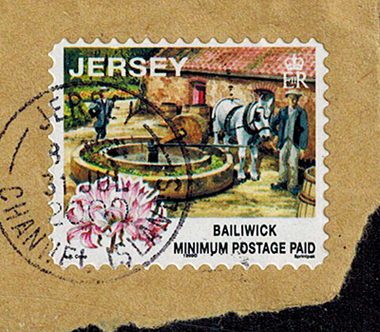 |
Send note to Staff 
|
|
|
Bedrock Of The Community
United States
10824 Posts |
|
|
US catalogs usually post new issues at double face, and have done so for several decades. The retail price of any individual stamp has always been variable, based on several factors. No catalog will ever be able to change that. Every stamp will have different levels of value to different people. One persons fine is another persons very fine, or only very good. This will never change. |
|
Send note to Staff
|
|
|
Pillar Of The Community
United States
2055 Posts |
|
|
Stampworld has a free online catalog with its own numbering system, but the amount of technical information it contains is limited, with many minor varieties unmentioned. Still, one can get images and basic information for most commonly encountered stamps. I use it to see new issues that haven't made it into Scott or even Linn's updates yet, but use Scott for everything else. If expanded and enhanced, Stampworld could form the genesis of such a project as outlined in the OP.
|
|
Send note to Staff
|
|
|
Pillar Of The Community
United States
716 Posts |
|
|
Pillar Of The Community
Canada
1462 Posts |
|
|
I think the other online stamp catalogue - whose name is apparently banned to use in a post - is closest to what I would call a online stamp catalog wiki, superior to Stampworld, although I use both. It allows users to add details & lists under multiple catalog numbering schemes and has pretty good abilities to filter/search for specific criteria. It doesn't list values. So something building on that would be my ideal "global" online stamp catalog.
And looking back, old catalogues work just fine for IDing purposes and to give an idea of relative valuations. My 1978 Michel specialized provides everything I need for my German related stamps. And a few minutes work will convert 1978 DM values into current Euros/dollars, should I really want. |
|
Send note to Staff
|
|
|
Bedrock Of The Community
United States
10824 Posts |
|
|
Catalogs have a wide range of info. For example, the new Specialized just out has an article about a new type of paper for the 1922 fourth bureaus. Some may have know about it before, but most probably did not. |
|
Send note to Staff
|
|
|
Valued Member
United Kingdom
439 Posts |
|
|
Revcollector you are so right about "learn to use them properly" I am still learning how to make full use of Stanley Gibbons catalogues. They did have a catalogue on CD at one time I seem to remember. I would have to improve my computer skills to use any online resource. An online catalogue sounds good, but it is would be a monumental task involving false starts arguments and hard compromise before we could even begin to reach uniformity. EVen some form of Nationalism would get in the way as a majority of collectors are more familiar with the market dominant catalogue of their region. I like the format of a British Stanley Gibbons catalogue. My canadian friend likes Scott. Not sure that one is better than the other, its what we are familiar with. I suspect if I could read German the Michel catalogue would suit me also.
A country code would need to be 3 digits there are already over 600 stamp issuing countries and organisations whose stamps pass through the UPU system. would each country be willing to recognise each country? would Chinese collectors be happy at country codes for Tibet or Taiwan? What about all the stamps of the GrossDeutscher reich of The second world war? all questions that might arise after a functioning framework was made for a unified online catalogue. I am sure it can be done, but I'm sticking to collecting the stamps I don't fancy spending my life trying to change the way we reference what we collect. |
|
Send note to Staff
|
|
|
Pillar Of The Community
United States
1565 Posts |
|
|
I agree that Scott provides a useful amount of information, other than some valuations. I've never gotten into the grading craze or the SMQ. But, I'll be buying the Scott Classic Specialized when it comes out next month as my current edition is 2016. I have only one Gibbons catalog, an older one for British East African territories. If one is going to be something more than a general collector, I think one should be pursing acquisition of specialty catalogues for their areas.
I use Mundiphil for Portugal & colonies; Follansbee for classic Mexico; and have just begun to use Fischer for Poland. I have a good Portuguese-English dictionary and Follansbee is in English. Next literature acquisition will be a good Polish-English dictionary.
As for getting to some sort of universally accepted, online, number system, remember that the late Jacque Minkus tried a new numbering system in the 1960s. Ultimately it did not work out. |
|
Send note to Staff
|
|
|
Valued Member
United Kingdom
363 Posts |
|
|
80 or so years ago there dozens of companies publishing catalogs in the UK. For the past few decades there has just been Stanley Gibbons (pretty much) -- in the US Scott has an almost total monopoly.
There is a reason for this -- they make the best catalogs. They have well over a century of experience and have soundly beaten all competitors. Anyone wanting to produce a rival catalog at this stage of the game would be well advised to consider this.
Of course all such catalogs have serious issues, and using them to establish "real world" values is very confusing to novices. But before you try to create any alternative you should think long and hard about what these problems are and if they are soluble. |
|
Send note to Staff
|
|
|
Pillar Of The Community
559 Posts |
|
|
Pillar Of The Community
United States
4490 Posts |
|
|
The challenge of anyone attempting a catalog like listing is level of completeness.
Scott and SG go to a certain level of specialization that likely appeals to the broadest audience. For Scott, this drives album spaces provided in their printed albums. It is less tied to a catalog but to a printed album if you rely on these albums.
Robin Harris' Machin album pages are provided in 3 versions based upon desired specialization (even that is subjective) so you can better collect to the depth you like. |
|
Send note to Staff
|
Al |
| Edited by angore - 10/27/2019 08:41 am |
|
|
Pillar Of The Community
Israel
1237 Posts |
|
|
I use catalogs as a tool for my collection rather than a guideline as to how to arrange the collection.
I see the value of arranging stamps by date of publication, seeing the emphasis on design and topics changed over the years.
Yet it deprives me of other aspects that are lost in organizing by catalog sorting.
Placing together all "pro juventota" or British machine gives me a bigger picture, IMO, then what I get if I scatter those stamps in catalog year oriented way of sorting.
Having said all this - maybe I misunderstood the topic of this thread. |
|
Send note to Staff
|
| Edited by Rob Roy - 10/28/2019 12:52 pm |
|
|
Pillar Of The Community
559 Posts |
|
|
a discussion in a danish facebook group concerning this topic had a few good suggestions.
making the basic webpage is easy enough, but the amount of data required to be punched in is enormous and too much work for anyone person.
it would require a field of qualified collectors from around the world.
a standardized way of doing it, same resolution pictures only unused etc. references to scott, facit, michell y/t and so on.
how ever if made simple (with options to expand a collection into a specialized) and in english with good pictures and correct informations, I personally think that could be a winner for every collector.
it would take years to complete.
|
|
Send note to Staff
|
|
|
Moderator

United States
12330 Posts |
|
|
Sorsh,
You are describing the Stamp Smarter Community project approach. Currently there are over 20 SQL databases which support 'crowd sourcing' type data input and vetting. No special app needed, the approach works with any operating system and browser. With the SQL database foundation and webpage-based data forms for input, and webpage reports; these online projects have been a part of Stamp Smarter for the last 6 years.
Don |
|
Send note to Staff
|
|
|
|
Pillar Of The Community
725 Posts |
|
|
Definitely an interesting topic. I still use my catalogs every day especially for the global items as it serves as a guide in a number of ways. I prefer the paper version and would struggle with moving to online as it can be more tedious imo. I'm sure if it moved to online, in 20 years all new collectors would just be accustomed to online and we'd just be the dinosaur relics still using paper.
I only purchase about every 10 years or so and find that suffices for me - and even those I buy used a few years outdated but it's for guide purposes and no more. I think it would be helpful if the more specialized albums and works were all scanned and available online - things like re-entries, postmarks, stuff not in the catalogs, etc etc. All those years of research and study should be out there for the world rather than lost in time. Yes, that stuff can be found, especially asking here as people often know or can find the answer, but I'd rather see the online collaboration be to a massive and easily searched digital library for that.
As for prices, it would be nice if there was another value section for "typical market value" but I do think this would be only for a limited market and too difficult to do. Experienced collectors will know it is typically X % or will see the current trends online. Local shows often have higher prices and dealers even higher still. So how does one even begin that. At the end of the day, it's only worth what the next person will pay. In that sense, the emphasis should be explaining very clearly in catalogs and to newer collectors about the realities. Thankfully communities like ours exist to help and anyone not swayed by the initial highs then lows will stick around and enjoy the hobby.
Great thread though!! |
|
Send note to Staff
|
|
|
Replies: 49 / Views: 6,245 |
|




 Posted 10/10/2019 5:48 pm


