| Author |
 Replies: 697 / Views: 136,344 Replies: 697 / Views: 136,344 |
|
|
|
Valued Member
Russian Federation
197 Posts |
|
|
Am I allowed to ask questions on KGV outside of your dedicated area of 1p reds? |
Send note to Staff 
|
|
|
Pillar Of The Community
Australia
4034 Posts |
|
|
Yes I am into all of the Australian KGV's.I will try to answer your questions. If I am a bit slow to answer or get off track you need to know..... I have a lot to do these days when it come to having an ebay store for Australia decimal from 1990 to now. Have 1.5kgs of international post stamps on paper to sort and soak plus 1.2kgs of used sheet stamps on paper with heaps of high values to sort and soak as well. Just finished sorting the last 10kgs of 60c kiloware.We are behind with 60c used sets and have about 5kgs to take off paper that should of been finished in January. Have been making 15 x 5kg+ boxes of goodies. Nearly finished, the 60c kiloware was holding me up. Lost my listings for relisting as eBays only holds the unsold lots for 2 months now and not 3 month. I am half way through fixing that mess.It is so nice to have a life full of what I can do and that is stamps. Penny red are very special to me as I use to sort them when I was very young, over many years, for a stamp dealer. |
|
Send note to Staff
|
|
|
Valued Member
Russian Federation
197 Posts |
|
|
Thank you, KVG Collector, for your time. I can see how busy you are, so I'll try to be laconic. Here is a 1/2 stamp (large multi wk) with crown pearls joined, also something on the beak of the ostrich, plus a burr in the right value tablet. Occasional dots here and there I dismiss as 'tinsheds'. Any interest in some of these flaws? 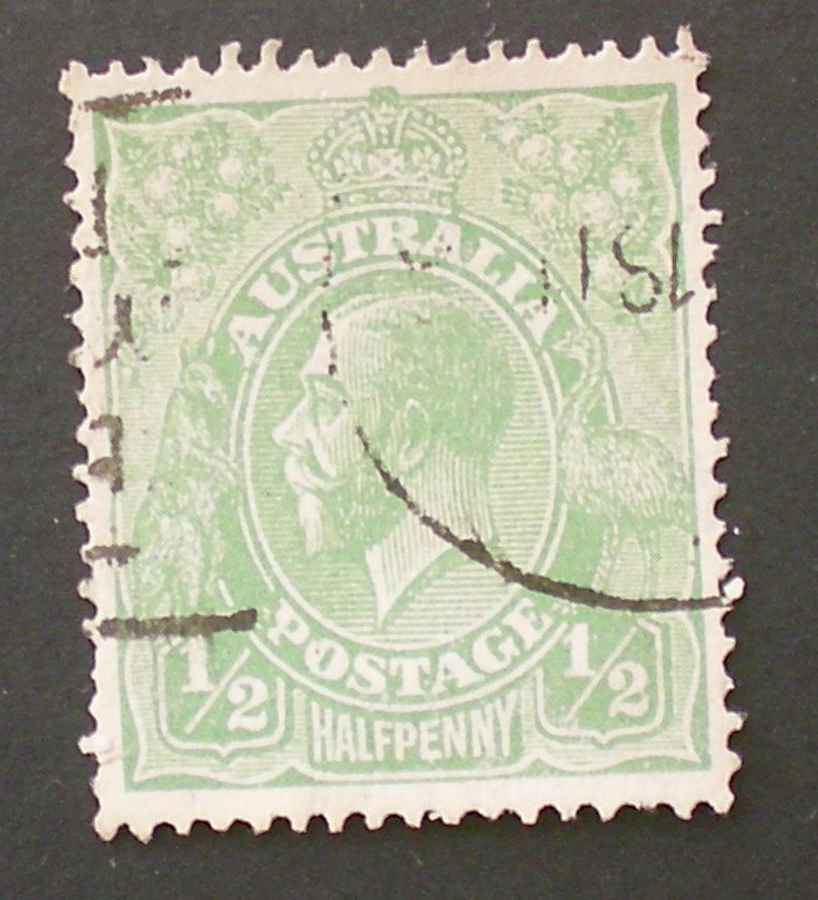 |
|
Send note to Staff
|
|
|
Pillar Of The Community
Australia
4034 Posts |
|
|
Interesting flaws in the crown area and the white dot before the "A" Australia but can not find it in ACSC.
Nice stamp! |
|
Send note to Staff
|
|
|
Valued Member
Russian Federation
197 Posts |
|
|
Thank you, KVG Collector !
I'd also like to hear something about the strange shape of the perfs, e.g. top of the stamps, Individual perfs look "gnawed" at the root while between them I can see little hamps going up. Also please look at the emu beak. |
|
Send note to Staff
|
|
|
Pillar Of The Community
Australia
4034 Posts |
|
|
The basically all the perfs are showing that the perforation pins were blunt. As a lot of sheets were perforated at one time the bottom sheets were more effected to have rough perfs than the top sheets. A very rough perf example.  |
|
Send note to Staff
|
|
|
Valued Member
Russian Federation
197 Posts |
|
|
Thank you !
Could you say something about the rough perfs: can one expect anything special seeing these, are they comb or line, etc? |
|
Send note to Staff
|
|
|
Pillar Of The Community
Australia
4034 Posts |
|
|
Rough perforations can take place with any type of perforating, with any stamp issue when the perforations pins are blunt.
Even with the very modern die cut perfs they get blunt as well. I have had trouble separation Pstamps from the self adhesive backing.
In 1914 Australia used 500 million penny red stamps alone per year.
With stamp production at such a high output rates things went wrong in very short periods of time.
In the morning the peroration pins would be fine but by 3pm the perforation pins could be as blunt as but the orders for the stamps had to be sent by the of the working day to the Post Offices around the county. Especially in the cities Post Offices that were screaming for stamps supplies.
Things could not be fixed because of the mentioned pressures on the stamp makers so faults in the stamp making found there way through the stamp making rooms and into the Post Offices.
I like the look of rough perfs in a block of stamps but I am not so keen on single stamps with this fault. The catalogue price also drops for single stamp rough perf examples. |
|
Send note to Staff
|
|
|
Valued Member
Russian Federation
197 Posts |
|
|
I appreciate your detailed answer. No more pictures so far, but a couple of questions anyway, if you don't mind.
Could you show an example of rusted cliche (PI 2rt pane R6/4 and 5)? I have no idea what all these letters and figures signify, I just quote from SG. Even though you do not use it, you might know what it is (SG does not illustrate it).
Another request is to show how the back of a stamp printed on coarse unsurfaced paper looks like.
Kind regards |
|
Send note to Staff
|
|
|
Pillar Of The Community
Australia
4034 Posts |
|
|
(PI 2rt pane R6/4 and 5)?
PI 2rt = ?. pane R = right hand side of the stamp printed sheet. 6 = Is the row of stamps they are in/. 4 and 5 = the stamp position in the row of stamps.
I am not use to seeing PI 2rt. But the sheets were printed with 4 blocks of 60 stamps. 2 blocks on the left and 2 blocks on the right of the stamp sheet.
This did vary with printings but is a basic idea of what is going on.
No, I can not post an image of course meshed paper because I do not have one. But they are very obvious to the naked eye. |
|
Send note to Staff
|
|
|
Pillar Of The Community
Australia
4034 Posts |
|
|
Sorry CollGStamps I got your question wrong. Quote:
Another request is to show how the back of a stamp printed on coarse unsurfaced paper looks like. The backs of rough paper stamps look the same as any stamp. The print of the stamp on rough paper is what stands out. Also the feel of the front of the stamp is rough as well. Rough paper can become very confusing along with thin paper. |
|
Send note to Staff
|
|
|
Pillar Of The Community
Australia
4034 Posts |
|
|
No I can not give you an image of that rusted cliche but I can give an example of one. Quote:
Could you show an example of rusted cliche(PI 2rt pane R6/4 and 5 The white area beside the top of right value tablet is a rusted cliche.  |
|
Send note to Staff
|
| Edited by KGV Collector - 04/20/2014 8:23 pm |
|
|
Valued Member
Russian Federation
197 Posts |
|
|
Thank you for the answer and photo !
Now, is there a difference between rough unsurfaced paper and coarse unsurfaced paper ? |
|
Send note to Staff
|
|
|
Pillar Of The Community
Australia
4034 Posts |
|
|
Thank you for the kind words. Quote:
is there a difference between rough unsurfaced paper and coarse unsurfaced paper There is 3 words used to describe the one type of KGV printings. The word unsurfaced is right, the word rough is right and also the word coarse is right as well. Three words that mean the same thing for these KGV printings. They are also called war savings paper. During the WW1 Australia had to finish making its own paper to print stamps on. So the paper was left unsurfaced and was gummed after the stamp sheet was printed. A common way to recognize the KGV's of this era was the post marks most commonly used on rough paper in this WW1 period of time. I just can not remember which one it is now, as one.....maybe "War Bonds" cancel was the one after WW1. |
|
Send note to Staff
|
|
|
Valued Member
Russian Federation
197 Posts |
|
|
Thank you so much !
Now it seems somewhat clearer. Another question while I can...
How does one see if it is dry ink? |
|
Send note to Staff
|
|
|
Replies: 697 / Views: 136,344 |
|



 Posted 04/17/2014 1:34 pm


