| Author |
 Replies: 10 / Views: 1,376 Replies: 10 / Views: 1,376 |
|
|
Pillar Of The Community

United States
814 Posts |
|
|
   In my Commonwealth and Empire catalogue, this is Stanley Gibbons image 88 (Scott A46), hence either SG #384, #396, #401, #409, #416, #426, #433, #446, or #460. The year of cancellation is smudgy, but I make it to be '02 or '03. That would reduce my options to #384, #401, and #409. There are three possible Die States, and I make this to be Die State I. That too would eliminate all but those three candidates, along with most of their sub-types. The normal sideways watermark eliminates the rest. My problem is the perforation. For #384 it's 12 x 12 ½. For #401 it's perf 11, and for #409 it's "compound or mixed perf 12 ½ and 11." My stamp is clearly not perf 11, so #401 is out. The most likely is #384 yet, try as I might, I've only been able to gauge the perf of my stamp at 12 ½ all the way 'round. I know what compound perf is but am unfamiliar with "mixed." The sources I've consulted suggest features that I don't see here, though it does seem that my stamp has somewhat irregular perforation on at least one side. Any thoughts? |
|
Send note to Staff
|
|
|
|
|
Pillar Of The Community
Australia
980 Posts |
|
|
There is a break in the bottom frame line under the 'PO' of 'POSTAGE'. This confirms it as Die I, 1901-1904.
Mixed perfs usually result from a misplaced perforation line being redone and occur on only one side of the stamp. I use a Stanley Gibbons 'Instanta' gauge. |
Send note to Staff 
|
|
|
Valued Member
New Zealand
62 Posts |
|
|
EMaxim, thanks for the question - these tiny stamps are always nice to look at. To cater for stamps of different sizes, two types of perforating machines were used; line perf machines and comb perf machines. Line perfs were as the name suggests, just a straight row of pins and in the period for this stamp there were two such machines gauging 12½ and 11 respectively. The comb perforating machine in this period was 12 x 12½. Line perf machines can do stamps of any size whereas comb perf machines save time, but are made for stamps of one size only.
Because this stamp was exactly half the size of the normal stamp it was perforated with the comb machine to start with, then every alternate column done with either of the line machines. So we routinely get the stamp either 12½ or 12½x11, depending on which line perf was used to finish off the work.
In the case of the latter this creates a compound perf - compound perfs are where the top and bottom are one gauge and the sides are a different gauge.
Mixed perfs are where the top and bottom (or left and right) are different. They are created to fix mistakes or re-perf off-centre work and the pins used to fix up the work are of a different gauge to the original.
This makes your stamp originally done as expected with the 12½ comb perf machine, then every second column was done with the 12½ line perf machine, making it 12½ all around.
The latest SG catalogue (Australia 11th ed.) shows the ½d with p12½ in the listing, which matches your stamp nicely. The three catalogue numbers you quote are now noted as:
384 p12x12½ or p12½
401 p11
409 compound or mixed perfs of 12x12½ or 12½ and 11
So your stamp is the "done as expected" copy, SG384. SG409 is for the cases where they used the p11 line machine to finish off the work or made a mistake by omitting a column, then fixing it later, or fixed up a misaligned set of holes with a second machine.
If you want more info (come one, we ALL love more details on these!) then look at Kellow's book "The Stamps of Victoria" on pages 26 and 27. Or ask me again if I have explained it badly!
|
|
Send note to Staff
|
| Edited by indigo - 04/05/2020 6:15 pm |
|
|
Pillar Of The Community
United States
814 Posts |
|
|
Thank you both. Clears it up nicely. My Commonwealth and Empire volume is 2004 and didn't contain that perf info for #384.
Your explanations of mixed perfing concur with what I've found so far from sources [Gibbons and L.N. Williams (Fundamentals of Philately)]. I couldn't see any clear evidence of re-perfing here, but the top row did look a bit irregular. Also, using my Instanta gauge I couldn't place the guide line in the center of the first hole top and bottom without skewing the entire stamp to one side: also odd. But I suppose there would be other reasons for that.
In any event, thanks again. I'm new to Australian States, enjoying them greatly, and am glad to find such knowledgeable and helpful people in this forum.
|
|
Send note to Staff
|
|
|
Valued Member
New Zealand
62 Posts |
|
|
It is good to hear that you are enjoying the Australian states - a complicated area where a good catalogue is a necessity. To avoid another 3000 words, I have included three pictures so you can see what the differences are. Just like Scott is essential for USA and Michel for Germany and so on, the SG Australia is the number one reference for this stuff. They have revised the listing quite a bit in the last ten or twenty years but it has settled down now. The prices below give a good guide to what's going on. The cheapest is the normal situation, the one you have. The p11 is rarer and was probably only done because the other perforating machines were busy on that day. The third listing is for the much rarer cases where mistakes were made and got "patched up", and what's more they got patched up with a machine of a different gauge, so we can tell what went on. And yes, with such a tiny stamp to work on it is very tough sometimes to get an accurate measure. The p11 is easy to spot but remember the convention is that p12 is 12 and a bit under and p12½ is anything between 12 and 12½. Doesn't make sense to me really but that is how many, many people who collect the area have explained it to me.    |
|
Send note to Staff
|
|
|
Pillar Of The Community
Australia
937 Posts |
|
|
Pillar Of The Community
Australia
980 Posts |
|
|
Pillar Of The Community
United States
814 Posts |
|
|
Indigo, thanks for taking the trouble to scan those pages. My Commonwealth and Empire pages are quite similar, but for the all-important (in this case) info about perforations. Convinces me to look for an affordable copy of SG Australia. Would have spared me several frustrating hours. This is, in fact, one of the most important things I've learned since getting started: the advantages (necessity, really) of having the right catalogues. And right you are, 64idgaf. Now here it is, fresh and clean as the day it rolled from the press (or nearly so).  I like to get the ID right before soaking. Here's what happened when I didn't.  I'd thought the French didn't use chalk-surfaced paper. Now I know that in the colonies they did. Wishing you all good health, Eric |
|
Send note to Staff
|
|
|
Bedrock Of The Community
Australia
38679 Posts |
|
|
Does Stanley Gibbons mention the VICTCRIA error? 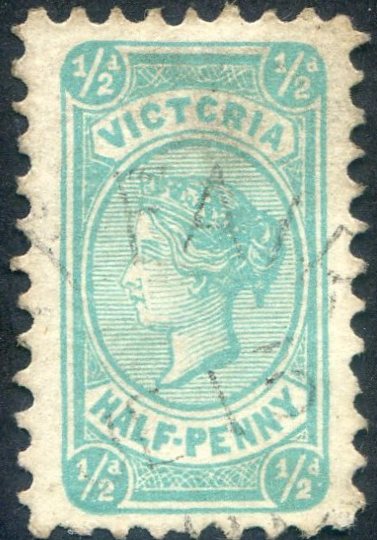 PS: If you soak early Netherlands Indies, they also will fade. PS: If you soak early Netherlands Indies, they also will fade. |
|
Send note to Staff
|
| Edited by rod222 - 04/06/2020 8:04 pm |
|
|
Pillar Of The Community
Australia
937 Posts |
|
|
Quote:
Does Stanley Gibbons mention the VICTCRIA error? Yes, it is listed as SG 376a. |
|
Send note to Staff
|
https://www.fairdinkumstamps.com Fair Dinkum Stamps - Specialising in stamps from early Australia and the colonies, Australian philatelic literature, catalogues, stockbooks and accessories. |
|
|
Bedrock Of The Community
Australia
38679 Posts |
|
| |
Replies: 10 / Views: 1,376 |
|




 Posted 04/05/2020 12:48 pm


