| Author |
 Replies: 16 / Views: 1,610 Replies: 16 / Views: 1,610 |
|
Pillar Of The Community
Canada
878 Posts |
|
|
|
|
Pillar Of The Community
6364 Posts |
|
|
For those of us without the specialty Australian catalogs ... I have no idea what I am looking at without some arrows or supplemental text. |
Send note to Staff 
|
|
|
Pillar Of The Community
United States
8956 Posts |
|
|
Pillar Of The Community
United States
1430 Posts |
|
|
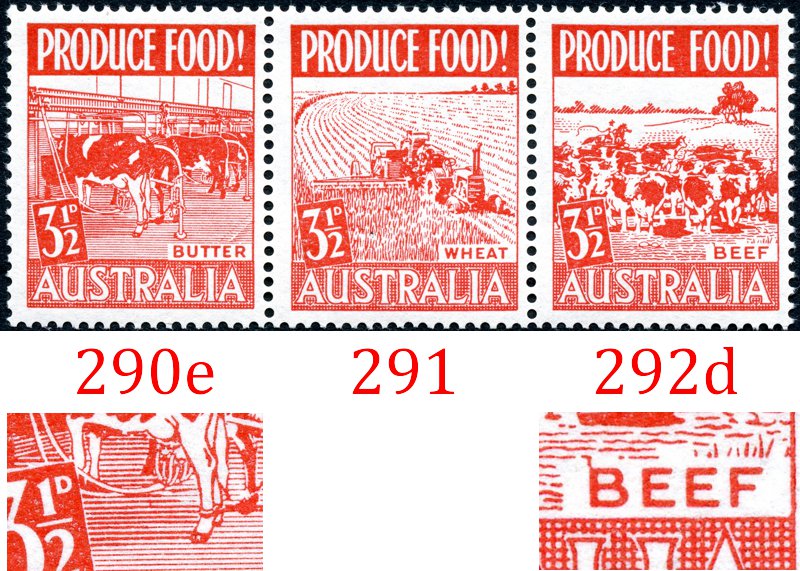
The defining characteristic of 292d would appear to be the little ink mark over the B of BEEF, but I have no idea what's special about the cows' legs in the 290 varieties. |
|
Send note to Staff
|
|
|
Bedrock Of The Community
Australia
38679 Posts |
|
|
Quote:
For those of us without the specialty Australian catalogs ... I have no idea what I am looking at without some arrows or supplemental text. Indeed. We can all learn, here, "How to make a good Post" |
|
Send note to Staff
|
|
|
Pillar Of The Community
United Kingdom
631 Posts |
|
|
Is this variety relating to shading under the cow?
Regards
DavidR |
|
Send note to Staff
|
| Edited by DavidR - 11/10/2020 04:54 am |
|
|
Pillar Of The Community
Canada
878 Posts |
|
|
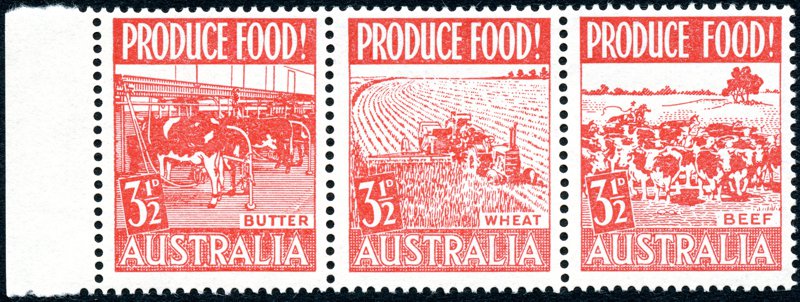
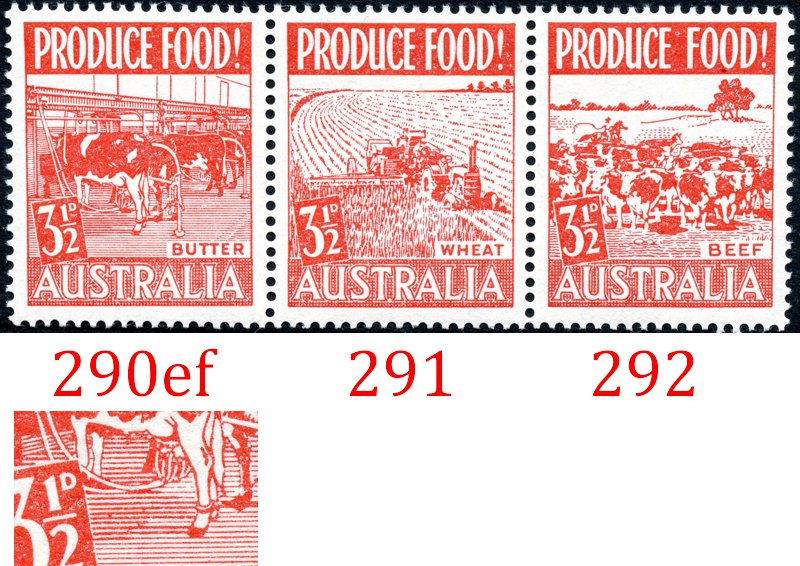
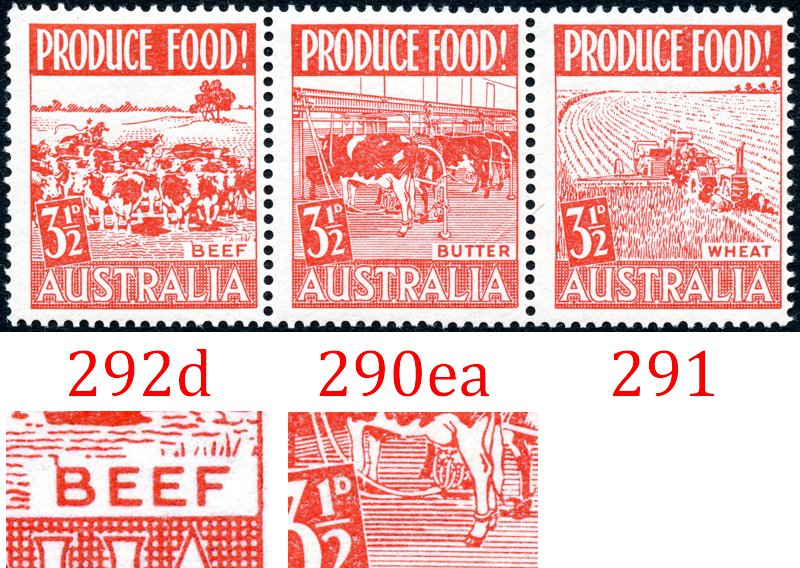
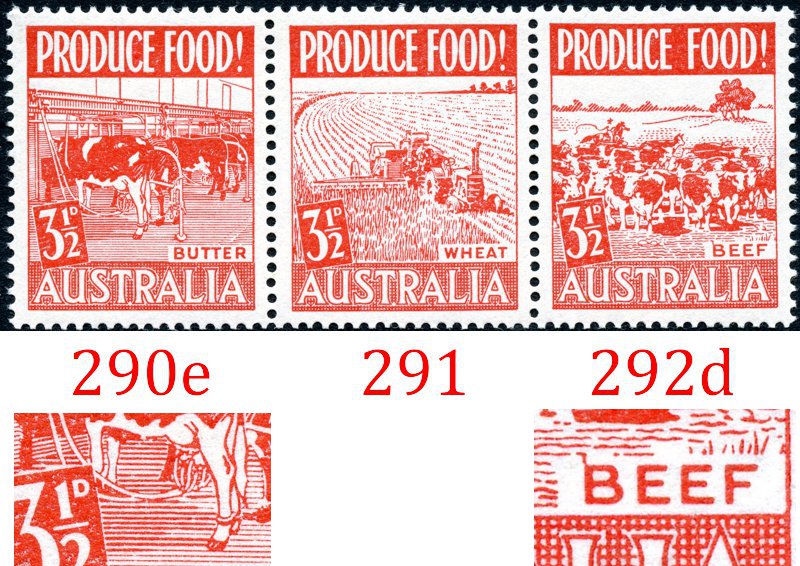
My apologies to all. I was in too much of a hurry to beat the dinner gong and didn't add the variety descriptions from ACSC. I'll do the BW 292d first as it is the much simpler of the two - Colour spur at top of B of BEEF. The collective description for the BW 290 varieties is - Retouch beneath milking cup on cow. These are a Master Plate varieties. ACSC (2019) states that, due to production difficulties, 17 instances had to be retouched, five of which are "virtually indistinguishable" from the normal. So here is a detailed description and an image pointing to the features I selected to make an identification. The image includes the normal in top centre position. 292eA - Thickened shading line 292ea B - Merged shading lines C - Greater than normal weakness in shading line 292efD - Merged shading lines with incursion into cow's leg 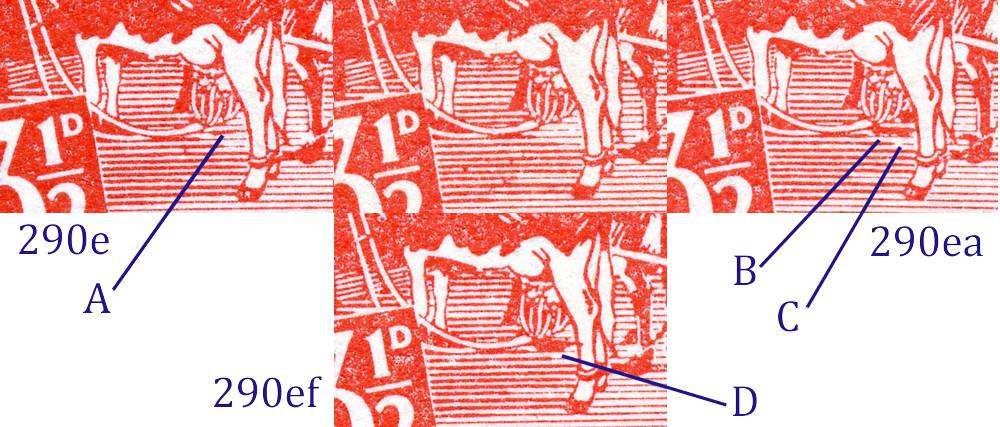 Foe BW 292, other than providing illustrations, ACSC leaves you on your own to decide what constitutes the varieties. Re the varieties, ACSC has an obvious error. It states that there are 13 distinguishable varieties, but gives only 12 in the listing and the note, then goes on to say that there are 4 indistinguishable, but lists 5. Apparently, the variety in Position Row 5/Stamp 9 didn't make the final cut. Going back to my 1996 ASCS page, the Note includes 5/9 in the 13 distinguishables, but in the listing there are only 12 varieties, i.e. excluding 5/9. (Other ruminations on this stamp. There are no errors noted for this set of 3 stamps in the 1988 catalogue. The new A4 pages in the 2019 QEII Catalogue is a great improvement as the illustrations for the 292e varieties are about twice the size and make comparison so much easier.) |
|
Send note to Staff
|
|
|
Pillar Of The Community
United States
1430 Posts |
|
|
Bedrock Of The Community
Australia
38679 Posts |
|
|
Quote:
There are no errors noted for this set of 3 stamps in the 1988 catalogue. Yet....There is 1 in the 1974 ACSC Cat#564(d) White flaw in NE corner of value tablet (UP., R5/2 3d Green Beef) |
|
Send note to Staff
|
| Edited by rod222 - 11/10/2020 6:50 pm |
|
|
Pillar Of The Community
Canada
878 Posts |
|
|
Erliaz:
I just couldn't let that opportunity pass me by.
Rod:
Much as I love ACSC, I sometimes have to wonder about it. It would be interesting to know the basis on which they choose to include or ignore varieties. There are some major flaws that they ignore. There are also series of flaws, such as the "secret mark" where they include some but not equally prominent others. I just hope that the decision is not based on their policy (I've only found one exception) to order the varieties based on their positions on the sheet.
Frank. |
|
Send note to Staff
|
|
|
Bedrock Of The Community
Australia
38679 Posts |
|
|
Valid query Frank.
Myself, I remain in awe, of what they have produced for the Georgian sideface and Kangaroo.
Possibly the deepest research of any design set in existence.
I guess there has to be a line in the sand, regarding "flaws" their dimensions and constancy.
The RH white frame line flaw on the Georgian, surprised me, not being listed, but a rare occurrence for mine.
Not sure on the "Produce" impressions, whether the red 3.5d and the green 3d, contain similar flaws in position, or, a separate set of plates were issued for each value. |
|
Send note to Staff
|
|
|
Pillar Of The Community
Canada
878 Posts |
|
|
Rod:
My reading of ACSC is that eight electros plus a ninth spare were made made for each denomination. See the "Plates used" section at the start of the entry for these stamps.
Afterthought:
The electros were created from master plates. I don't see how a single master plate could have resulted in such different variety listings, given the the 3 1/2d flaws are all master plate varieties which would appear on all electros. (The 3d flaws are electro varieties thus appear on only one of the eight panes on the printed sheet.)
Another mystery:
Why did ACSC change the definition of stamp location to Row/Column from the previously used Position?
Frank. |
|
Send note to Staff
|
| Edited by itma - 11/10/2020 10:16 pm |
|
|
Bedrock Of The Community
Australia
38679 Posts |
|
|
Quote:
Why did ACSC change the definition of stamp location to Row/Column from the previously used Position? I do not understand. I do not have your Catalogue, and working from 1974 version! In sheets of 100, 2 panes, one above the other, each 5 rows of 10 Each Value was surface printed from electrotype plates built up from a master group of 50. (corresponding to the single pane) ergo, flaws on the upper pane, found also on lower pane. Thus, any flaw could have 2 possible positions, located identical apart from being upper or lower. The 290 flaw/s appear to me to be just wear of the copper or nickle, and are "states" of the initial shading line damage (similar to Kangaroo die wear/cracks) |
|
Send note to Staff
|
|
|
Pillar Of The Community
Canada
878 Posts |
|
|
ACSC added the BW 290 varieties somewhere between 1988 and 1996 (the two older catalogues I have). In the 1996 and 2019 Catalogues, they indicate that they are Master Plate (MP) varieties so they will appear across the all electros. ACSC says that 9 electros were made, with Electro IX being a spare and never used. On the basis of that, there will be no original state, pre-variety copies of 290, excepting perhaps the Plate Proofs. ACSC also says: Quote:
From original drawings, a glass plate 50-on negative was produced which was used to prepare a master plate of 50 (5 horizontal rows of 10) by etching. I read this to mean that one MP was created for 287/288/289 and another for 290/291/292. There is no mention of a single MP with denomination plugs being use à la Kangaroo series. This is supported by the varieties being denomination-specific. Now, wrt the original point of my previous post, to define the location of a stamp in the pane, ACSC in QEII and KGVI uses to numbers (row/column) rather than one, 1.e. 5/3 vs 28 for a pane with 5 stamps per row. This just makes a cluncky system even clunkier. KGV stamp locations are Plate/Pane/Position or Electro/Position, e.g. BW 89(15)d is 15L19 and BW 78(3)m is VI/21. Compare this to location for 287f which is ShD L3/8. Which do you think is the most user friendly. Coupled with this, another ambiguity creeps in: Does L mean Left or Lower? Perhaps they should have used T for Top and B for Bottom. Or as they say: BW works in its mysterious ways its wonders to perform. |
|
Send note to Staff
|
|
|
Bedrock Of The Community
Australia
38679 Posts |
|
|
Still hazy, over this issue, not having a reference alongside. Quote:
ACSC in QEII and KGVI uses to numbers (row/column) rather than one, 1.e. 5/3 vs 28 for a pane with 5 stamps per row. This just makes a cluncky system even clunkier. Perhaps you have answered your own question? For your reflection. If a master plate consists of a 50 on negative, then there is no need to quote row / column, as they remain fixed throughout production. 28 is a simple solution for a position. If the plate were made up from individual cliches, (a forme) then row / column is required. I have made a bid on the catalogue in an upcoming auction, I'd like to read the preamble, forward at front of catalogue. |
|
Send note to Staff
|
| Edited by rod222 - 11/11/2020 5:06 pm |
|
|
Bedrock Of The Community
Australia
38679 Posts |
|
|
Quote:
Coupled with this, another ambiguity creeps in: Does L mean Left or Lower? As the master plate, consists of only 2 panes, one above the other, the corollory dictates, it has to be U=upper, L=Lower. |
|
Send note to Staff
|
|
|
Replies: 16 / Views: 1,610 |
|




 Posted 11/09/2020 5:06 pm