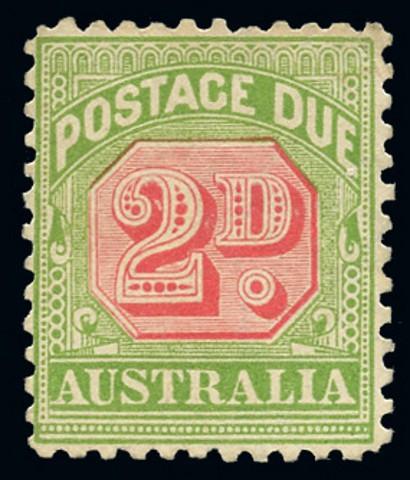
I know a little about the stamp.
2d P11 – SG D74a
That 2d Postage Due, Perf 11
Australian Stamp Monthly July 1972
Having had an opportunity of inspecting the stamp, I find that it is unused but without gum, undoubtedly on the thick paper of about 1911 vintage – and almost certainly one of what used to be known as "Cooke's Specials". The then stamp printer, J B Cooke, was never described as 'tidy' – a former friend of his once described his office to me as being "full of trial sheets everywhere, even on the floor – possibly the ceiling too". But occasionally Cooke would have a spring cleaning – so "take these put and perforate them and put 'em into stock", so usually, to 11 gauge single line machine they went, and yet more "perf 11" varieties to the tune of one or two sheets only would be added to the lists of Victoria, South Australia, Tasmania and Western Australia – or, as in this case, of Australian Postage Dues.
My feeling about this new discovery is – possibly only one sheet, mostly used and pen (or pencil) cancelled by the postman – and, as in those days no respectable collector or dealer thought pen-cancelled PD's of any possible interest, most were duly destroyed. But the postman neglected to write on this one, which was duly soaked off and put into the collection. So Cooke's special comes to light as a real vintage item.
A rare Australian Commonwealth Stamp
The Australasian Stamp catalogue, 1981 17th Edition.
Author not disclosed.
A most remarkable event occurred in Australia in 1972. A unique stamp was discovered. Its existence had remained unknown for sixty-one years. Following its discovery no further copies have been reported. This astonishing stamp is the 1911 Perf 11 x 11, Die 2 2d. Postage Due. It has taken its place in the annals of world philately as Australia's rarest stamp.
Definition of Rarest Stamp.
By rarest stamp one means the stamp with the fewest number of known copies. On this definition no stamp could be rarer than one of which there is but a single example known. There are actually quite a considerable number of unique stamps, but only a few of them have received much publicity. The 1911 2d. Perf.11 Postage Due has some special features, noted in this article.
Australia's Rarest Stamp
At different times various stamps have been claimed to be the rarest Australian stamp. In 1924 the Victorian Philatelic Record ran a competition to select the rarest Australian stamp. Their choice was the Georgian ½d single watermark green, variety "thin fraction", of which about a dozen copies are said to exist.
In recent years, it has sometimes been claimed that the rarest stamp is the Western Australia 1854 4d. Blue inverted frame variety, although fifteen copies are known.
Another stamp recently declared to be the rarest is the George V 4d. violet "line through value" variety, of which six copies are said to exist.
The George V 2d. red tete-beche pair variety has sometimes been described as Australia's greatest philatelic rarity. However, that unique item is not strictly comparable with other stamps.
An Astounding Discovery.
One day in Melbourne in 1972 a collection was being lotted for sale by a dealer. Mr. Trevor Ross of Robson Lowe (Australasia) Ltd. Noticed that on one album page containing specimens of the 1d. and 6d. perf 11 Postage Dues there was mounted the previously unknown 2d. Perf. 11 Postage Due. The collection in which the stamp was found was part of the estate of a retired Fiji police officer. How, when and where he obtained the stamp remains obscure.
The Stamp's Origins.
Australian stamps experts sought to explain the possible origins of the stamp. The late Mr A. A. Rosenblum inspected it and thought that it was probably a "Cooke's Special". J. B. Cooke, the Stamp Printer of the day, was reputed to have had his office cluttered with trial sheets much of the time. Occasionally he would order these to be taken out, perforated and put into stock. According to Rosenblum, the use of the 11 gauge single line machine for this purpose would have added a small number of sheets to the lists of some of the Australian States, and in this instance, to the Australian Postage Dues.
Another explanation has been advanced by Mr. R. P. Hyeronimus, a leading authority on Australian Postage Dues. Mr. Hyeronimus has said that the stamp should be regarded as having been issued in the normal way. He has stated:
"The three perforating machines taken over by the Printing Office were apparently used according to pressure of demand, operational condition of the individual machines or staff availability. They were probably in the same room and it is not hard to imagine circumstances where a small number of odd sheets, say 1-5, on occasions might be run through on any machine temporarily standing idle. This suggestion is supported by the existence of the 1d. and 6d. values in the same series perf. 11. These are very scarce. Such perforated stamps would have been passed into stock in the usual way without any contemporary advices".
The thick paper of the stamp identifies its year of origin as 1911. The watermark of the rosine and yellow-green stamp is Double-lined A and Crown.
Unused Condition.
Another enigmatic aspect of this stamps is its lack of gum. It has been suggested that the stamp may never have been gummed at all. However, the perforation 11 postage dues would have been gummed after printing. Has there ever been any reference to sheets appearing in stock without gum? Mr. Hyeronimus has stated:
"I believe this stamp would have been originally gummed and three reasons can be advanced for the present lack of gum:
1. The stamps was originally used and not cancelled or pencil cancelled with subsequent removal of the gum.
2. The stamp was at some time in the hands of a non-philatelist who had been told that there was something special about it. This person then stuck it down to something as a means of not losing it, but from which it has been removed.
3. The gum was removed by a former owner to improve the appearance of the back of the stamp."
The Stamp's Standing.
Whether one accepts Rosenblum's trial sheet theory or Hyeronimus' well-argued thesis, the status of this stamp remains unaltered. Mr Hyeronimus has said:
"In my forthcoming book on the Postage Dues, I have treated this stamp as if issued normally but very rare in this perforation. In the absence of other information and in view of the fact that no further copies (from the same source) have appeared on the market, I consider the stamp to be fully acceptable in a collection."
The standing of the stamp is unaffected by the fact that only one copy is known to exist. Certainly the task of stamp experts would have been easier of other copies had been found. A mint with full gum copy or a normally postally used copy would have been especially helpful for purposes of comparison. The stamp was examined by an expert committee of the British Philatelic Association in 1972 and was given a certificate of genuineness.
The survival of only one copy seems rather puzzling. Perhaps only one sheet of stamps was ever perforated. What, then, would have happened to the other stamps in the sheet? One would assume that they were mostly cancelled with pen or pencil and discarded. Very few collectors and dealers of the time were interested in Postage Dues. Somehow one stamp survived uncancelled and was preserved, presumably by a collector who noticed its different perforation.
The Claim of Uniqueness.
Knowledgeable and discerning philatelists naturally tend to sceptical of any claim that a particular stamp is unique. One of course cannot conclusively prove that no other copies of the 1911 2d. Die 2 perf 11 Postage Due exist, however, this may be reasonably inferred.
Finally one should consider the probable circumstances of this issue, as discussed above, and then one should take full account of the fact that prior to 1972 the stamp's existence was not publicly known. Hence collectors had no incentive to search for copies prior to 1972.. It is obviously most difficult to trace copies after sixty-one years. The effluxion of time surely diminishes the chances of further copies being found.
Moreover, one should note that this stamp has twice been given publicity in the Australian philatelic press. Its discovery was reported in 1972, and an article on the stamp was published in 1979. One would expect that such publicity would inspire a search by interested collectors for other copies of the stamp. Neither occasion was followed by any reports of further copies being found.
Last Word.
There is an old saying that, "The last word in philately will never be written". However, the 1911 2d. Die 2 perf 11 Postage Due must surely be the "last word" in mystery and elusiveness among Australian stamps. It has a special aura all its own.
Postscript.
In 1988 a second copy was found. It is pen cancelled and undated. Being in this condition it provides little further background to its origin.
My conclusion is this: you do not possess the stamp, despite your grammatically awful claim that "Found a 2d stamp Needing help on how much it's value".
I was surprised that when last offered, the sale price was only around $AUD12,000, I would have thought it would sell for more.
|





 Posted 12/07/2020 01:03 am