Dear Bloemzee,
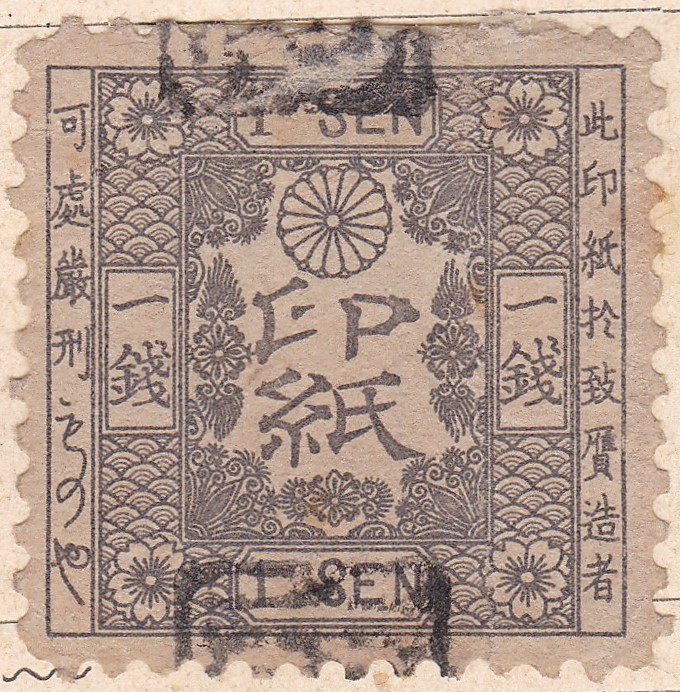
This is a very common, yet very interesting and attractive revenue stamp indeed - my favorite of all Japanese revenues.
As already mentioned by our expert members, it is from the last issue of the documentary revenue stamps; it has been categorized as the "4th Issue, electroplated-multiplicative printing" but Hasegawa in his recent catalogue (2019) has proposed to be as "5th issue, Multiplicative printing".
The original plate is hand-engraved (hand-etched), similar to other Japanese classical stamps. For 1 Sen, two (2) original plates have been engraved (Plate I and II). Using the original plates, multiple copies were generated using electroplating technique, which has been introduced to Japan then and has been also applied to print Koban stamps. This is the main reason that this 1 Sen revenue is so abundant and easy to find in the market today.
The earlier issues (e.g. 4th issue, perforated, foreign paper) were printed directly using the original plates, and has gutter width of 2mm, whereas the multiplicative issues has gutter width of 3mm, which could be used to distinguish the 4th and 5th issue stamps.

Two types of "foreign paper" (e.g. ordinary western paper) is listed in Hasegawa 2019 catalogue; normal paper and porous paper. However I have noticed other paper variations as well (such as ivory-colored paper, wove paper with apparent wove patterns) and am still investigating on this.
Variety of perforation could be found; 8 1/2, 10 , 11 (11L), 12 1/2 (or 13) and some combined perfs.

Etching varieties do exist, but relatively minor compared to those of earlier issues (especially the 1st issue on Japanese paper, rouletted). In addition to the well known variety in Plate II position 8, I have hitherto identified three etching varieties;


Hope this helps !
- unechan from Osaka, Japan





 Posted 02/14/2021 3:18 pm