| Author |
 Replies: 9 / Views: 849 Replies: 9 / Views: 849 |
|
|
Valued Member
United States
182 Posts |
|
|
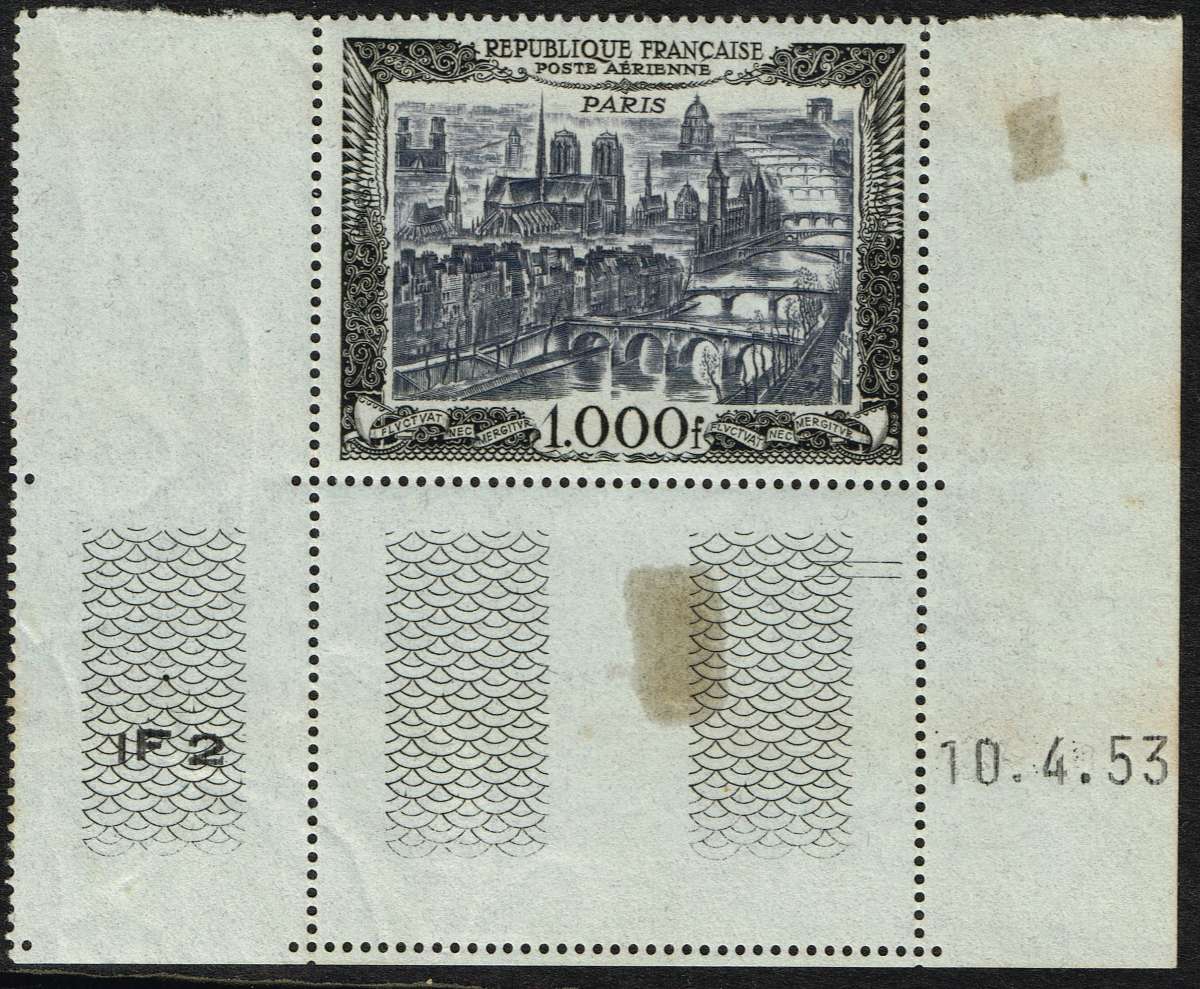
Hi all, I have a mint block of French stamps, and I noticed some numbers at the bottom of the block. 64548 on the bottom left IN 5 in the middle 13.12.49 on the right I would like to learn about what I have, and find out what the numbers mean. Thanks!  |
|
Send note to Staff
|
| Edited by Prexie3c - 04/10/2021 7:54 pm |
|
|
|
|
Bedrock Of The Community
12770 Posts |
|
|
Bedrock Of The Community
Australia
38679 Posts |
|
|
Sc# C27
Guess
13.12.49 13th December 1949 = Printing date
IN 5 IN? Perhaps "Intaglio" 5 Printing Press
64548 Design 645 1948
645 maybe designer or engraver
Look forward to reading the correct.
|
Send note to Staff 
|
| Edited by rod222 - 04/10/2021 8:11 pm |
|
|
Valued Member
United States
191 Posts |
|
|
It was issued in 1950, C27. The outside frame was the first time Jacques Combet, a prolific French engraver, worked on a stamp. |
|
Send note to Staff
|
|
|
Pillar Of The Community
Canada
1462 Posts |
|
|
What you have is a Coin daté (dated corner) from 1949 of C27 (Yvert PA29). A collectible area for French stamps & Maury has a section dedicated to them. The date in the lower right is indeed the printing date, I'm not sure what the other numbers mean (picture in the catalog for this issue has values of 23215 & IM 7). For this stamp, there are coin datés from 1949, 1951, 52 and 53. Maury gives this one a value of 900 Euros not hinged, 700 hinged. |
|
Send note to Staff
|
|
|
Pillar Of The Community
Canada
877 Posts |
|
|
The number on the left is most likely a sheet number for accounting purposes. This suggestion ( not based on actual knowledge ) is supported by the appearance of the number apparently being printed by a mechanical counter, as would be the time stamp. If it were fixed data, as suggested by Rod, it would probably use the same font as the "IN 5" notation.
The sheet number has no real significance unless the counter is reset at the start of a print run or the start or end number is known. If one number is known, the the other can be inferred from the usually published number of stamps. This might be a useful thing to know, for example, to determine scarcity if a variety is first seen with early or late sheet numbers.
Other suggestions for the "IN 5" are they it identifies either the plate or the printing press.
Sheet numbers are common on Australian stamps. Printing dates are common on Swiss stamps. |
|
Send note to Staff
|
|
|
Pillar Of The Community
France, Metropolitan
3756 Posts |
|
|
It starts out with the sheet number then the press no.(the machine that was used,this code is always in the interspacig in older stamp sheets) & printing date. |
|
Send note to Staff
|
| Edited by perf12 - 04/11/2021 09:05 am |
|
|
Pillar Of The Community
Netherlands
6646 Posts |
|
|
Pillar Of The Community
Canada
5821 Posts |
|
|
Die Proofs by Giorgio Leccese explains it this way 2nd period 1933-64
A new reference number was added to the sheet markings, taking the form of "I C 2"; the letter "I" was always used, possible standing for "indicatif"; "C" referred to the press operator, and "2" the number of" the press.http://www.dieproofs.it/english/tip...mpa_eng.html |
|
Send note to Staff
|
|
|
Bedrock Of The Community
Australia
38679 Posts |
|
| |
Replies: 9 / Views: 849 |
|




 Posted 04/10/2021 7:43 pm