In the 1950s, the moor water used in the production of stamp paper caused the paper to have a cream colour. In the early 1960s, the Post Office allowed paper makers to add optical brightening agents to the paper. This made the paper appear whiter. At the same time, it caused the paper to show a varying degree of fluorescent reaction to uv-light. In 1963, the Post Office conducted a trial with coated paper. The coating itself did not contain an optical brightening agent.
The coating of original coated paper (OCP) was like that used in the 1963 trial. It did not contain an optical brightening agent (OBA). When exposed to uv-light it turns blackish. At the same time, the paper itself did contain OBAs to varying degrees. Stamps on OCP may, therefore, show fluorescence from the back. As the gum can absorb some uv-light, mint stamps may show a somewhat reduced fluorescence from the back. Consequently, to check the paper type, the printed side should be irradiated with uv-light.
Fluorescent coated paper (FCP) has OBA added to the coating. Consequently, stamps printed on FCP-paper show fluorescence under UV-light from the front. As the amount of OBA varies, the reaction may be anything from noticeable, but not very strong, to "summer has arrived."
Phosphor coated paper (PCP) has phosphor added to the coating. After irradiation with (preferably short-wave) uv-light, the phosphor reaction will cause an afterglow. In the case of the two to-pay labels issued in 1980, this afterglow is greenish. The phosphor coated paper stamps have a finish that varies from dull (PCP1) to glossy (PCP2). This is not a difference in phosphor but a reaction to the phosphor coating. The two to-pay labels issued in 1980 have a glossy finish, being PCP2.
 Fluorescence under a short-wave (Leuchtturm/Lighthouse) uv-lamp: OCP, FCP, and PCP2 (from left to right)
 Fluorescence under a long-wave (Leuchtturm/Lighthouse) uv-lamp: OCP, FCP, and PCP2 (from left to right)
Fluorescence tends to be more visible under long-wave uv-light. Note the blackish appearance of the left (OCP) stamp in the latter picture.
 Phosphorescence under a short-wave (Leuchtturm/Lighthouse) uv-lamp: OCP, FCP, and PCP2 (from left to right)
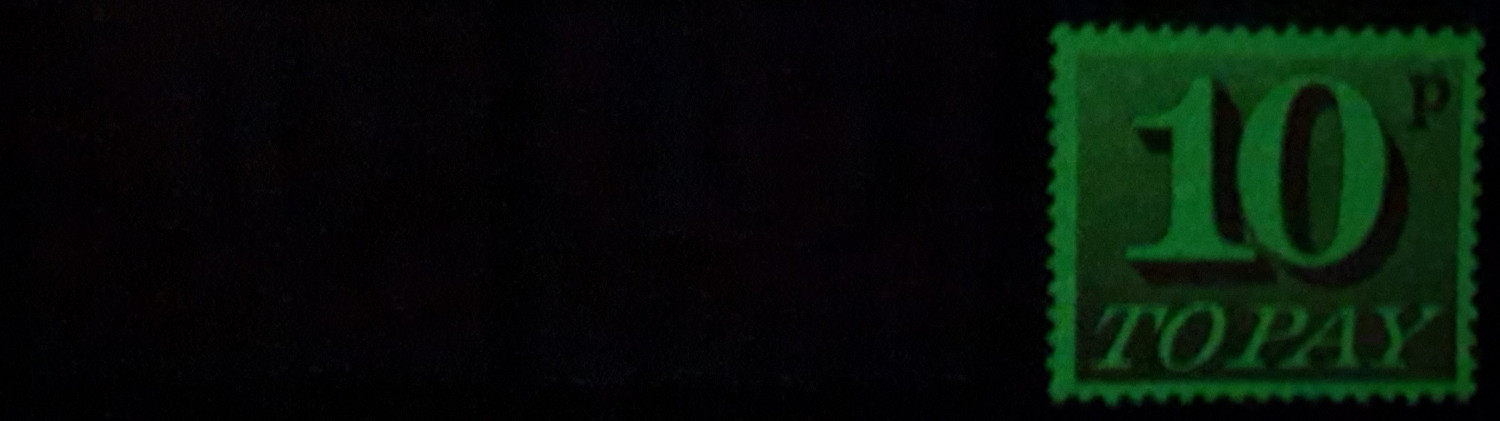 Phosphorescence under a long-wave (Leuchtturm/Lighthouse) uv-lamp: OCP, FCP, and PCP2 (from left to right)
British phosphors on decimal stamps up to 1992, generally, show a violet phosphorescent reaction to short-wave uv-light. These stamps show a greenish reaction that is strong after irradiation with both short-wave and long-wave uv-light. In the top picture, the OCP and FCP stamps are just about visible.
 Paper fluorescence of the OCP stamp under a long-wave (Leuchtturm/Lighthouse) uv-lamp
Note the bright fluorescent reaction of the OCP stamp in the bottom picture, compared to that of the same stamp in the second picture on the left. The coating does not contain OBAs, but the paper itself does. The pictures were taken under the same circumstances.





 Posted 06/02/2021 5:28 pm


