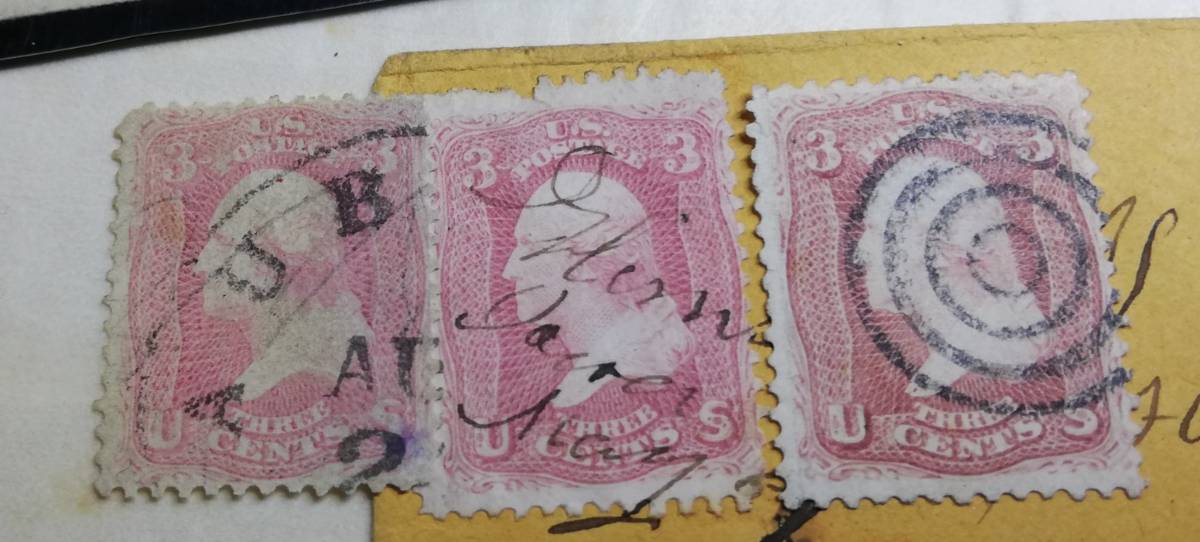
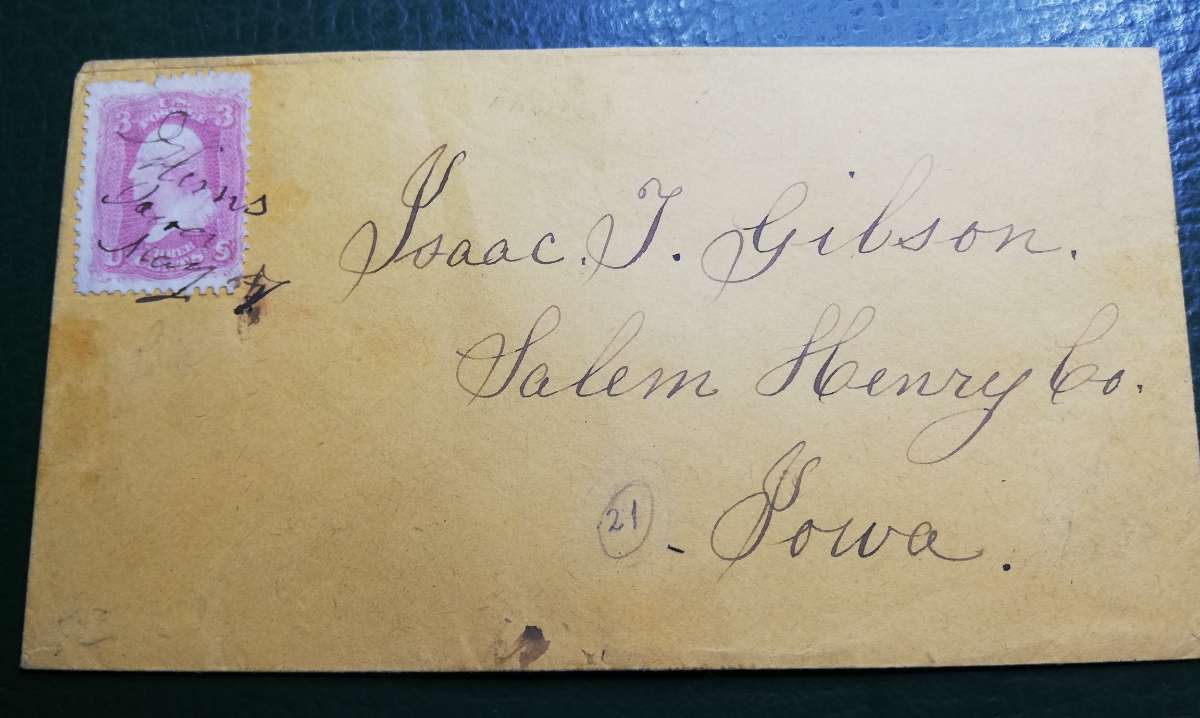
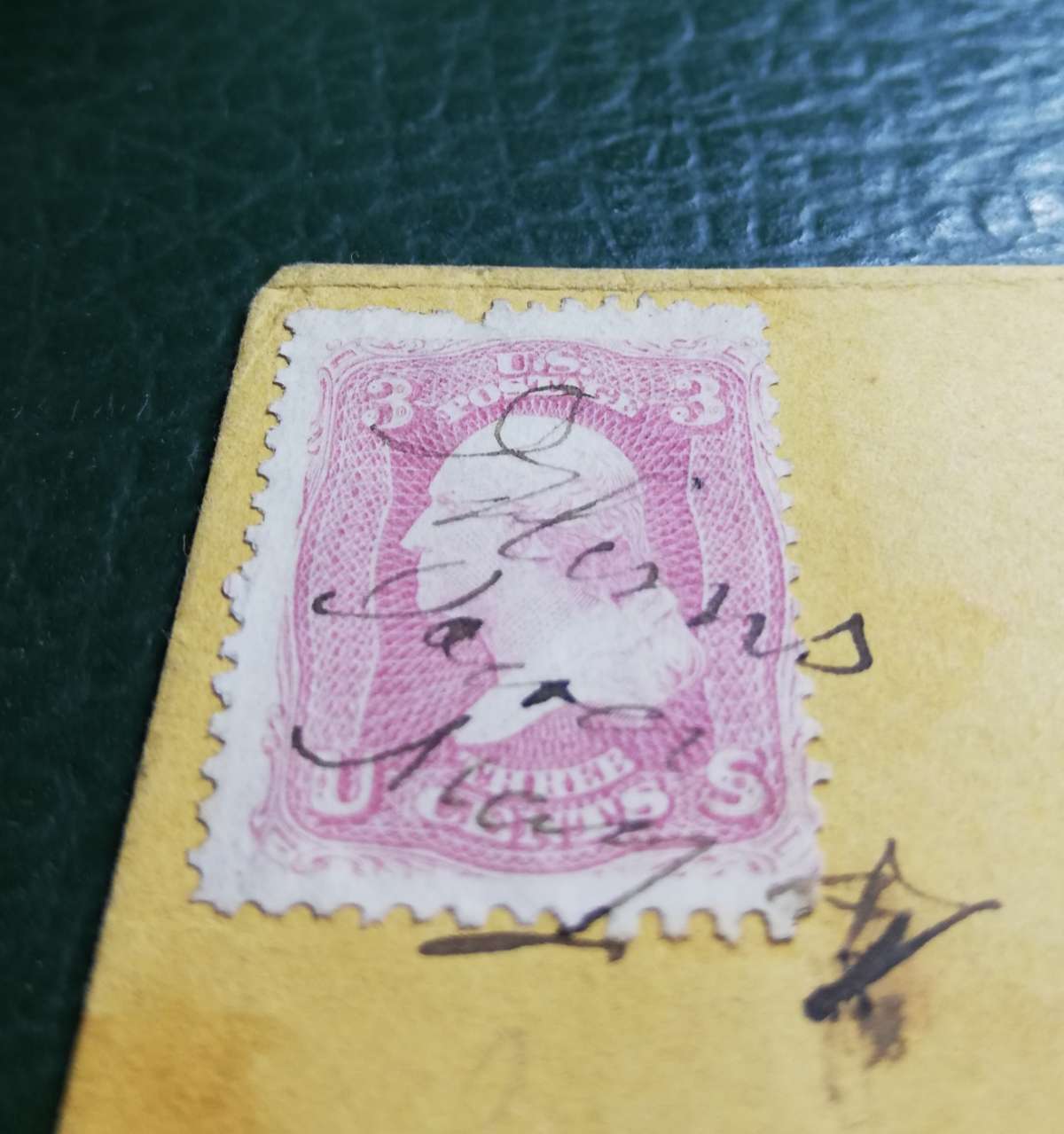
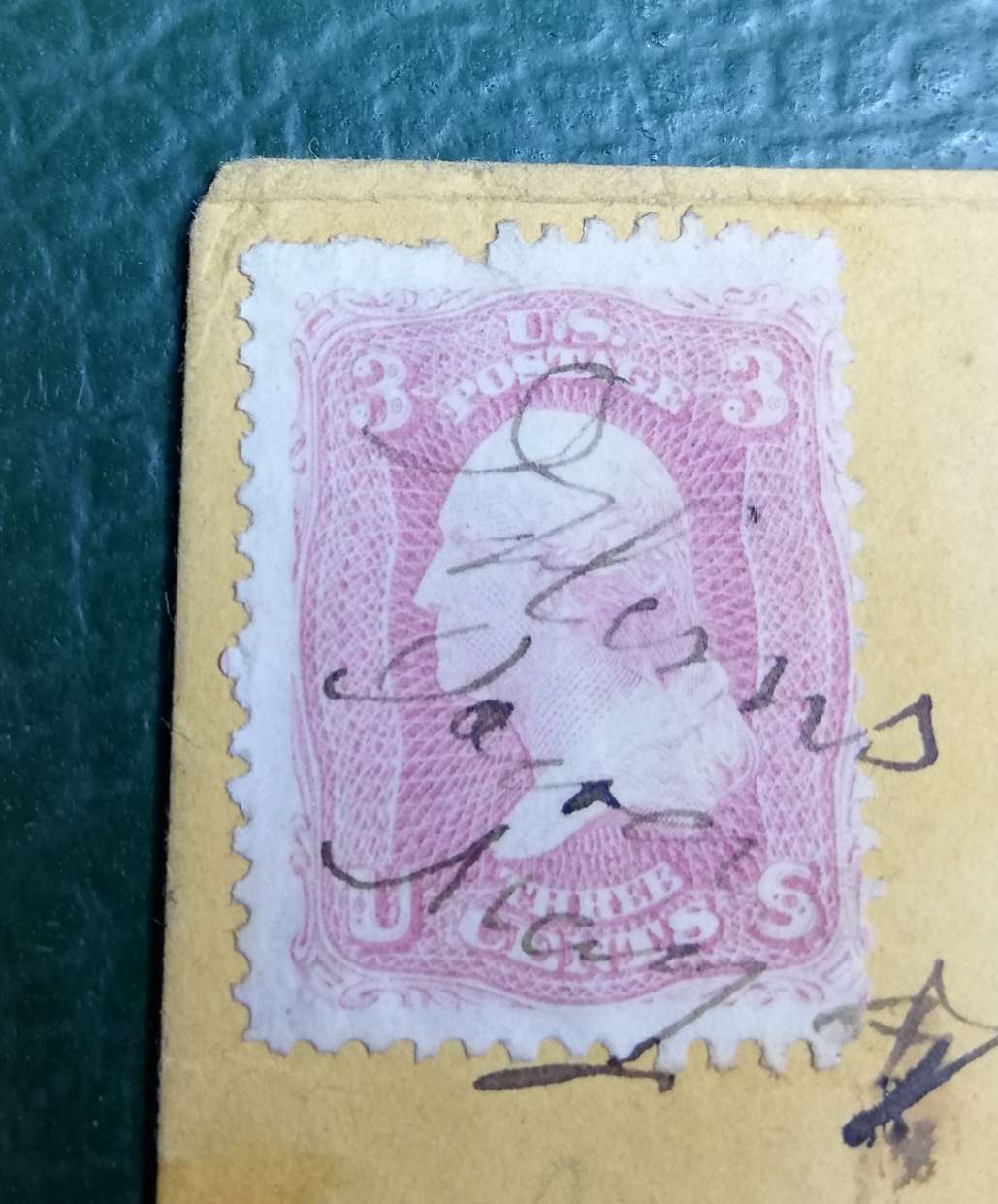
Hi. I recently acquired this cover. My question is why is there no date and can anyone help to decipher what is written on the stamp.
A quick Google search turned up some nice info on Isaac Gibson, whom the letter is addressed to. Quite the man it seems...
Isaac T. Gibson was reared to manhood in Ohio, receiving but limited educational privileges. He married Anna M. Hiatt, of Salem, Iowa, who was born in 1835, and is a daughter of Allen Hiatt, who is mentioned elsewhere in this work. She acquired her education in Earlham College at Richmond, Indiana, and at the time of her marriage began housekeeping in Salem. Mr. Gibson was at that time a merchant of Salem, in which business he continued for ten years, after which he joined his father-in-law, Mr. Hiatt, in the conduct of a nursery and also in farming operations. For many years he continued to carry on general agricultural pursuits but is now living retired, maintaining his home in Salem. He has been a very prominent and active factor in public life, his efforts gaining him more than local prominence. He served on the school board for several terms, was secretary and a member of the village council for seven years and also acted as its clerk. While he was the incumbent in that office a new charter for the village was obtained. For many years he was notary public and he was also secretary of the first county agricultural society which held its fair in Salem. An earnest Christian man he has ever done much for the upbuilding of the church. He was likewise a member of the Northwestern Freedmen's Aid Commission, which was organized in Chicago in 1864, and became one of the board of managers which was composed of eminent men from all the Christian bodies of the northwest. He continued a member of this board until it was merged into the American Missionary Association. This commission was the channel through which the benevolent people of the northwest sent their contributions in aid of the suffering freedmen of the south during the latter part of the war and following its close. After the war Mr. Gibson was sent to establish schools among the colored people of the southwest and was also appointed agent of the American Missionary Association and of the Freedmen's Bureau by General O. O. Howard. He was engaged in Missouri for two years in organizing schools and secured the introduction of free schools for colored people. During this time he was frequently threatened with personal violence. He secured public school buildings for the many colored people whose parents paid heavy taxes in St. Louis. At this time he was appointed by the state legislature a member of the reform school board, of which he was made treasurer and superintendent of the completion of White's Institute, the first reform school building in this state. He was also United States Indian agent of the Osage and other, tribes in the Indian Territory and during the trying times in 1869 between the whites and the Indians he succeeded in bringing about a better condition of affairs and in winning the respect and confidence of both parties. He continued in the work until 1876 with great success. He prevented the passing of a treaty which by fraud the Osages had been induced to make, selling eight million acres of land which they owned in the best part of southwestern Kansas for eighteen cents per acre. He forwarded through the assistant superintendent all the information he could gather to the government and General Grant withdrew the treaty. He represented the Indians at the next congress in Washington and aided in securing the first passage of the bill for the sale of the lands at one dollar and a quarter per acre and placing the proceeds at interest for the Osage Indians, thus making them a wealthy tribe. At length resigning his position as Indian agent he spent two years in Washington, D. C, as claim agent and while there also acted as president of the National Christian Association for the District of Columbia. He was likewise secretary of the National Arbitration League, whose object it is to substitute arbitration for war between the nations, the president of the league being Governor Stanton, of Kansas. He was also secretary of the national convention held at Washington, of which Hon. Edward S. Tobey, of Boston, was president. Mr. Gibson is a member of the Iowa Friends Peace Society and after his return to Salem he never missed an annual meeting" unless absent upon official business until the ill health of his wife caused him to remain at home. He has been treasurer of. the missionary board of Iowa yearly meeting and president of the church evangelical committee. In 1867, while the Friends were trying to sustain a school the "Whittier College Association'' was formed by him and other Friends and the work carried forward to successful completion. Mr. Gibson was secretary and financial manager of the board from its organization but has declined all other positions for some years.
In early life Mr. Gibson, strongly opposing the cause of slavery, became a republican upon the organization of the party for the purpose of preventing the further extension of slavery but in more recent years has been a prohibitionist, believing that the temperance question is one of the most important today before the people.
 *** Moved by Staff to a more appropriate forum. ***





 Posted 09/03/2021 07:42 am