Stamp Community Family of Web Sites
Thousands of stamps, consistently graded, competitively priced and hundreds of in-depth blog posts to read


Stamp Community Forum
 
Username:
Password:
Save Password
Forgot your Password?

This page may contain links that result in small commissions to keep this free site up and running.

Welcome Guest! Registering and/or logging in will remove the anchor (bottom) ads. It's Free!

Scott #6B "Swing Positions"

 
To participate in the forum you must log in or register.
Author Previous TopicReplies: 8 / Views: 1,029Next Topic  
Valued Member
Norway
450 Posts
Posted 11/06/2021   8:23 pm  Show Profile Bookmark this topic Add widglo46 to your friends list Get a Link to this Message
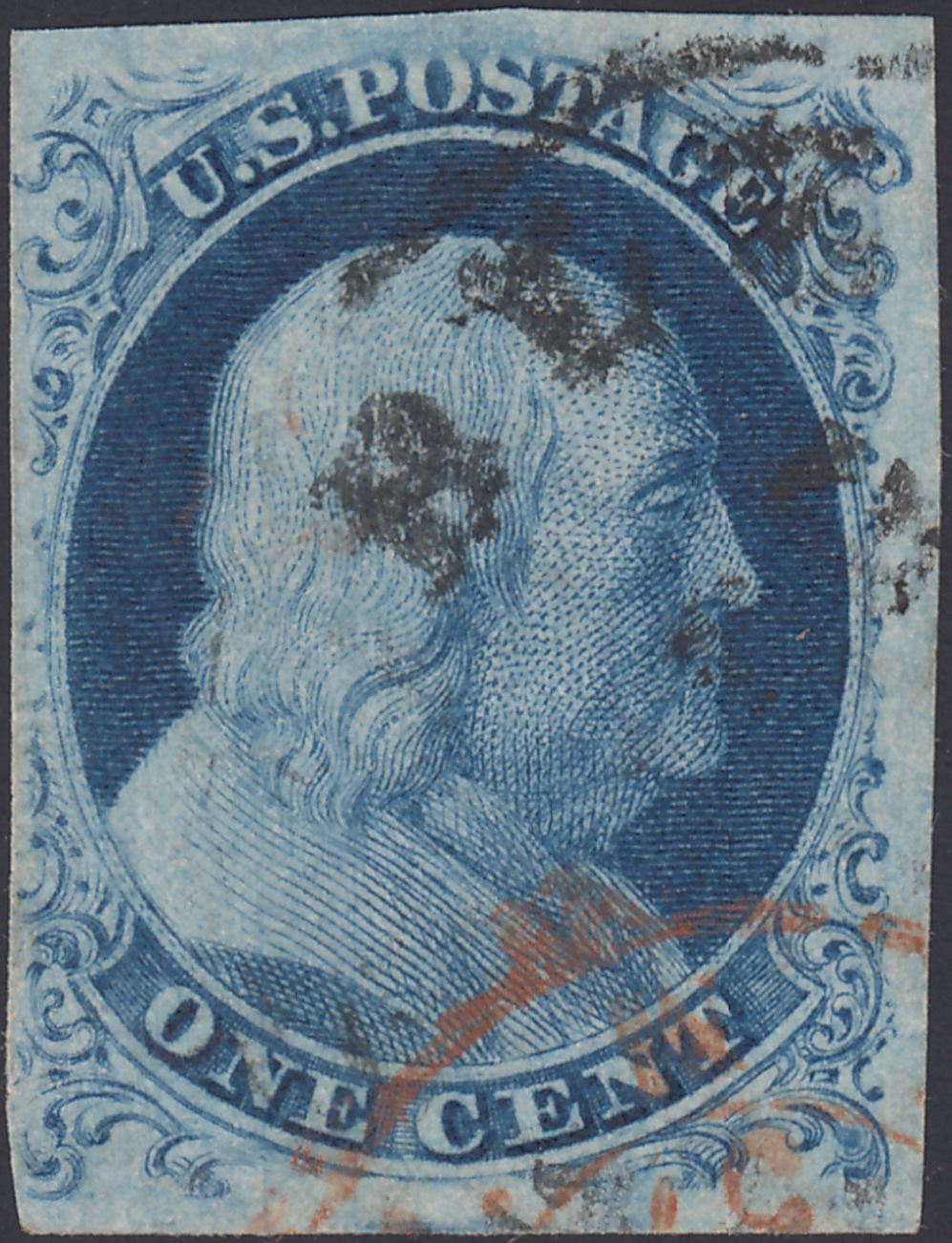
I recently purchased a PF certified #6b that was easy to plate as position 41R4. Neinken writes a fair amount about this particular position and states that, depending upon the impression, it can be classified as either a Type Ic or a Type IIIa. He writes specifically, "...the stamp under observation is not a Type Ic, if it shows less of the design than position 89R4 illustrated in Fig.1 5A23." Position 89R4 has a nearly complete, but not complete left plume, and small breaks in the top frame line.

When considering any #6b, I thought that the primary consideration when judging the impression was the completeness of the plumes, and particularly the left plume - if it were complete or very nearly so, it could be called a Ic and hence a Scott #6b. On looking through the Siegel database, however, I read a description of lot 176 in sale 963 that confused me. The lot in question was a Type III-Ic (8-6b) pair, positions 82-83L4 and Siegel wrote: "Type Ic occurs on only ten of the 200 positions from Plate 4 and does not occur on any other plate. Two of these ten are swing positions (41R4 and 49R4), which developed gaps at either top or bottom as the plate wore during use, becoming Type IIIa."

The implication I get from this explanation is that gaps in the frame line can also determine how a swing position is classified. So I am left wondering. I think that on my 41R4, the left plume is complete or nearly so. The top line, however, is more widely broken than 89R4. Should it still be classified as a Ic or does it become a IIIa ? The Neinken map of 41R4 and all other examples I've been able to compare also have wide gaps in the top frame line.

I'll post a better quality scan when I receive the stamp.

Send note to Staff

Pillar Of The Community
United States
3488 Posts
Posted 11/06/2021   8:57 pm  Show Profile Bookmark this reply Add txstamp to your friends list  Get a Link to this Reply
We had a long discussion on this subject here:

https://goscf.com/t/59061&whichpage=12#660896
Send note to Staff  Go to Top of Page
Pillar Of The Community
United States
2555 Posts
Posted 11/07/2021   08:04 am  Show Profile Check sinclair2010's eBay Listings Bookmark this reply Add sinclair2010 to your friends list  Get a Link to this Reply
I don't have enough time to put forth several theories as to why Siegel wrote what they did or what they meant, but my quick advice in a nutshell would be to try to forget that you read it as quickly as possible and go back to your previous understanding.
Send note to Staff  Go to Top of Page
Valued Member
Norway
450 Posts
Posted 11/07/2021   08:42 am  Show Profile Bookmark this reply Add widglo46 to your friends list  Get a Link to this Reply
txstamp - Thanks for the link to the discussion of type Ic on the Plate 4 thread. I considered putting my post up on that thread, and it is embarrassing that I didn't take the time to look through it again to see if the topic had been discussed before. I ordinarily read the plate threads carefully, and I've even downloaded all of them and combined the multiple pages of each thread into a single pdf file so that it's easier to search through. I think the reason that I missed the Ic discussion was that I had, for whatever reason, just decided that type Ic was too esoteric and controversial to spend time learning about, and I just skipped through the posts on that subject.

This 41R4 caught my eye, though, and now I'm happy to acquire it even as a position piece. My original question also seems to have been answered - the wide gap in the top frame line is irrelevant to the Ic classification.
Send note to Staff  Go to Top of Page
Pillar Of The Community
United States
3488 Posts
Posted 11/07/2021   11:11 am  Show Profile Bookmark this reply Add txstamp to your friends list  Get a Link to this Reply
I'm happy that you are benefitting from the plating threads. That's great.

It can be difficult when an often reliable information source is suddenly shown to be fallible. Always feel free to ask about such things, and, as always- don't believe everything you read. Even here.
Send note to Staff  Go to Top of Page
Valued Member
Norway
450 Posts
Posted 11/12/2021   7:41 pm  Show Profile Bookmark this reply Add widglo46 to your friends list  Get a Link to this Reply
I received the stamp and here is a better scan for those who are interested.
Send note to Staff  Go to Top of Page
Pillar Of The Community
United States
3488 Posts
Posted 11/12/2021   7:46 pm  Show Profile Bookmark this reply Add txstamp to your friends list  Get a Link to this Reply
That is probably a French transit marking with a New Orleans origin.

There was a whole lot of mail from NO to France in this period.
Send note to Staff  Go to Top of Page
Pillar Of The Community
United States
3488 Posts
Posted 11/12/2021   7:59 pm  Show Profile Bookmark this reply Add txstamp to your friends list  Get a Link to this Reply
Its a very nice stamp.

It also illustrates one of my issues with Ty Ic. The bottom is fine for a Ic, but you can't see all of the outer left plume to tell if its sufficient to qualify. So it is indeterminable, essentially, in my opinion. I've seen quite a few of these on pfsearch, certed as Ic's.

Ironically, this is a case where it actually seems to pay off to have a narrow left margin. A stamp I used to have showed the full left outer plume area, and was disqualified, correctly, I'll say, based on seeing that the outer left was largely missing. Go figure.

None of that is meant to take away anything from the very nice stamp you got. Types are a somewhat arbitrary designation anyway.
Send note to Staff  Go to Top of Page
Valued Member
Norway
450 Posts
Posted 11/14/2021   10:32 am  Show Profile Bookmark this reply Add widglo46 to your friends list  Get a Link to this Reply

Quote:
Types are a somewhat arbitrary designation anyway.


txstamp - I agree fully with your comment about types, and it's not only the Ic/IIIa intermediates. The issue seems almost absurd to me with regard II/IIIa and IIIa/III intermediates. It's hard to understand that a worn plate 1E stamp that meets the requirement of a type IIIa can be worth more than an early impression type II from the same position. The same goes for a type IIIa that with wear becomes a type III.
Send note to Staff  Go to Top of Page
  Previous TopicReplies: 8 / Views: 1,029Next Topic  
 
To participate in the forum you must log in or register.

Go to Top of Page

Disclaimer: While a tremendous amount of effort goes into ensuring the accuracy of the information contained in this site, Stamp Community assumes no liability for errors. Copyright 2005 - 2026 Stamp Community Family - All rights reserved worldwide. Use of any images or content on this website without prior written permission of Stamp Community or the original lender is strictly prohibited.
Privacy Policy / Terms of Use    Advertise Here
Stamp Community Forum © 2007 - 2026 Stamp Community Forums
It took 0.15 seconds to lick this stamp. Powered By: Snitz Forums 2000 Version 3.4.05