| Author |
 Replies: 22 / Views: 2,335 Replies: 22 / Views: 2,335 |
|
|
|
Pillar Of The Community
United States
1115 Posts |
|
|
The P-7 cancel was known to be used from the 1860s to 1870. I understand the inclination to initially think the rosette may be from a NYFM use, because that was one of the more common usages of the 15c. The Waterbury cancels are most often seen on the 1c/3c stamps, but can be found on higher denominations as well, so it is a possibility for the 15c. |
Send note to Staff 
|
|
|
Valued Member
282 Posts |
|
|
Thank You Rogdcam there was a lot of great information in that website but I really don't see this design the gaps of the petal are wrong .The closest of the design is the Tr-W26/ul and that's because of the gaps. Here are images of the gaps. 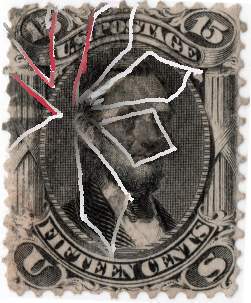  |
|
Send note to Staff
|
|
|
Moderator

United States
12330 Posts |
|
|
I recommend not 'over thinking' these kinds of fancy cancels; it is not likely to find a perfect match and it is common that these cancellers quickly changed over time and with usage. Most were hand carved from box wood or other hardwood, but they often quickly wore down, cracked, broke, etc. Additionally, fancy cancel strikes can be tricky since as a hand process they could vary from envelope to envelope depending upon the strength of the strike, the stack of envelope or substrate under the envelope, the ink pad, etc.
Don |
|
Send note to Staff
|
|
|
Valued Member
282 Posts |
|
|
Thats what I think is "true" they do change a bit but some how I think the basic shapes are their.
It also sounds like their maybe a hard time in document all the cancels at least that sounds like Skinner -Eno US cancellation documents I believe they started documenting in the early 1920's . |
|
Send note to Staff
|
|
|
Bedrock Of The Community
12753 Posts |
|
|
This why it is so important to leave stamps with fancy cancels on cover if found that way. All of these standalone stamps were obviously removed at some point and you may never pin down the exact location a cancel originated.
Stating the obvious but when you start into relatively simple seeming cancels you can go crazy coming to a conclusion.
I am a bit surprised that no one has created a tool to compare and identify potential matches for cancels utilizing digitized info from sources like Cole, Skinner-Eno and others. Weiss used to do NYFM cancel ID's for me long ago. They drove me crazy. |
|
Send note to Staff
|
|
|
Valued Member
282 Posts |
|
|
Hello everyone :
Here is something I found interesting in this document by Skinner and Eno.And why my Star or Radial design cancel of my exact stamp may not be documented.
Here is the interesting quote " The more elaborate and distinctive
designs (those readily recognizable off
cover) are treated as fully as available
records permit. For the more ordinary simple
designs (split corks, targets, grids, etc.) only
a representative sampling of each is shown to
illustrate the scope and variety of what exists,
and to avoid exhaustive and boring
repetition. The authors hope, therefore, that
this work will prove to be useful, pleasing to
the collector, and definitive.
This is from the Skinner Eno Us Cancellations book.
May be yes maybe no but it might ex plane it?
How do they really choose is the interesting question |
|
Send note to Staff
|
|
|
Pillar Of The Community
6363 Posts |
|
|
The various fancy cancel books have only a modest sampling of the countless tens of thousands of killers which were used, some more fancy than others. A thorough or complete U.S. listing would be impossible. Entire books shave been written about the cancels of single towns, Waterbury, Boston, etc. "Unlisted in Skinner/Eno" or "unlisted in Cole" should not surprise. here far more unlisted geometric and cut-cork cancels than listed. |
|
Send note to Staff
|
|
|
Replies: 22 / Views: 2,335 |
|




 Posted 01/11/2022 12:37 am


