| Author |
 Replies: 8 / Views: 879 Replies: 8 / Views: 879 |
|
|
Valued Member
United States
39 Posts |
|
|
Good morning. Could someone please verify or help me with Id'ing this stamp. I think Scott 32 maybe type II? Thanks in advance JoJo 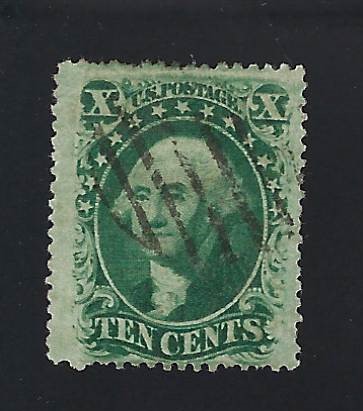 |
|
Send note to Staff
|
|
|
|
|
Bedrock Of The Community
United States
10862 Posts |
|
|
Rest in Peace
United States
652 Posts |
|
|
You should avail yourself of the information on Stamp Smarter and learn from that. Keys are the fullness of the scrolls at the bottom and whether or not the three pearls at lower left and at lower right are complete. |
Send note to Staff 
|
|
|
Valued Member
United States
39 Posts |
|
|
Please don't take this the wrong way but in the future, if you have no intention of helping me, please abstain from responding. I have a Scott catalog. I was asking for help because I dont have the years experience to discern nuances in stamps. But hey if you want to put me down go right ahead. |
|
Send note to Staff
|
|
|
Bedrock Of The Community
United States
10862 Posts |
|
|
No one is putting you down, we are trying to give you additional information that will help you learn these stamps for yourself instead of being dependent on others. Who may or may not give you a correct answer. If you are not willing to do a bit of study, you will never gain the experience. |
|
Send note to Staff
|
|
|
Valued Member
United States
319 Posts |
|
|
I don't think anyone was trying to 'put you down', although I understand that the stamp experts here can/do sound condescending at times. The stampsmarter website referred to is simply one of the most excellent sources online of great/detailed information about stamps (especially U.S.) and you'll find much, much more there than what is shown in the scott catalog.
Yours is the easiest to detect - #35 - why, because it does NOT have the requisite complete three pearls at lower left and at lower right (as Mr. Crowe referred to). |
|
Send note to Staff
|
|
|
Pillar Of The Community
6363 Posts |
|
|
JoJo,
A gentle explanation if I may … Everyone has a different definition of "help". There are two general philosophies which appear in replies to those asking for help here. The first is to teach a method of finding the answer, often with pointers, guidance and hints. The other is to directly supply the answer. In other words, "Teach a man to fish …" versus giving you a fish.
I admit from this post, I cannot tell your level of knowledge, years of collecting experience, area of specialty, what catalogs you have consulted, etc., so any responses from me or others may come back far too simplistic or far too complicated, given the lack of much background data. Where to start building from?
Revcollector provided a link to an extremely helpful site, especially useful to those not having a catalog handy. Wtcrowe echoed that site and provides guidance toward specific key areas on your stamp to look at. They are both very knowledgeable collectors. I fall into the "teach a man to fish" school also, since it gives me far greater satisfaction to climb up the learning curve with each stamp ID solved and I won't have to ask the next time I encounter a similar stamp.
Additionally, internet posts typically do not convey "tone" very well, as we reduce everything to the length of a Tweet. We seldom take the time to make lengthy, detailed posts. The shorter, blunter replies can come off different than intended – colder than they would over a friendly beer at the corner pub.
|
|
Send note to Staff
|
|
|
Pillar Of The Community

United States
1498 Posts |
|
|
Please don't take umbrage. The responders are actually trying to help. I suspect they want you to decide for yourself and then indicate why you choose what you do. Then, presumably, they would either agree with your choice or point out what you may have missed. I have seen this "dance" carried out a number of times on this forum. Frequently the original poster is annoyed by this technique, wanting only to know the correct id. The point to be made is that those responding are trying to teach you to id the stamp yourself.
Not being an expert myself, I do understand your impatience with trying to identify the correct type (I thru V) only using Scott. It can be frustrating, especially at first. I eventually invested $40 in Micarelli's book on the identification of U.S. regular issues from 1847-1934. It gives more detailed info than the Scott specialized catalogue although I'm not sure it's still in print.
The clues for your stamp, I think, are the incomplete side ornaments and the missing pearls. A careful reading of Scott will show that this is true only for one type. I'll let you decide which one. Hint: Not surprisingly, I think it will likely be the most common of the perforated 10-cent varieties. |
|
Send note to Staff
|
|
|
Valued Member
United States
39 Posts |
|
|
Thank you all for the information and advice. Now that I know the website to teach me about stamping "smarter", I will refrain from asking any further questions since I now know the answer in advance. JoJo |
|
Send note to Staff
|
|
| |
Replies: 8 / Views: 879 |
|



 Posted 02/25/2022 11:13 am


