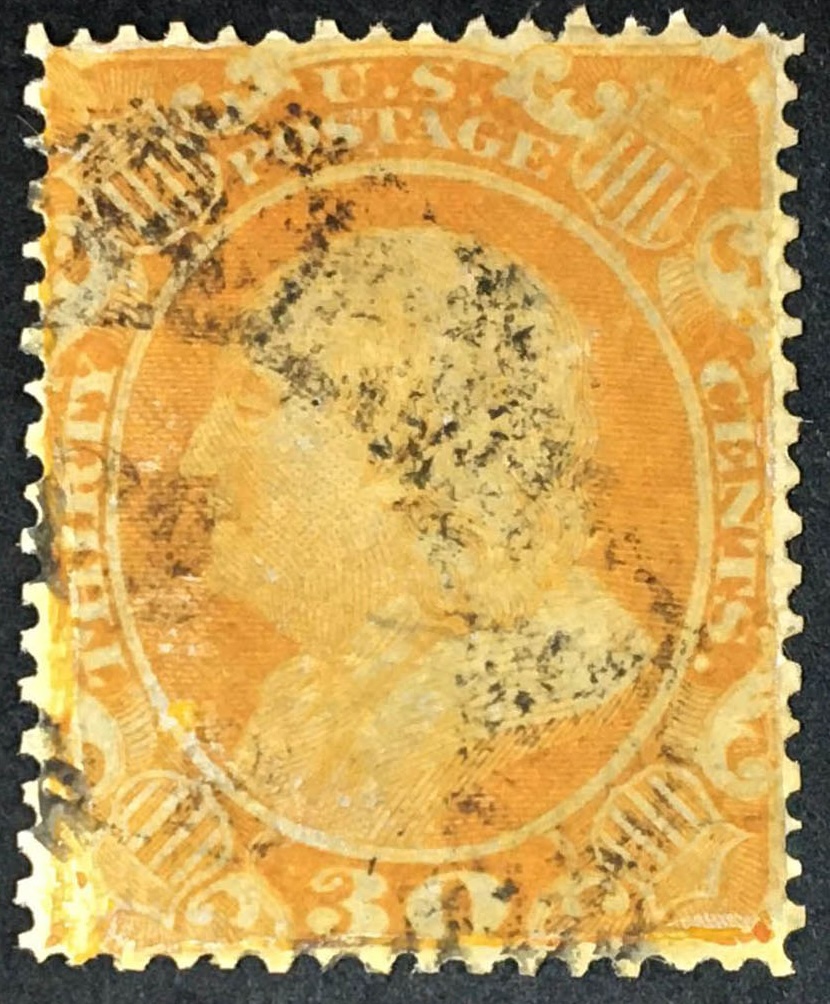
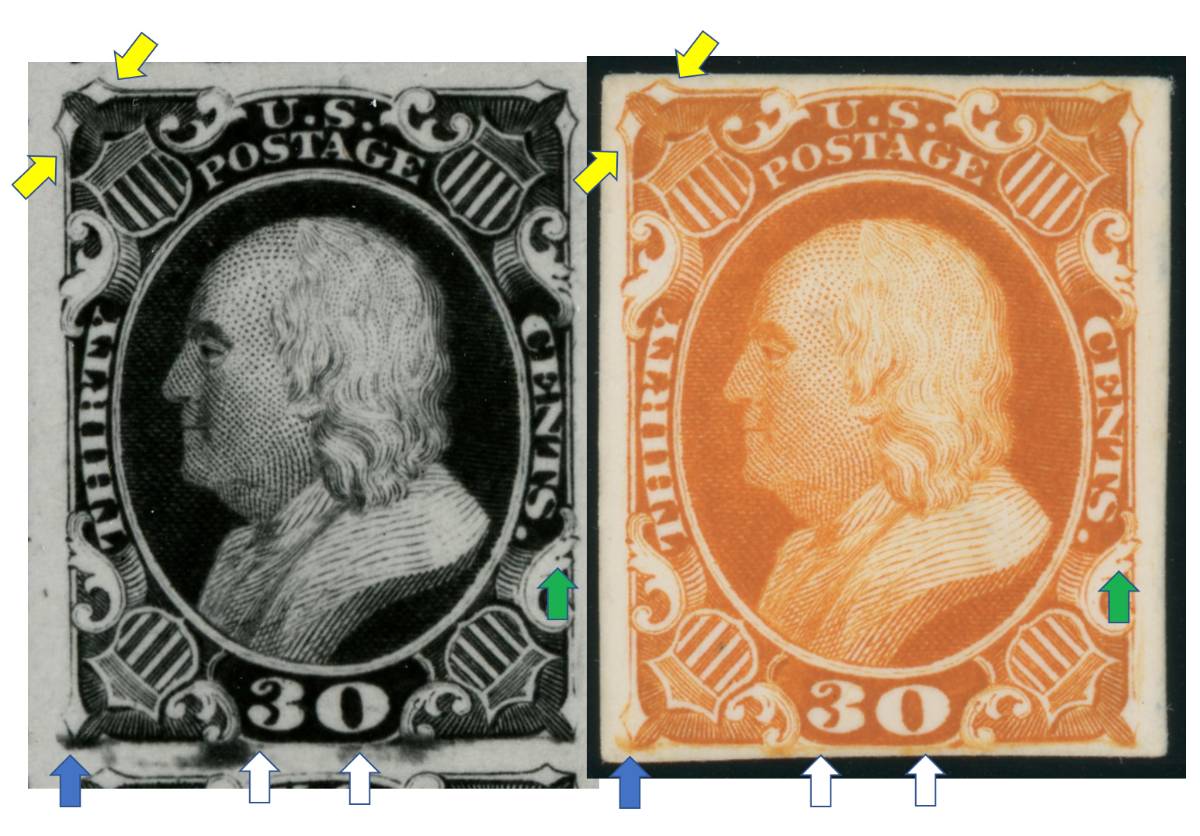
Here's a bit of the yin & yang behind plating this stamp using an example that's about as "low hanging fruit" as you can get because it has an easily noticeable double transfer (yellow arrows). What you're looking at is position 69L from the black & white Ashbrook proof pane photos, and a 38P4, proof on card. 69L means 7th row of stamps, second to last subject in the row, left pane. Additional indicators of this plate position:
• strong dot in ornament (green)
• ink smear, left corner, that hooks upward (blue)
• partial erasure of what was, on the design as approved, a continuous line below the "30" tablet. In this example the line segments are much longer than usual (white arrows).
There are other indicators of 69L but those should suffice to get the idea across. The doubled lines present the strongest evidence.
Where it becomes difficult to plate stamps (and proofs) without obvious indicators such as the double transfer has to do, in part, with differences in the extent of the ink smudges at the bottom. In this case, in the B/W photo we see a large smudge under the left curly ornament. But it doesn't present itself to nearly the same extent in the orange proof. Other differences in the smudging are easily seen.
There are other differences as well. Notice how the peak of the arced line at the top of the photograph is continuous and dark. But in the proof there's a noticeable thinning of the line, almost to the point where you could say that there's a gap in the line.
[edited for clarity]





 Posted 09/16/2024 11:06 pm