| Author |
 Replies: 16 / Views: 1,686 Replies: 16 / Views: 1,686 |
|
Valued Member
7 Posts |
|
|
Hello - My father passed me his stamp and coin collections before he passed 4 years ago. I'm learning quick on the numbering system, errors, etc.. but obviously just starting. As for this stamp - Is this winged or Imperf (...or both?). Its hard to tell what these things are worth (as a beginner), but I think it has at least some value over a normal one? Probably not necessary to have a 'comparison' in the picture in this forum, but wanted to show why I thought it was different. Thanks for you time! :)  |
|
Send note to Staff
|
|
|
|
|
Pillar Of The Community
United States
640 Posts |
|
|
Welcome to the Forum.
The stamps you show are part of the Prominent Americans Issues (1965 - 78). There are three main varieties of this issue, all of which have modest catalogue value (for examples in mint condition). Your examples would be considered damaged.
In simplest terms, look at the base of the necktie. In the top stamp, it touches the jacket lapel. In the btm stamp, there is a space btwn the tie and the lapel.
Btm stamp: Looks like left edge has been cut. There is a variety with one or two straight edges; these are booklet stamps.
|
Send note to Staff 
|
|
|
Pillar Of The Community
United States
8956 Posts |
|
|
Hi Mercury, and welcome. Your stamp looks like it might have come from a booklet
Peter |
|
Send note to Staff
|
|
|
Valued Member
7 Posts |
|
|
Thanks for the answers!
Booklet... So then, its neither wing or imperf then - I.haven't run into that booklet term yet, so new term to research - Thanks :)
|
|
Send note to Staff
|
|
|
Pillar Of The Community
United States
8956 Posts |
|
|
Mercury, you do not have to go far for this research. Go to the upper left corner of this page and find the word "Navigation". Underneath you will find "glossary" - click on it .
Go to the "b" and find "booklet"
Peter |
|
Send note to Staff
|
|
|
Valued Member
7 Posts |
|
|
I will check it out, thanks.
This site is great - there was a very thin odd one I couldn't figure via Google, but just found an enormous amount of posts here about it in another discussion. Apparently its an unused 50K OKCA Russian Army of the North on pelure paper... lol, never would've found that otherwise.
Thanks again |
|
Send note to Staff
|
|
|
Pillar Of The Community

United States
853 Posts |
|
|
Welcome, Mercury.
I'm uncertain what you might mean by "winged," but, it is not imperforate. Imperforate stamps lack any and all perforations.
The left side of the stamp you show is pretty ragged, and not trimmed neatly like a booklet ought to be. And the right hand perforations have been badly damaged too.
If you are trying to determine the monetary value of the stamps you've received, perhaps you might post a group photo of the oldest ones you've got and then we might start again.
Best wishes.
|
|
Send note to Staff
|
-- Jonathan |
|
|
Pillar Of The Community
United States
1434 Posts |
|
|
Some thoughts:
*No one is yet sure what you mean by "winged."
*To be imperforate, a stamp must by design be without perforations on all four sides.
*The original location of a stamp on a sheet or in a booklet rarely impacts its value, in and of itself. There are exceptions, but I won't complicate things.
*Damaged stamps scrape the bottom of the value barrel. Used are OK, damaged... not so much.
*US (and most modern) stamps issued after 1950 are rarely worth much. There are of course exceptions for errors and some regular issues (1960's PRC for example). |
|
Send note to Staff
|
|
|
Valued Member
7 Posts |
|
|
Thanks for all the replies, and you'll have to excuse my lack of proper terminology - at it now for all of about 7 days, but learning. All your posts help with that, so again thanks for taking the time.
It's kind of about value, but really the whole area is just interesting regardless - learning new things... new hobbies/interests. |
|
Send note to Staff
|
|
|
Pillar Of The Community
Australia
3293 Posts |
|
|
Pillar Of The Community
United States
1434 Posts |
|
|
Wing margins seem to be a uniquely British Commonwealth phenomenon. Or at least, all discussion of it uses BC stamps as examples. |
|
Send note to Staff
|
|
|
Pillar Of The Community
Australia
3293 Posts |
|
|
I think most of them are from De La Rue plates. Maybe someone could confirm?
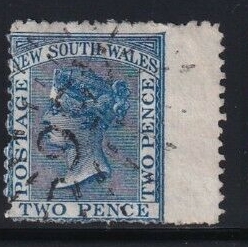
NSW large diadems can sometimes appear with wide margins on one or more sides but these are from the edges or corners of the sheet. |
|
Send note to Staff
|
|
|
Bedrock Of The Community
Australia
38679 Posts |
|
|
With the Imperial Crown Watermark introduced in 1880, "wing margins" ceased. "Wing Margins" are discussed in a US monograph (US Philatelic Classics society) Vol 59 Number 4 Year 2007 Author : Alan C campbell But from what I can see, he is referring to badly placed line perforations creating wide margins. Brit Comm True wing margins, seen on GB, Transvaal, NSW. ------------- Image Bib: Stamp collecting world dot com 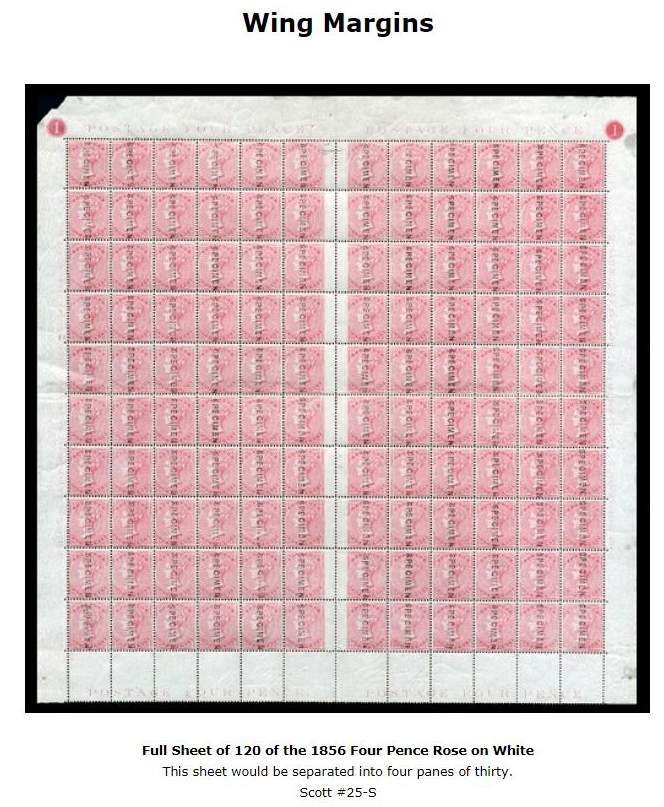 |
|
Send note to Staff
|
| Edited by rod222 - 05/04/2023 9:21 pm |
|
|
Bedrock Of The Community
Australia
38679 Posts |
|
|
GB : Wing Margin stamps occur on the surface printed stamps 1855-1880
Stamps with wmk emblem or spray 80 stamps from 240 will be wing margins (one third)
|
|
Send note to Staff
|
|
|
Pillar Of The Community
6352 Posts |
|
|
Our original poster notes he is just beginning this journey, so rather than complicating this thread with foreign material, let's return to the stamp issue in question .... Like many definitive stamps in the U.S., the Holmes stamp comes in three basic physical formats: 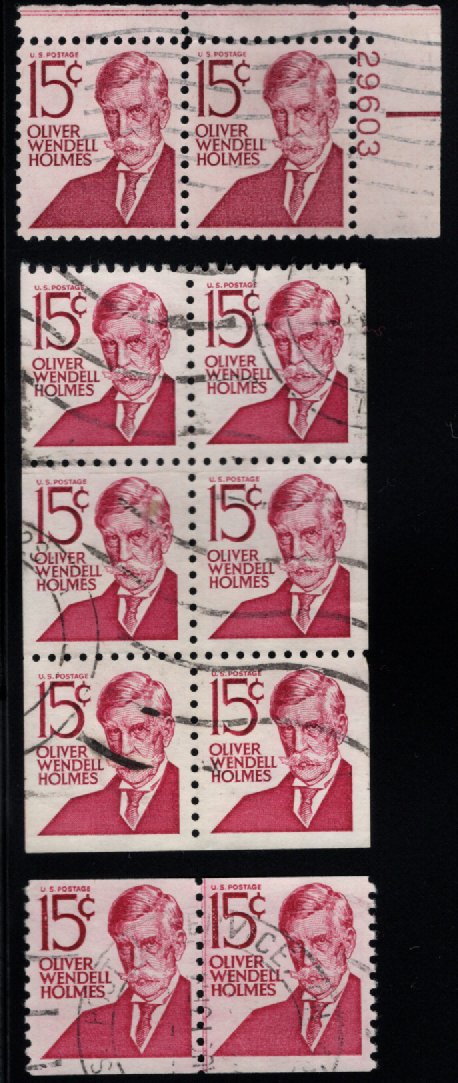 Sheets Sheets (or more properly a "pane"), which for this issue will be perforated on all four sides Booklets, small panes sold in cardboard covers, which will have one or more "natural straight edges" depending on their position in the booklet pane. Coils, or rolls, which will have two natural straight edges on *opposite* sides. Thus your two Holmes stamps come from a pane and booklet, respectively, and show typical examples. The Holmes stamp was a workhorse stamp, being current during the 15 cent first class letter rate. The quantities printed were immense. Used examples exist in the countless millions and have essentially no market value. Moderately-advanced U.S. collectors may be interested in another aspect: there were three dies made. Panes and coils come in both types I and II, and the booklets are type III, noted by Calstamp earlier and particularly evident in the bottom of the tie. There are also differences in gum and tagging/precanceling, which are typically of interest to more advanced collectors or specialists in this series. Mercury6, I would be curious to know where you picked up the word "wing", as it has only rare applications to U.S. stamps. |
|
Send note to Staff
|
| Edited by John Becker - 05/04/2023 11:36 pm |
|
|
Bedrock Of The Community
Australia
38679 Posts |
|
|
Quote:
so rather than complicating this thread with foreign material Complicating or not, Mercury had "winged" in his lexicon. we were addressing that query, that he / she asked Failing to do that would leave him / her still uninformed. Philatelic terms that cross geographic boundaries are pertinent. |
|
Send note to Staff
|
|
|
Replies: 16 / Views: 1,686 |
|




 Posted 05/04/2023 06:09 am