| Author |
 Replies: 57 / Views: 5,955 Replies: 57 / Views: 5,955 |
|
|
|
Pillar Of The Community
United States
3532 Posts |
|
|
Quote:
What kind of publishing would be needed to keep collectors aware of things like this? Revisiting @essayk's question about more in-depth and/or esoteric essay/proof items, in light of this useful discussion - it would seem as though stampsmarter articles might be of real use for material such as this. Some of the 5c 1847 plating work on stampsmarter has allowed for the successful plating of previously un-plated varieties of the 5c US Scott #1 just in the past couple of years. So, people are looking at stampsmarter pages for information. |
Send note to Staff 
|
|
|
Pillar Of The Community
United States
637 Posts |
|
|
For those interested in the 3 cent stamp of 1851 -- I would add Roy Weber's publication "US Three Cent 1851 Essays for Postage Stamps (And Related Topics)" to the list of resources -- available in pdf format for free at the USPCS website -- link is here: https://www.uspcs.org/wp-content/up...okmarked.pdfThis is pretty much " the bible" when it come to essays for the 1851 3 cent issue. |
|
Send note to Staff
|
|
|
Pillar Of The Community
United States
939 Posts |
|
|
"US Three Cent 1851 Essays for Postage Stamps (And Related Topics)"
You can take this PDF to one of those print books on demand website and get a hardcover copy printed for about $85. That's a really good price for a 328 page full color book. |
|
Send note to Staff
|
|
|
Pillar Of The Community
United States
1946 Posts |
|
|
txstamp wrote: Quote:
edit: I am somewhat surprised that the US Philatelic Classics Society didn't digitize the Brazer book for their online library, but I guess essay/proof stuff is largely out of their domain; belonging in the US Stamp Society now. Someone should digitize Brazer at some point. Just a thought. While there are a few catalog entries and particular details in notes in the Brazer catalog (original 1941 edition and Quarterman 1977 augmented reprint) that are not included in the Scott listings [incl Mason refs] (56E-F, G/M-29,M-42); 57aE/M-35), they are of more historical than functional interest except to specialists. However, if you wish to delve into the history of certain listings and/or material, then having at least the Quarterman reprint of the Brazer Essay catalog is a good idea. As for the USPCS treatment of essays vs the USSS, it is a fact that when the Essay-Proof Society folded up in 1992 their last Journal editor, Barbara Mueller, was better connected with the BIA/USSS than the USPCS at the time. But once the Brazer update was completed under Falk Finkelberg at that time, she ran out of writers ready/willing to publish. The fact that Bill Hatton at Scott was ready to pick up the Brazer work and carry it forward (with new ID numbers) looked like a final triumphant burst. It was in fact a last hurrah. It is one which recent events at Amos Press suggest is not long for this world. The truly sad thing about all this, is that there is considerable fertile ground for original research and discovery in the Essay-Proof field, that is largely unknown to US philatelists. The work by Peter Schwartz and Jan Hofmeyr on patent material is but the tip of the iceberg. The intrigues of Postal History at the usage end of stamp production have an undiscovered counterpart in the field of stamp design. That fact was a prime driver for Clarence Brazer (an architect cum stamp dealer). Studying stamps at this level makes for some rather strange bedfellows in the range of hobby. We have far more kinship with collectors of US paper money than most philatelists imagine, but there is a mutual reluctance on both sides of that divide to attempt to cross it. Yet, part of the appreciation of the work of an artist involves knowing who that is. One of the best resources for that kind of appreciation, The Engraver's Line by Gene Hessler, was not written by a philatelist. He writes for numismatic publications. One of the finest studies on ABNCo die sequencing I have ever encountered was written by Mark Tomasko for a numismatic publication. He very generously sent me a copy he had cut out. (BTW the Paper Money boys usually outbid us where it counts). One of the founding members of the Essay-Proof Society was Julian Blanchard, who was a Paper Money specialist friend of Clarence Brazer. Blanchard contributed more than a few articles to the EPJ. |
|
Send note to Staff
|
| Edited by essayk - 06/19/2025 2:10 pm |
|
|
Pillar Of The Community
United States
925 Posts |
|
|
Quote:
edit: I am somewhat surprised that the US Philatelic Classics Society didn't digitize the Brazer book for their online library, but I guess essay/proof stuff is largely out of their domain; belonging in the US Stamp Society now. Someone should digitize Brazer at some point. Just a thought. The USPCS has digitized Brazer's research archive - it is available here: https://www.uspcs.org/resource-cent...er-archives/ |
|
Send note to Staff
|
|
|
Pillar Of The Community
United States
925 Posts |
|
|
Quote:
It seems like, historically, more in-depth specialized items are better covered in reference material for the period or stamp-issue in question. For example, Ashbrook & Neinken cover a lot concerning 1851 issue related essay-proof material in their books on stamps of the period. Things like the 6c essay in the 1c 1851 stamp design, for example. 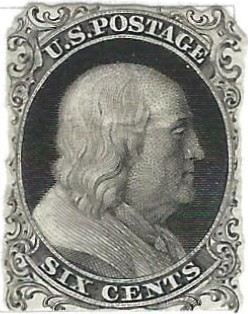 That gives me a reason to share one of my favorite essay items - 5-E2, the 1 cent stamp design originally prepared as a 6 cent stamp for the 1851 prepaid rate to California |
|
Send note to Staff
|
|
|
Pillar Of The Community
United States
3532 Posts |
|
|
@spqr - Thanks for the pointer to Brazer's archive. Very nice 5-E2 ! @essayk - I will probably pick up the Quarterman reprint of Brazer. Pics are always nice. I don't have a great scan of my 6c essay, however, this item does have a brief back story. It is the copy illustrated in Neinken (1c book), on page 15 figure 6-A. I bought it circa 1990, from the one and only Bill Langs. I held it for 15 years, and prior to my sale, I called up Dick Celler and suggested that he buy it from me, as it seemed like something that he should own. He bought it, and he held it for 16 years, until he passed away in 2021. At that time, I bought it back. So it has been locked away between myself and Dick for 35 years. It would be one of the last things I'd part with. I believe this one is ex-Chase. 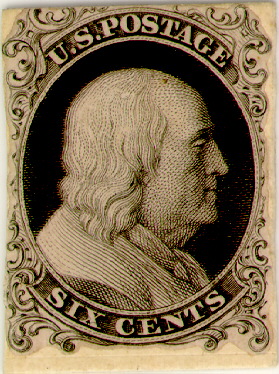 |
|
Send note to Staff
|
|
|
Pillar Of The Community
United States
1946 Posts |
|
|
SPQR said: Quote:
That gives me a reason to share one of my favorite essay items - 5-E2 I'm a Banknote guy for the most part, but oddly enough you rang a chime for me with your comment on 5-E2. Though I scarcely attend to the early essays, the original 6c did catch my attention too. Something about putting Franklin on the double rate and then moving him to the starting slot was enigmatic. He stayed at the head of the pack for the rest of the century and well into the next (for difinitives). 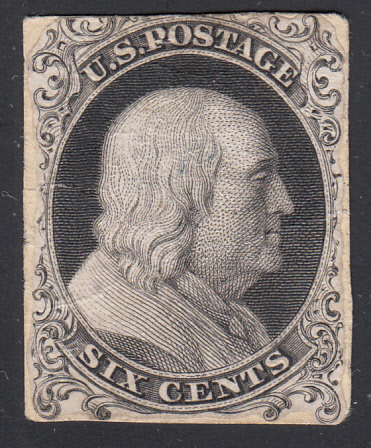 I had to get one. Go figure. |
|
Send note to Staff
|
|
|
Pillar Of The Community
United States
925 Posts |
|
|
Pillar Of The Community
United States
3532 Posts |
|
|
I think we can only speculate. This was Toppan Carpenter's first contract with the government for postage stamps. The other two completed designs - 3c and 12c at the time, were both rectangular, with boxy frames - easy to cut around. Maybe the scissor-guy then ran into this thing and didn't quite know what to do, or what hit him, when trying to trim it. Or vice-versa - this was first, and they decided to make boxy designs because of this mess of dangling ornamentation.  |
|
Send note to Staff
|
|
|
Pillar Of The Community
United States
4465 Posts |
|
|
Since a Siegel sale was discussed previously in this thread, I will pointout that Siegel's 2025 Rarity of the World sale has some better essays and proofs of popular issues, including a set of 1869 Inverts and great 1901 issue material. The two day rarities sale starts TOMORROW, June 25. |
|
Send note to Staff
|
|
|
Bedrock Of The Community
12781 Posts |
|
|
On 18 June I posted: Quote:
The upcoming Siegel Rarities of the World sale on 25 June has many actually rare and high dollar US proofs and it will be interesting to see what happens. Likely not a good indicator of general trends since the items are truly in class of their own. Pan-Pacific's (1861-6 small die proofs), 1869 inverts (three complete separate sets), largest known multiples (1887-8 banknotes blocks of 12 with plate blocks contained ex: Lilly) etc. |
|
Send note to Staff
|
|
|
Pillar Of The Community
United States
4465 Posts |
|
|
I was just testing you rogdcam while pointing out it starts tomorrow. I did write, Quote:
Since a Siegel sale was discussed previously in this thread how do you know I wasn't talking about your post? Huh, Huh, Huh?????  Anyway, I am thinking the percent of catalog should be higher for this material. If not, it is not a good sign for the E&P market. I still stand by my believe taking the E&P section out of the Scott US Specialized injured the market as I explained previously. |
|
Send note to Staff
|
|
|
Bedrock Of The Community
12781 Posts |
|
|
PPG - Initially my feeling was hurt but I quickly recovered.  …..  I am on the fence about whether segregating the P&E's from the parent catalog has harmed the market. My reasoning is that the P&E category is not where beginner/intermediate collectors find themselves. The material does not fill traditional album spaces unless you are filling an expensive space on the cheap. Even then I can't remember the last time I processed a legacy US collection purchase that had proofs in it. I also think the sheer scope of the category both in cost and quantity intimidates those that seek completion. For little old me, the attraction of this material is the aesthetics which made me dabble in it over the years. Problem was that with finite finances choices had to be made and the front-of-book won. |
|
Send note to Staff
|
|
|
Pillar Of The Community

United States
1162 Posts |
|
|
Most people dabble before they decide to specialize in an area. I remember when I first started, having the proofs in the regular Specialized catalog helped me understand what I had, and which other numbers were affordable and I should look for. If I had to pay another $40 for a separate catalog just to get the basic listings, I may have not started collecting them at all.
Here is a suggestion, just like Scott has a US basic catalog and a US specialized catalog, how about listing the 10 pages of common proofs that most people may run across (pre-1894 P3s and P4s) in the back of the regular US Specialized catalog to allow us to dabble for free, and continue to offer the 150-ish pages of detailed and rare listings in the separate Proofs and Essays catalog for those who want to go more in depth. The marketing department would probably say no because it would cannibalize on their sales of the full catalog, but I would argue no collector starting today would even think of buying the proofs and essays catalog before dipping their toe in the water with the basic issues from the regular catalog.
Regarding the Siegel sale today, it is hard to draw conclusions based on the selection offered in the Rarities sale. I mean 3 sets of the 1869 inverts may flood the market, so to speak, and unintentionally suppress prices. I wish they had broken up one of the sets to sell as singles to give more people a chance to get just one for their collection. $2500 CV is still a high barrier to entry for most collectors, but still easier than an $11K commitment. We shall soon see the results. |
|
Send note to Staff
|
|
|
Replies: 57 / Views: 5,955 |
|




 Posted 06/19/2025 10:35 am


