| Author |
 Replies: 52 / Views: 11,385 Replies: 52 / Views: 11,385 |
|
|
|
Bedrock Of The Community
Australia
38679 Posts |
|
|
I am aware of the "Refugee relief" overprints. May I get commentary on the Opts on these revenues Two differing languages? or a Revenue Opt Any Catalogue ref for the standard un-overprinted example? Thanks for any contributions. 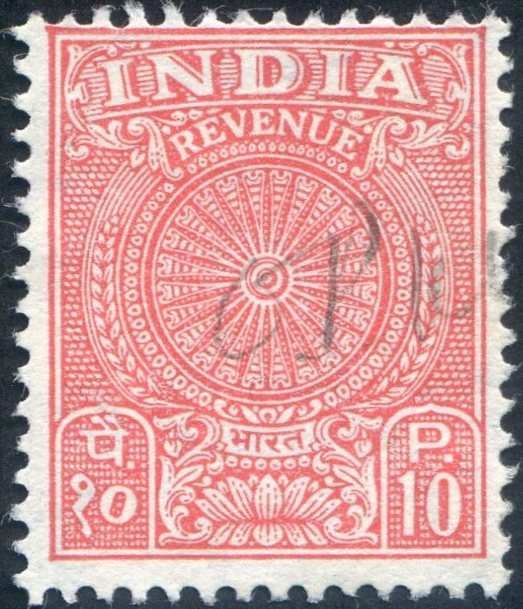 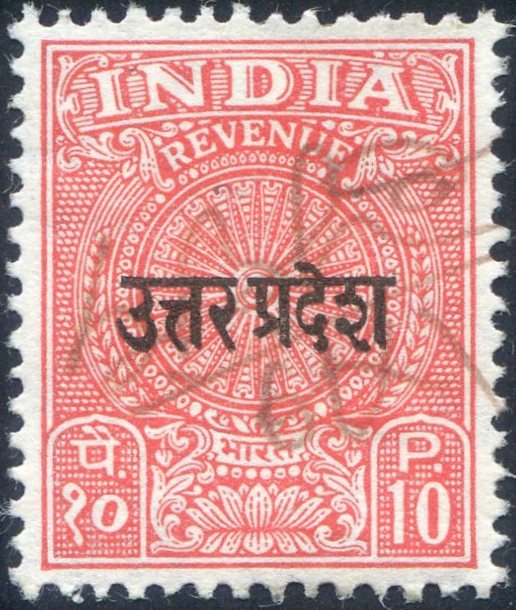 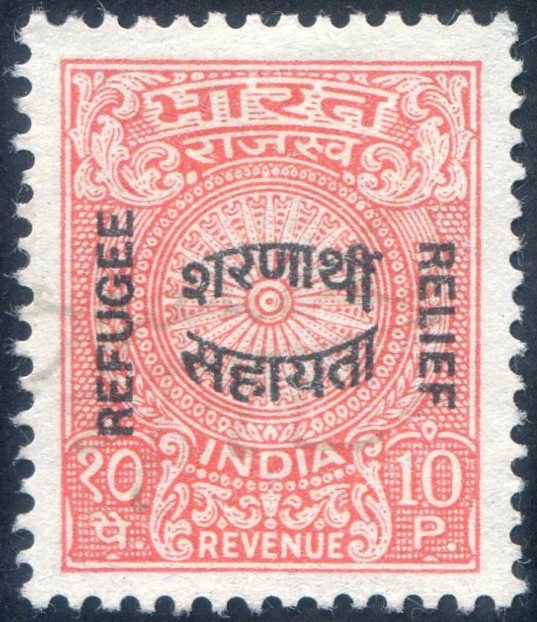 |
Send note to Staff 
|
|
|
Pillar Of The Community
United States
5894 Posts |
|
|
This design came out in 1985 in India. This is a basic revenue stamp. The 2008 Barefoot does not list a value of 10p for this series. I assume the second stamp is a local overprint, though the catalog makes no mention of that possibility. |
|
Send note to Staff
|
|
|
Pillar Of The Community
Canada
6525 Posts |
|
|
Bedrock Of The Community
Australia
38679 Posts |
|
|
Thanks Smauggie, there are two differing designs, or maybe they were se-tenant, with being bi-lingual. I have the 2000 Barefoot, I'll have a gander at that, Why I didn't check before I posted  My focus was generally on the "Refugee relief" I'll check James' issue also. The puncture in Her Majesty's eye, is a stationery Spike damage, when the revenue was collated in the office. |
|
Send note to Staff
|
|
|
Bedrock Of The Community
Australia
38679 Posts |
|
|
James Your stamp (Telegraph, normally found cut in half) does not appear to be listed in Scott, Barefoot, or Byrum. Letters in Overprint will be district which I cannot decipher. Have seen DELHI and BOMBAY Just wiki (See 1869) https://commons.wikimedia.org/wiki/...mps_of_IndiaMy stamps in order Stamp 1 1964 currency expressed as P, Barefoot#25 CV10c Stamp 2 ditto (Overprint unknown) Stamp 3 1971 Barefoot #2 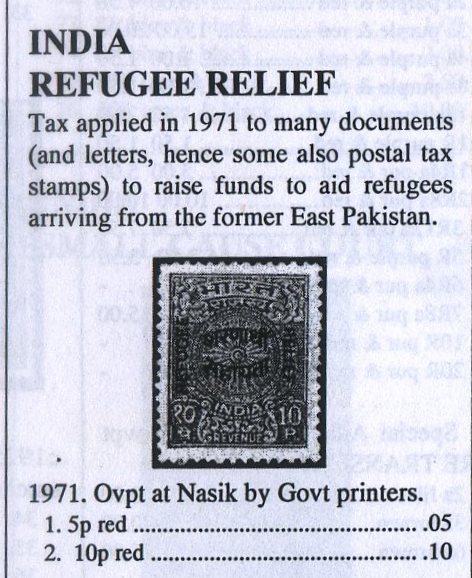 |
|
Send note to Staff
|
| Edited by rod222 - 03/13/2017 01:03 am |
|
|
Pillar Of The Community
Australia
3547 Posts |
|
|
Listed in the 2017 Gibbons Part 1. James's half 8 Anna used is listed at 1 Pound, unless it's watermark inverted. |
|
Send note to Staff
|
|
|
Bedrock Of The Community
Australia
38679 Posts |
|
|
Quote:
Listed in the 2017 Gibbons Part 1. James's half 8 Anna used is listed at 1 Pound, unless it's watermark inverted. Thanks Tony, any guesses of the opt? ALLAHA BAD ? or is that just one word? |
|
Send note to Staff
|
|
|
Pillar Of The Community
India
557 Posts |
|
|
Quote:
any guesses of the opt? ALLAHA BAD ? or is that just one word?
The Ilahabad mark is a telegraph cancel which is accompanied by date either at the right of the Telegraph Office name or below it. Here are the basic types of such Telegraph Office and Date cancelations. 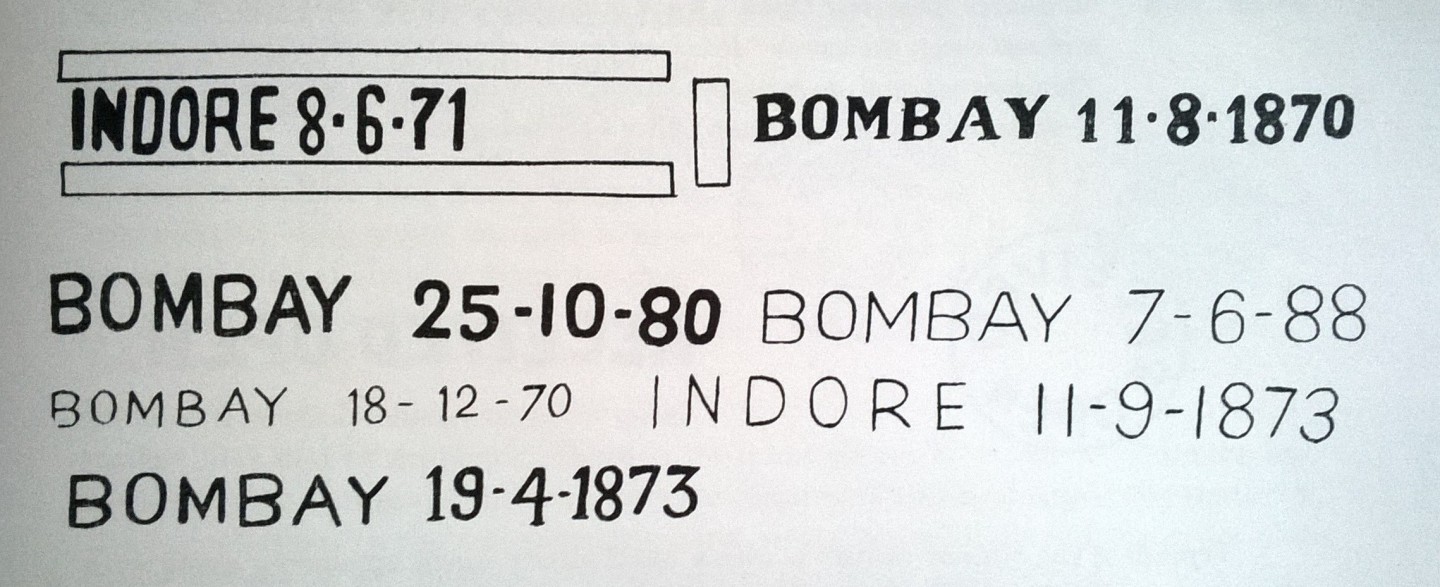 This type was the first telegraph cancelation of India, introduced on February 1,1869 following the Para. 6 of the Directorate General of Telegraph in India Notification dt. Dec 22,1868 issued by Daniel George Robinson, Director General of Telegraph in India (1865–77). The Rule for impressing these TO cancels was regulated in the Rule 181 of the Indian Telegraph Department Traffic Code Rule of 1879. Rule 181Every message draft, whether 'Sent', 'Received' or 'Transit', is to be legibly impressed with the name and date stamp of the Office to which it belongs; on 'Sent' drafts, the impression will be made across the stamps; on 'Received' and 'Transit' messages in the lower left hand corner of the form. When a message is written on more than one form, each form used must be stamped. In the case of bearing messages, the impression will be made across the 'Space for Stamp'. Each draft is examined by the Telegraph Master in charge to ascertain that it has been correctly disposed of.This cancelation type was in use till the abolition of the telegraph stamps with effect from April 1,1908 following the administrative reform by Trevor Douglas Davies Berrington, Director General of Telegraph in India (1907–11) vide Circular No. 120/104 dt. March 9,1908. Here is an example of complete striking of this telegraph cancelation type used by Ujjain TO used on F.A. Sent Inland Telegraph Form, introduced on December 1,1883. 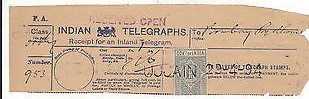 References: 1. Indian Telegraphs (1851–1914) Philatelic and Operational History of Indian Telegraphs. Ilyas Ahmad Patel and Dhanañjay Shantilal Desai. Desai and Company, Ahmadabad 1995 Chapter VIII: Telegraph Marks and Cancellations; pp.202-3 2. Indian Telegraphic Cancellations. Lionel Edward Dawson. The Philatelic Journal of India (Vol.XLVI No.3 March 1942), pp.34-6 3. Indian Postal and Telegraphic Cancellations. Kaus Hormuz. The Philatelic Journal of India (Vol.XLV No.6 June 1942), pp.73-5 4. Indian Postal and Telegraphic Cancellations. RF Stoney. The Philatelic Journal of India (Vol.XLV No.9 September 1942), p.118 |
|
Send note to Staff
|
|
|
Pillar Of The Community
India
557 Posts |
|
|
Ilahabad Telegraph Office was opened to the public for traffic on February 1,1855. Telegraph Map of India in 1855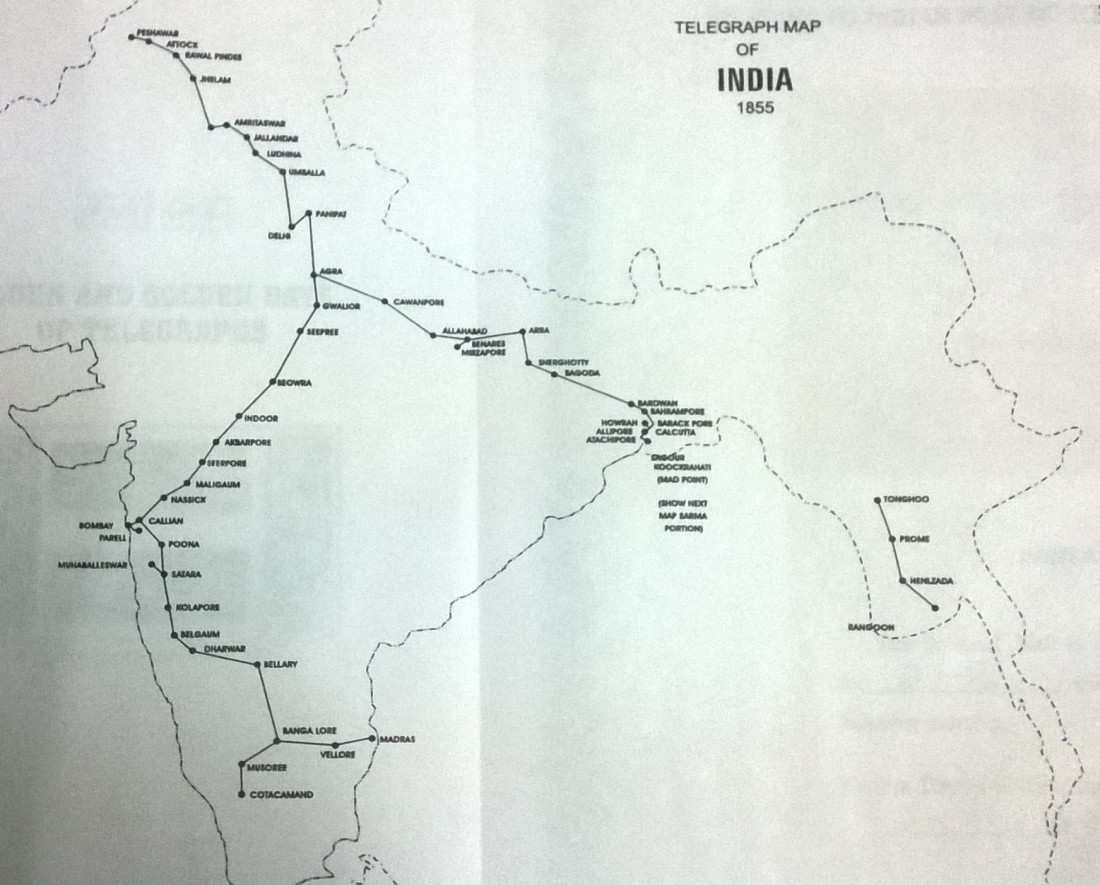 It was established in the Kolkata–Agra telegraph line, the construction work of which began in November 1853 and completed on March 24,1854. |
|
Send note to Staff
|
|
|
Pillar Of The Community
India
557 Posts |
|
|
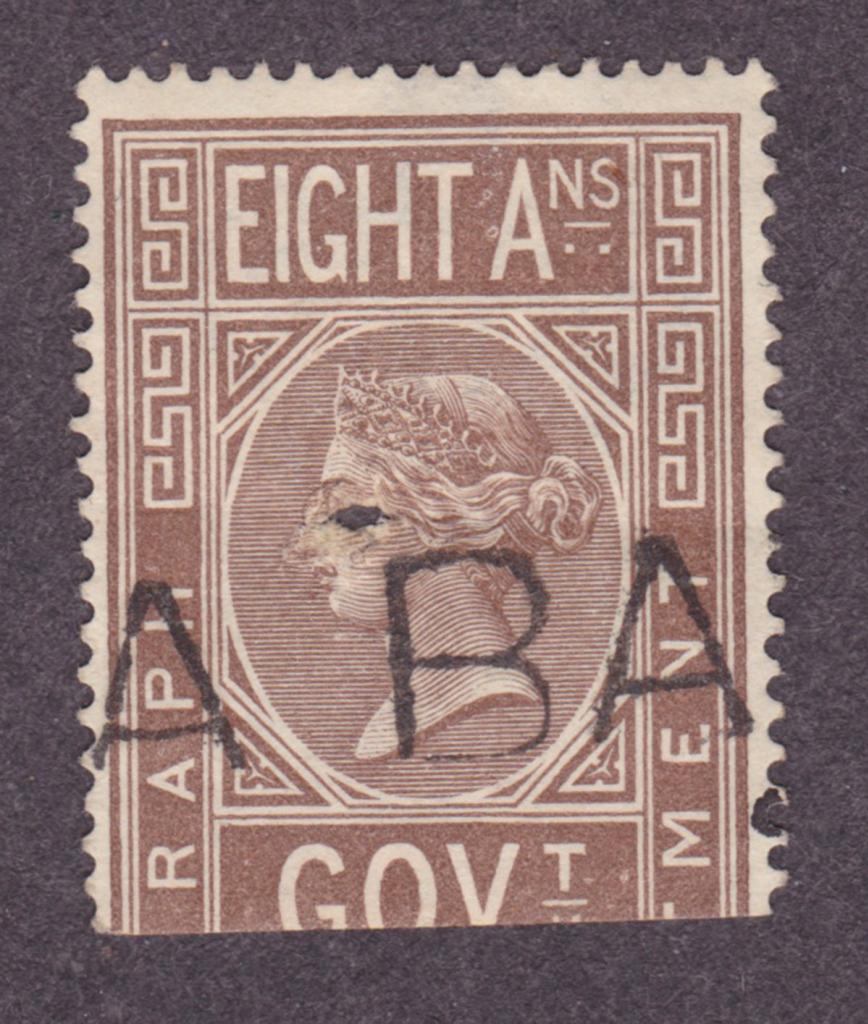 This can be either British India 1869 8A Vic. brown telegraph stamp (SG T7) if it has SG type T19 watermark or Br. India 1882 8A brown (SG T35) if it has SG type T25 watermark, both having perf.14. So, scan of the back is very important. SG Type T19 Watermark of Br. India 1869 Series Telegraph Stamps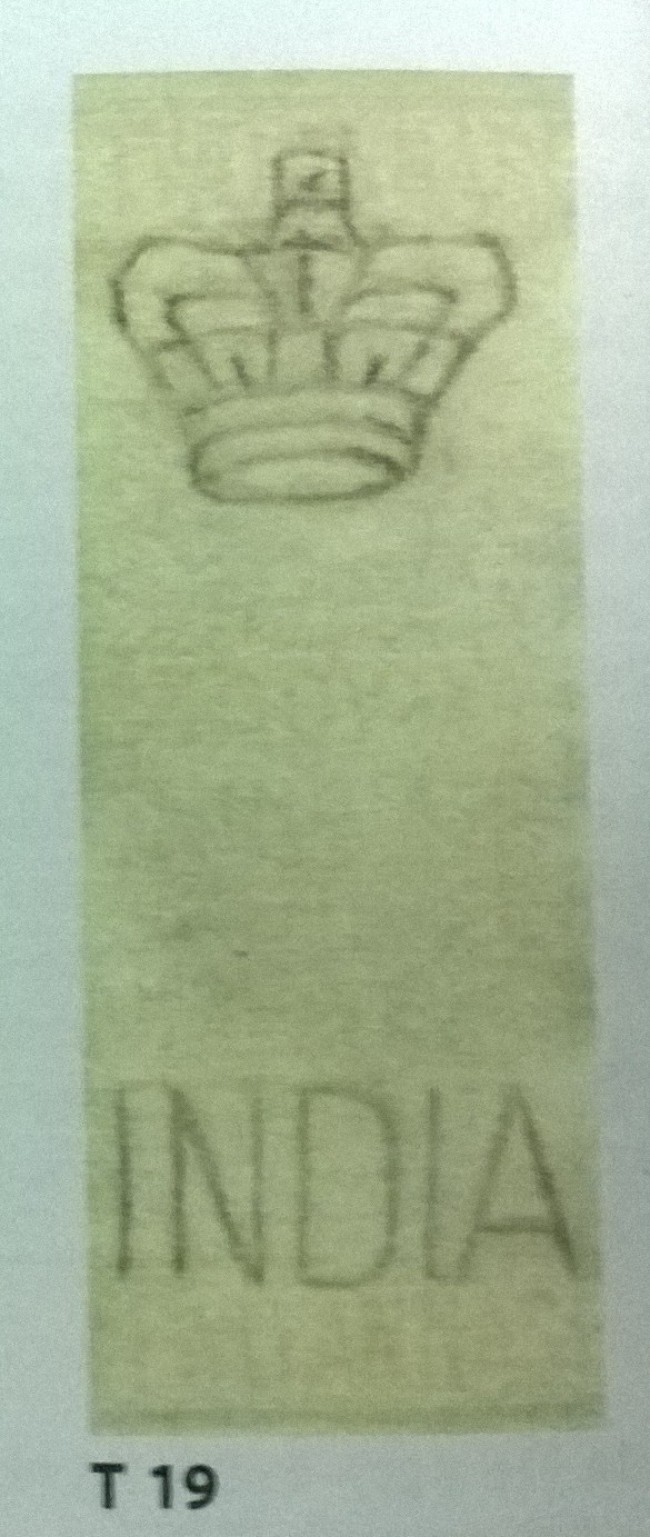 SG Type T25 Watermark of Br. India 1882 Series Telegraph Stamps SG Type T25 Watermark of Br. India 1882 Series Telegraph Stamps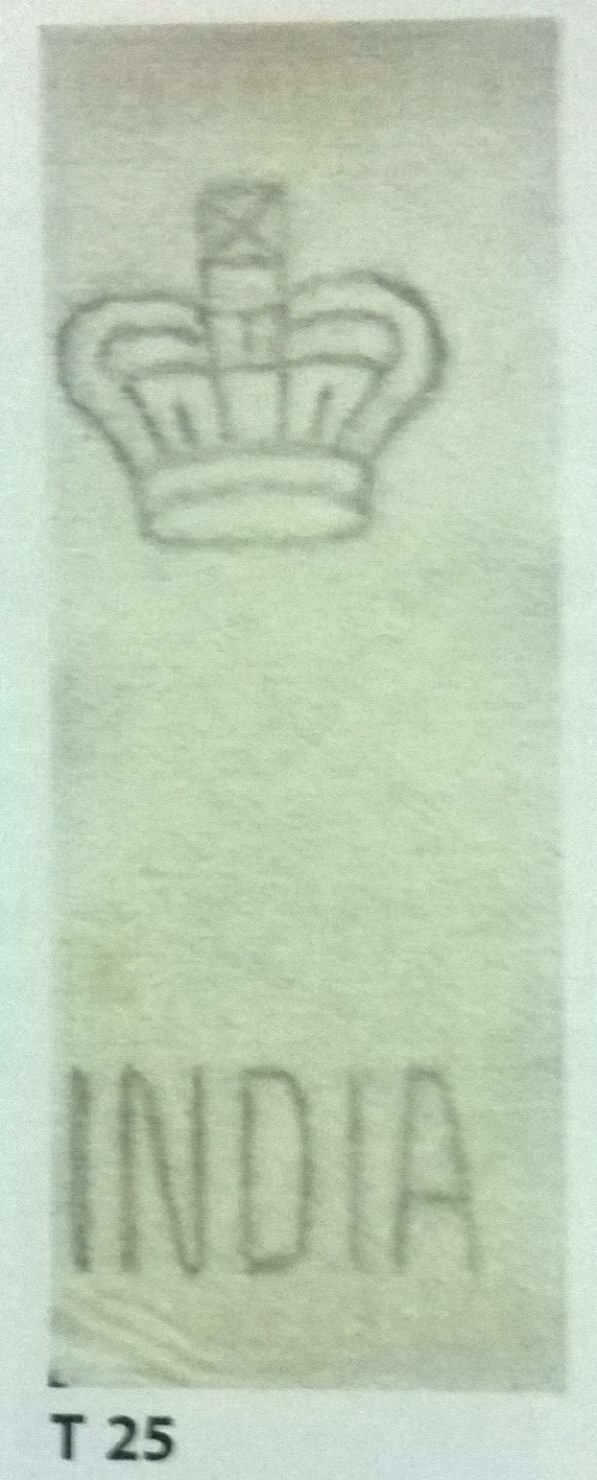 The complete stamp: 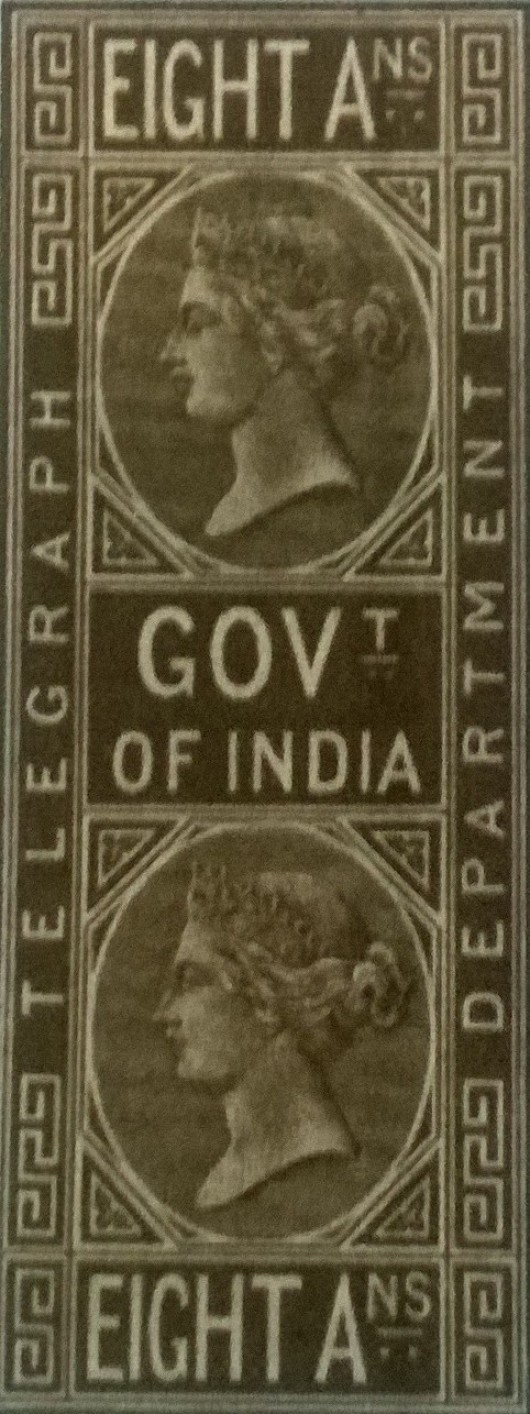 The value in SG Stamp Catalog India (2013 4th Ed.) for both SG T7 and T35 is £1 for the used upper halves of the stamps. The lower halves are extremely rare as those remained on the Telegraph Forms kept by the Telegraph Offices which were later destroyed. The whole used stamps are found with additional punched holes in the upper half. |
|
Send note to Staff
|
|
|
Pillar Of The Community
India
557 Posts |
|
|
Short History of Br. India 1869 8A (SG T7) and 1882 8A (SG T7) Telegraph Stamps
SG T7 was issued as part of the first double-headed telegraph stamp series, on February 1,1869 but the dates of registration of the plates (5) are as follows.
Plate No.B2 December 10,1866
Plate No.B1 December 14,1866
Plate No.B3 (Current No.87) June 2,1869
Plate No.B4 (Current No.88) June 16,1869
Plate No.B5 (Current No.284) dt. of registration not recorded
The 8A value was printed on paper with varying degrees of blueing and the imperf. variant (SG T7a) comes only from Plate B1 and it is recorded being used only in Kolamba in October 1878.
It also exists with watermark inverted and shades range from light brown to dark reddish brown which hopelessly Gibbons does not list.
The proposal for the double-headed telegraph stamps was first mooted by Daniel George Robinson, Director General of Telegraph in India (1865–77) in the official letter No.1036 dt. August 5,1865 which was principally approved in the official reply letters No.2450 dt. October 2,1865 and No.405 dt. January 12,1866 of the Under-Secretary to the Government of India.
In the follow-up reply from the DG in letter No.2391 dt. February 23,1866, total 2m quantity of 8A telegraph stamps worth R1m was proposed to get them printed from Thomas de la Rue and Company, London, England.
The main distribution of the 8A stamps were as follows.
Mumbai Treasury–12007 sheets
Kolkata Treasury–11047 sheets
Chennai Treasury–2163 sheets
The official notification for the sale of 1869 series to the public at Telegraph Offices and the Civil Treasuries was published in Telegraph Notice dt. December 22,1869, issued by DG Robinson, DG of Telegraph in India.
This double-headed series was also made available to the public in exchange of the old 1860 series telegraph stamps, vide, Telegraph Notice dt. October 5,1869 issued by Rivers Thompson, Officiating Secretary to the Government of Bng, published in The Kolkata Gazette dt. October 20,1869.
The 1882 series 8A stamp was printed from Plate B6 (Current No.311), registered on March 30,1882.
The printing of the 1882 series was ordered by Charles Robert Murray, DG of Telegraph in India (1877–83).
References:
1. The Postage and Telegraph Stamps of British India.
Charles Stewart-Wilson and Charles Stanhope Foster Crofton.
The Philatelic Society of India, Kolkata and Stanley Gibbons Limited, London, England 1907
Part II: Telegraph Stamps
Section II: The Double-Headed Issue, The Original Values; pp.160-5
2. Indian Telegraphs (1851–1914) Philatelic and Operational History of Indian Telegraphs.
Ilyas Ahmad Patel and Dhanañjay Shantilal Desai.
Desai and Company, Ahmadanad 1995
Chapter V: Telegraph Stamps; pp. 125-7, 135, 140
Annexure 5.1: Reference List for Telegraph Stamps; pp.149, 151, 156, 158
3. A Collection of the Catalog, Statutes and Notices Relating to Indian Post Office till the End of 19th Century.
Ed. Guna Balachandra Pai.
Philatelic Congress of India, New Dilli 1997
Part II: Notices Connected with the Issue of Postage and Telegraph Stamps, Envelopes and Postcards in India; pp.79-81
4. The Imperial Post Offices of British India 1774–1914 (Vol.II).
Mohinilala Majumdar.
Philatelia, Kolkata 1999
Part VI: The Philately–Postage Stamps and Stationery; pp.449, 452 |
|
Send note to Staff
|
|
|
Pillar Of The Community
India
557 Posts |
|
|
rod222 Quote:
James
Your stamp (Telegraph, normally found cut in half) does appear to be listed in Scott, Barefoot, or Byrum.
The telegraph stamps of Br. India are catalogued in Barefoot.  Telegraph Stamps of the World. John Barefoot Limited, York, England 2013 I have it but cannot find it right now in the mess. |
|
Send note to Staff
|
| Edited by Joy Daschaudhuri - 03/13/2017 4:57 pm |
|
|
Pillar Of The Community
Australia
3547 Posts |
|
|
The Indian (and Jammu & Kashmir) Telegraph stamps are listed in the 2017 Gibbons Part 1, Commonwealth & British Empire Stamps, 1840-1970.
Both versions of the 8 Anna are still listed at 1 Pound used. |
|
Send note to Staff
|
|
|
Bedrock Of The Community
Australia
38679 Posts |
|
|
Astonishing response !  Michelin 5 star quality. I am madly printing it all out for my Album. Thank you very much, Joy and Tony. Whew, that must inspire us to collect India. Quote:
I have it but cannot find it right now in the mess. That, I find hard to believe. |
|
Send note to Staff
|
|
|
Bedrock Of The Community
Australia
38679 Posts |
|
|
Replies: 52 / Views: 11,385 |
|




 Posted 03/12/2017 9:51 pm


