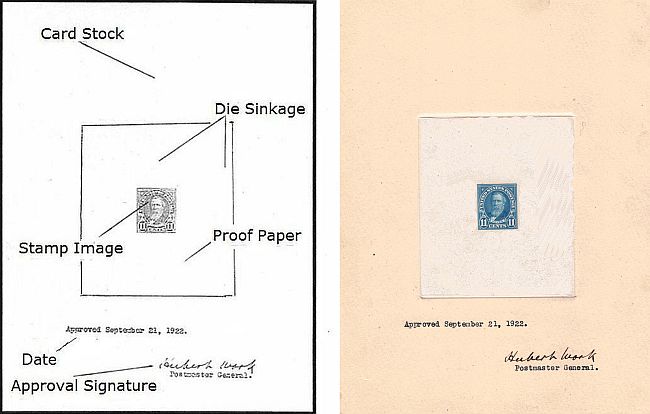
There seems to be some interaction among nineteenth century proof collectors, but not much among owners of later proofs. I'm going to try with proofs of the Fourth Bureau Issue (FBI).
What you might own can fall into several different groups of large FBI proofs.
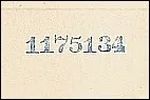
The most common proof group is the one with more than 200 proofs from the nine sets of proofs that PMG Harry S. New gave away as gifts. They are PMG signed and dated on 6 in. x 8 in. cards. 46 of the proofs have 6-digit proving room numbers on the card backings while the rest have 7-digit proving room numbers. The 6-digit proofs were pulled in 1929 when PMG New needed more proofs to help make up his gift proof sets; needing about 2 more proofs per issue. All of the other proofs were pulled and signed earlier, mostly when the original signed proofs were pulled; 1922-23, 1925. At least one of the sets is still intact.
A set of unsigned FBI proofs was bound into a leather album for presentation to Sir William Joynson-Hicks, the Postmaster General of Great Britain. The occasion was the International Stamp Exhibition in London in May, 1923. Even though the proving room numbers were removed from the proofs, they can still be identified by the binding on the side of the proof cards that bound them to the album. The album was broken up and the individual proofs were sold at auction in 1989. The cards are slightly less than 6 in. x 8 in.
It has been said that BEP Director Alvin Hall feared, when Democrat Franklin D. Roosevelt was elected President, that he would be replaced since he had been appointed by the Republican predecessor. Knowing that FDR was a stamp collector, he had all the stamp dies removed from the vault, cleaned, and pulled. A set of proofs was sent to the White House. Hall received an acknowledgement with the comment that FDR hoped he'd continue to do such a great job at the BEP. The FBI proofs are unsigned and have 6 in. x 8 in. cards with 6-digit proving room numbers. Their set was broken up in 1946.
There is a Siegel auction record from February, 1971 for a set of proofs owned by Rudolph Wunderlich that is described as "a 1923 set being mounted on thin 3 x 3½ cards." The dimensions and the thin card seem to imply that the proofs were trimmed down to the depressed die sinkage. I have not been able to track this set down.
There are 26 proofs of 14 different FBI issues that were once owned by engraver John Eissler. They are unsigned and the original proving room numbers were removed and replaced by counterfeit 5-digit numbers. Card sizes range from 6 in. x 8 in. down to various trimmed sizes.
A set of FBI unsigned proofs appeared in a 2001 Siegel auction. They had been trimmed to 120 mm by 152 mm and the control numbers were removed. The proof papers did not fully extend across the die sinkages. I believe that the proofs had at one time belonged to engraver Joachim Benzing.
A lot of eight different trial color proofs of the 1/2c Hale stamp came onto the market in a March, 2004 Siegel auction. A check of BEP proving room numbers showed that their numbers fell within a group of 16 Hale proofs that were pulled on 03/17/25 at the request of the Post Office Department. It is assumed that the eight missing proofs are also trial colors.
The following table lists other known large unsigned proofs that have 7-digit proving room control numbers. There are probably others that exist. It's hard to distinguish them from the unsigned Joynson-Hicks and FDR proofs when auctions do not specifically list the proving room number when it exists for a proof.

In total, fewer than 400 FBI proofs have fallen into collector hands. They are not commonly found on
ebay.





 Posted 12/24/2025 8:57 pm