Stamp Community Family of Web Sites
Thousands of stamps, consistently graded, competitively priced and hundreds of in-depth blog posts to read


Stamp Community Forum
 
Username:
Password:
Save Password
Forgot your Password?

This page may contain links that result in small commissions to keep this free site up and running.

Welcome Guest! Registering and/or logging in will remove the anchor (bottom) ads. It's Free!

Scott 651 Revisited: From Concept To Plate Blocks

 
To participate in the forum you must log in or register.
Author Previous TopicReplies: 6 / Views: 594Next Topic  
Valued Member
United States
74 Posts
Posted 12/26/2025   12:42 pm  Show Profile Bookmark this topic Add Hayes to your friends list Get a Link to this Message
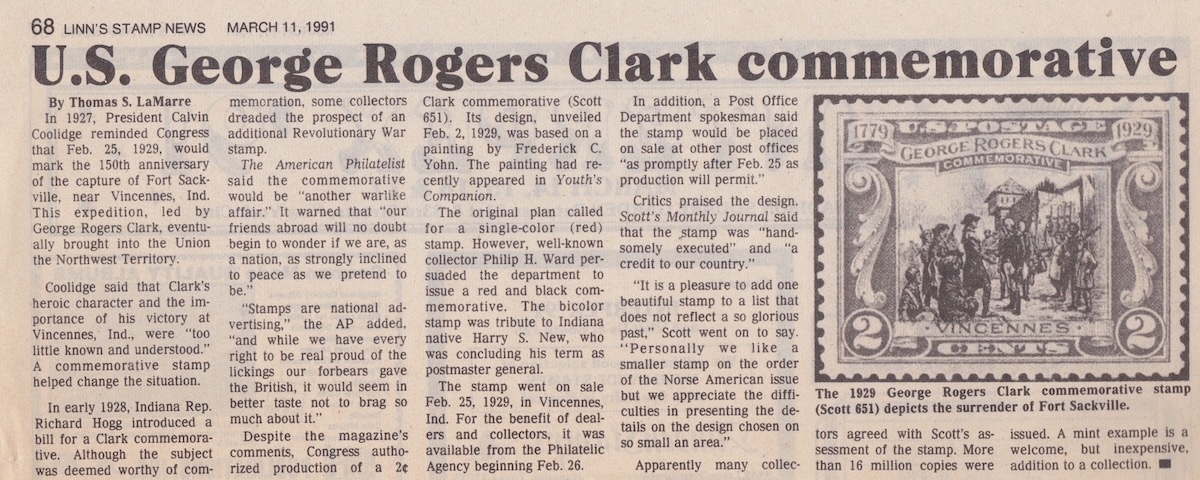
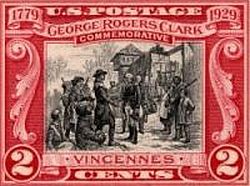
Scott 651 commemorates the 150th anniversary of the surrender of Fort Sackville near British controlled Vincennes (Indiana) to George Rogers Clark. His 1729 victory was the key to American forces gaining control of the Northwest Territory. He had also captured the British outposts at Kaskaskis and Cahoki the year before.

Frederick C. Yohn's painting "Surrender at Fort Sackville" inspired the central design of the stamp. He is best known for his painting of George Washington at Valley Forge.
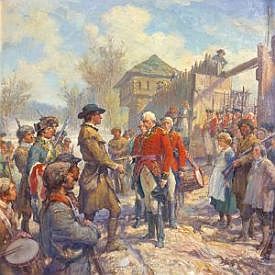
It was felt that a larger stamp format was needed to preserve the details of the design so the format was increased to 1 1/4 in. x 1 5/8 in., much like that of the Beacon Air Mail stamp of 1928 (Scott C11). That also gave rise to the concept of a bicolor stamp since the air mail stamp is bicolored. The planned frame would be carmine colored while the central design (vignette) of the new stamp would be colored black.
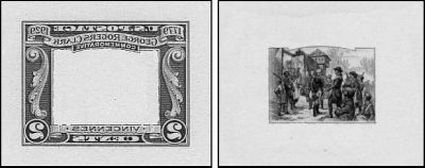
Since the flat plate printing press could only handle one color at a time, two stamp dies, one for the frame and one for the vignette were made. The engravings on the frame and vignette dies above hold mirror images of the planned design. The following bicolor die proof was made from the two dies.
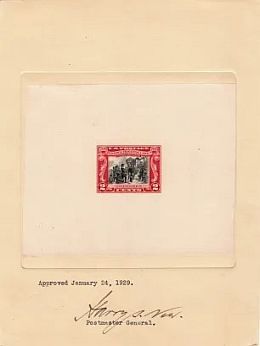
Postmaster General (PMG) Harry S. New, whose home state was Indiana, approved the final prepared image of the new stamp on January 14, 1929 by signing a die proof card that he received from the Bureau of Engraving and Printing (BEP). The return of the signed card to the BEP gave them the signal to prepare printing plates from the frame and vignette dies and start production of the new stamp.
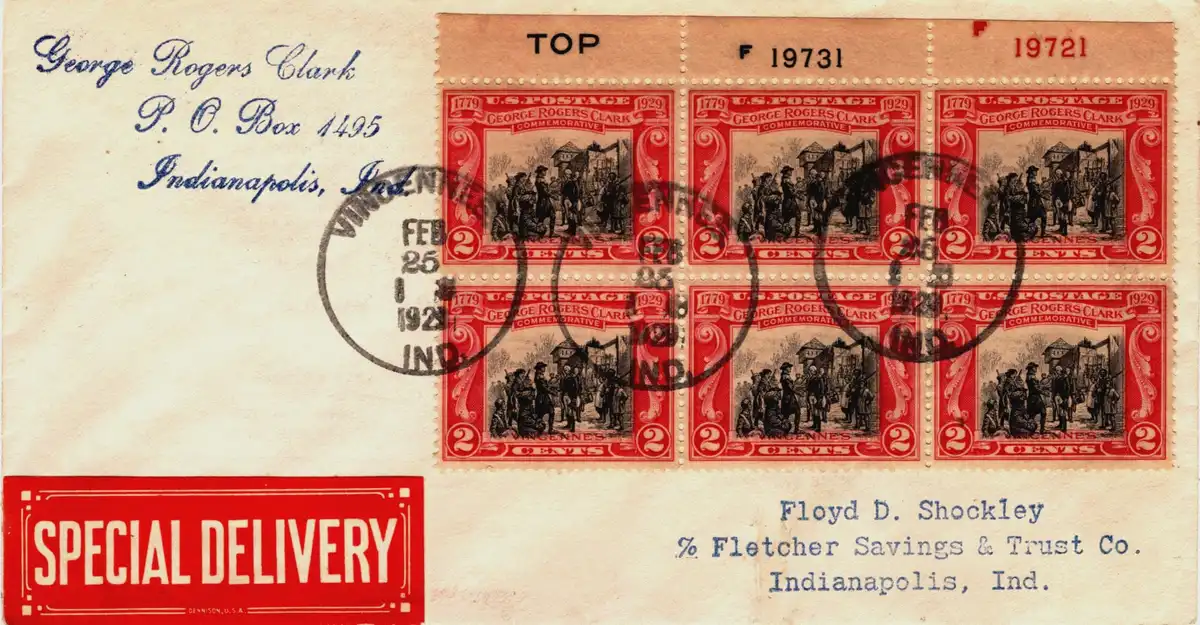
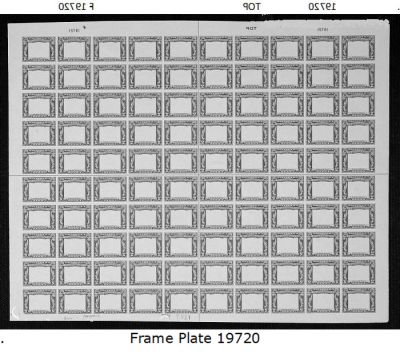
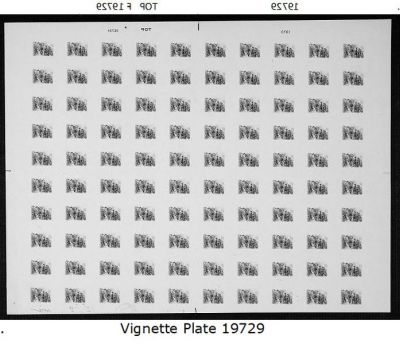
Two sets of printing plates would be required, one for printing the carmine frame and one for printing the black vignette. The plates would have only 100 stamp images because of the larger stamp dimensions. Plate number identifications would be engraved into plate top margins. The word "Top" was also added to the top margin of both sets of plates. That safeguard was to help press operators catch any final output where the frame Top and the vignette Top printed from each of the two press runs did not appear together. No more "Inverted Jennys". Illustrations of frame plate 19720 and vignette plate 19729 are shown below. Like the die proofs, the plate stamp images are mirror images of the stamp.
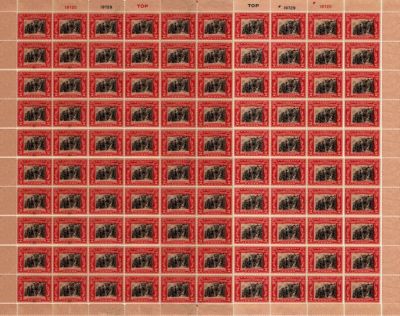
The printed press sheet after the frame and vignette press runs would then look like the following (17 in. x 13 1/2 in.). It would later be slit into left side and right side panes of 50 stamps each (8 1/2 in. x 13 1/2 in.) that would be sent to post offices.
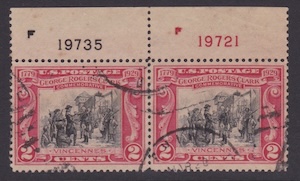
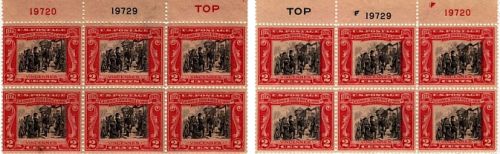
If we remove the plate blocks from the left side and right side post office panes, we would see the following collectable matched left side and right side blocks.
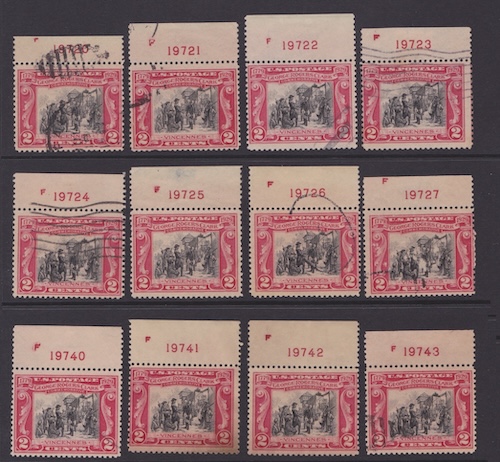
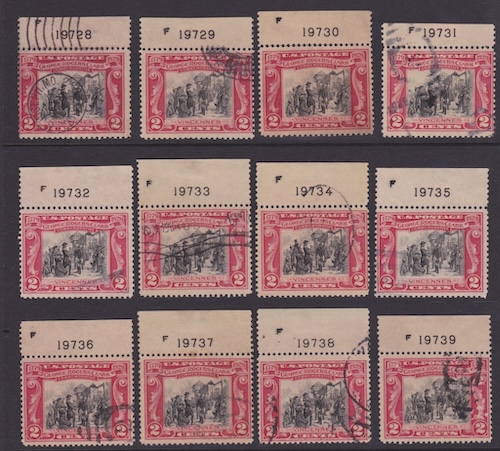
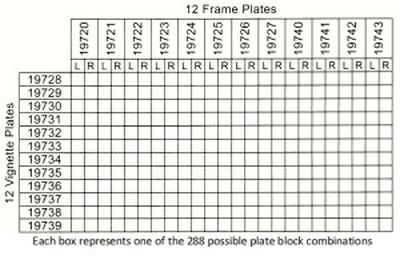
12 different frame plates and 12 different vignette plates were used to produce 23.4 million stamps in early 1929. Every frame plate number exists in a plate number block combination with every vignette plate number. Thus, a complete collection of left and right pane combinations means 288 collectible plate blocks (see chart below). Although there are no rare combinations, completion of a full set is difficult and mixed centering is to be expected. I have a full set.


Send note to Staff

Bedrock Of The Community
United States
10593 Posts
Posted 12/26/2025   1:09 pm  Show Profile Bookmark this reply Add revcollector to your friends list  Get a Link to this Reply
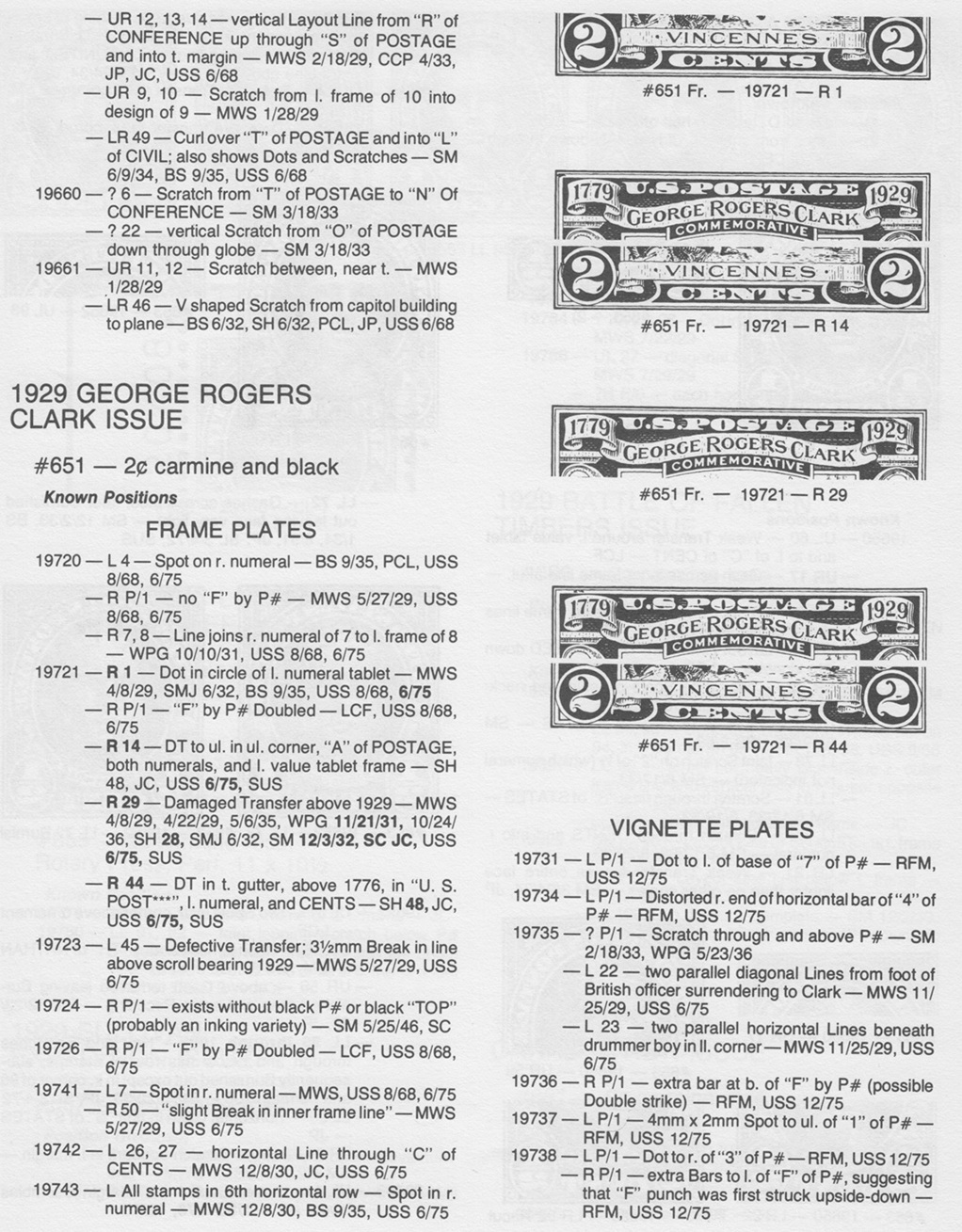
It also has three double transfers.
Send note to Staff  Go to Top of Page
Valued Member
United States
74 Posts
Posted 12/26/2025   1:46 pm  Show Profile Bookmark this reply Add Hayes to your friends list  Get a Link to this Reply
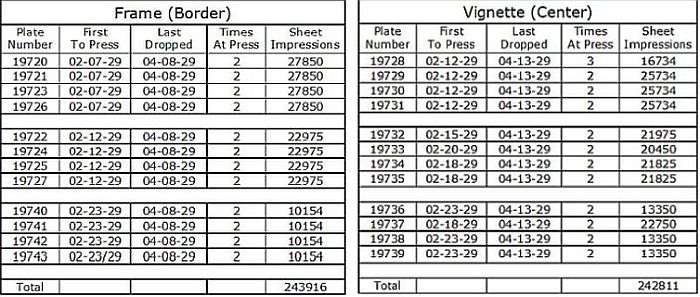
We do not know how common or rare plate blocks are with respect to plate number combinations. However, the following tables do tell us how many press sheets in total were printed from each plate. The numbers are from a Bureau Issues Association (B.I.A.) Plate Number Checklist published in 1990. Note that the frames were printed before the vignettes.

<center></center>
Send note to Staff  Go to Top of Page
Moderator
Learn More...
United States
5094 Posts
Posted 12/26/2025   2:39 pm  Show Profile Bookmark this reply Add Partime to your friends list  Get a Link to this Reply
Nice information. Thanks for posting. As revcollector noted, there are some recognized Double-Transfers, plus "French's Encyclopedia" notes several other fly-specking list, as follows:

Send note to Staff  Go to Top of Page
Pillar Of The Community
Learn More...
United States
1055 Posts
Posted 12/26/2025   2:57 pm  Show Profile Bookmark this reply Add ZebraMan to your friends list  Get a Link to this Reply
Such a pretty stamp, with so many different ways to collect variations of it.
I have plate number singles from each of the 12 red and black plates. Finding them as used pairs is much harder, I only have a few of the 288 combinations.


Send note to Staff  Go to Top of Page
Valued Member
United States
39 Posts
Posted 12/28/2025   6:17 pm  Show Profile Bookmark this reply Add Junius_Morgan to your friends list  Get a Link to this Reply
Great post. Where are the images of the frame and vignette by themselves from ?
Send note to Staff  Go to Top of Page
Valued Member
United States
74 Posts
Posted 12/28/2025   6:43 pm  Show Profile Bookmark this reply Add Hayes to your friends list  Get a Link to this Reply
Homemade. Reversed the stamp image and erased what wasn't necessary.
Send note to Staff  Go to Top of Page
  Previous TopicReplies: 6 / Views: 594Next Topic  
 
To participate in the forum you must log in or register.

Go to Top of Page

Disclaimer: While a tremendous amount of effort goes into ensuring the accuracy of the information contained in this site, Stamp Community assumes no liability for errors. Copyright 2005 - 2026 Stamp Community Family - All rights reserved worldwide. Use of any images or content on this website without prior written permission of Stamp Community or the original lender is strictly prohibited.
Privacy Policy / Terms of Use    Advertise Here
Stamp Community Forum © 2007 - 2026 Stamp Community Forums
It took 0.19 seconds to lick this stamp. Powered By: Snitz Forums 2000 Version 3.4.05