To participate in the forum you must log in or register.
| Author |
 Replies: 24 / Views: 9,379 Replies: 24 / Views: 9,379 |
|
Pillar Of The Community
United States
1946 Posts |
|
|
This thread was spawned by a set of comments on another thread. Rather than disrupt that thread I felt it best to start this, should any discussion happen to arise. I had written: Quote: Quote:
Ninety cents was a lot of money in the 1860s and 1870s and the USPS was uber-paranoid about getting ripped off - thus the reason for grills, experimental paper, and demonetization.
I tend to go along with what you said about the cancel on the stamp under discussion, Rileysan, and I follow the logic of your remarks here. But I am curious about your sources of information for the point I have specially highlighted. What is it that gives you the impression that the P.O.D. (not USPS) was uber-paranoid about getting ripped off in the 1860s and 70s? It is something that is "common knowledge" and generally believed, but based on what, if you don't mind my asking? Just curious. Rileysan replied: Quote: Quote:
What is it that gives you the impression that the P.O.D. (not USPS) was uber-paranoid about getting ripped off in the 1860s and 70s? It is something that is "common knowledge" and generally believed, but based on what, if you don't mind my asking? Just curious.
It may very well be speculation and/or tribal knowledge based on the grilling experiments of that time, but at least I have a quote from a reputable source to reference. I have no idea who Brookman cited as his source for the following statement ... From Brookman's book "The United States Postage Stamps of the 19th Century" Vol II pg 67 Quote: Quote:
In the years between 1860 and 1870, the Government became much concerned over the real or imaginary cleaning and reuse of postage stamps. Inventors turned their talents to the perfecting of devices to eliminate the possibility of cleaning stamps so that they would look unused and thus be in such condition that they could be used the second time without detection by the postal authorities.
During this period the Government failed to provide the smaller Post Offices with cancelling devices and the common practice of using a pen to cancel the stamps on the mail made it rather easy to make these stamps appear unused with the aid of a little ink eradicator.
That reply spurred the following, somewhat rambling, narrative from me: Brookman. Excellent. Thank you. Brookman associates the "paranoia" image with the POD in conjunction with the grilling experiment. That is the sort of thing I suspected. If you look at the paragraph just ahead of the one you cited, he lists the names of prominent philatelic students, some who were still living and some already deceased, whose works he consulted back in the 1930s when he was pulling all that together in his Notes On the Grilled Issues of the United States publication. Specifically, he got material or advice or both from E. Perry, H.L. Wiley, J. Klemann, and C. Brazer - all were dealers and/or philatelic consultants at the time. He also looked at published work by W. Stevenson, J. Tiffany, J.B Leavy, and J. Luff. These men were editors or columnists for philatelic publications in the decades around the turn of the twentieth century. You will notice that Brookman does not reference the actual works he consulted, but merely names the authors. Because of their importance to the hobby; their lines of access to people, material, and information; and the overall quality of the work they did, these men had virtually become unquestioned authorities in the field by the time Brookman put his work together. In 1966 Harry Lindquist and Company published a three volume compilation of Brookman's work which he had edited together for them. At the time it was the sine qua non for early stamps of the United States, available at $10 per volume. Ten years later, in 1976 at Interphil, they displayed the three volumes, though with the tag that the set was out of print. Nonetheless, I got a set from them then for the original price. Not long after that the set shot up to $125. But it is available for free download from the USPCS website, for which Rileysan has kindly provided a link. What happened? A few years ago the USPCS acquired the rights to the Brookman books, with the intention of splicing in updated information and new discoveries since the time Brookman did his work. They appointed a committee to oversee each of the sections by issue and a general editor to pull it all together. The plan was to keep to the layout Brookman had used and just expand everything. But the new editor discovered that it would not be possible to stay with the original core of Brookman's work, in part because much of the more recent study not only supplemented what he had done, but actually had to replace it. In fact, the amount of revision was so extensive that the new work was becoming the "Non-Brookman Brookman." Section editors and contributing scholars left and right began abandoning the project, and in the end, the "New Brookman" project was scrubbed. In order to get primary source information on stamp production, men like those who had advised or influenced Brookman, had to be "gentlemen." They had to know how to develop connections with their informants in the government and stamp production fields, and discriminate what could be said, or not, in their journals. In this world, there was plenty of call for horn blowing, but not much patience for whistleblowing. So the dirty little secrets involved in the business of getting the nation's stamps produced, tended not to get published or discussed, not even in the oral tradition that gave rise to the aura of authority those men enjoyed. Elliot Perry used to chafe about that situation. His famous motto "Less bunkum and more facts" was a signal call for documentation of some of the interpretive stories surrounding those early stamps. What Brookman published is well documented when it deals with the physical aspects of the material he discusses, but when it comes to the "who" and in particular the "why" of the story, things tend to slip. Independent studies in recent times by students working with the grilled issues from 1867, such as my friend Richard Drews, have come to some of the same conclusions as I have from our examination of material not previously reported in the literature. These have led us to new readings of the terms of contract and correspondence between the government and those who were, or wanted to be, stamp producers. Not surprisingly, we're finding it was a cut-throat business, and the motivations for conducting it were not as altruistic as the pictures sometimes might suggest. Rich is not far from publishing his work on grilling and the issues involved in that. So, I will hold off on giving another view of the question of government paranoia until he has brought his study out. My work on the Philadelphia Bank Note Company is well along, as well as studies of uncataloged material among the experimentals, patented and otherwise. These studies will take a rather different approach to discussion of the men and companies involved in "the business" than what Brookman and his confreres were willing or able to do. When I acquired the Brookman books, I felt I had reached a milestone in my development as a philatelist. For me it marked the final turning point in my transition from a general collector to a specialist, just as Barbara Mueller's United States Postage Stamps had transitioned me from a world collector to a U.S Specialist in my teenage years. At the time, the information in Brookman far exceeded what I and even most advanced students knew about 19th century US stamps, and gave it a kind of nobility. But the discoveries since Brookman are set to make the 21st century collecting of early US every bit as exciting and revealing as his efforts were in the middle twentieth century. As for nobility, it will go where it is deserved. It's a good time to be in the hobby. |
|
Send note to Staff
|
|
|
|
|
Pillar Of The Community
United States
2963 Posts |
|
|
Quote:
Not surprisingly, we're finding it was a cut-throat business, and the motivations for conducting it were not as altruistic as the pictures sometimes might suggest This sounds like it has the makings of a Hollywood movie  Quote:
Rich is not far from publishing his work on grilling and the issues involved in that. So, I will hold off on giving another view of the question of government paranoia until he has brought his study out I look forward to reading it! Please keep us informed when it is released. Quote:
When I acquired the Brookman books, I felt I had reached a milestone in my development as a philatelist. For me it marked the final turning point in my transition from a general collector to a specialist, just as Barbara Mueller's United States Postage Stamps had transitioned me from a world collector to a U.S Specialist in my teenage years. At the time, the information in Brookman far exceeded what I and even most advanced students knew about 19th century US stamps, and gave it a kind of nobility. But the discoveries since Brookman are set to make the 21st century collecting of early US every bit as exciting and revealing as his efforts were in the middle twentieth century. As for nobility, it will go where it is deserved. In many ways I feel the same way about SCF when I joined more than 3 years ago. I hope that doesn't sound ridiculous, but this site is the first place I go to to search or ask for information. As a rule, the people that contribute to this site are helpful and insightful (and at times, inciteful :)). If answers aren't readily available, they know where to find it! Quote:
It's a good time to be in the hobby. It is indeed! Brian |
Send note to Staff 
|
|
|
Pillar Of The Community
United States
2547 Posts |
|
|
Just a few thoughts about reuse prevention. I has spend a lot of time over the past 10 or so years researching reuse prevention techniques and the paranoia began long before the 1860's. In my research I have found over 160 different reuse prevention techniques. Below is a short introduction to reuse prevention that I wrote a few years ago. The United States Government had concerns that it was suffering substantial loss due to the reuse of both postage and revenue stamps. Although they were probably experiencing significant loss with revenue stamps, the loss due to reuse of postage stamps was much exaggerated. Several letters from the archives of the National Postal Museum show that concerns of stamp reuse surfaced almost as soon as the first stamps were issued. The adhesive stamps were first issued on July 1, 1847. The first is a letter from James Buchanan, Baltimore postmaster, dated October 21, 1847 to Postmaster General Cave Johnson: "Sir
My attention has been elicited in several instances to the imperfect, and ineffective, manner in which post office stamps are cancelled. A gentleman of this city called a day or two ago, to show me an instance, in which, by a very slight process (which he said was done by way of experiment) the canceling marks were extracted, and the stamps made to assume so perfect an appearance that it was passed through the office a second time. I have enjoined a more minute investigation of these stamps, when they come into this office, and also, instructed the clerks to be careful in canceling them in the most effectual manner. But I beg leave, respectfully, to suggest that the present mode of doing this, by means of the instrument furnished by the department to the post offices, is not sufficiently secure against fraud, it appears to me, that a sharp instrument that would cut, or pierce, instead of simply to make an impression, would be a desirable, at all events, in my opinion Post Masters throughout the country should be instructed to mutilate them with more care than my observation leads me to believe are generally done."Undoubtedly, the Department received other letters expressing similar concerns. The following is a excerpt from a letter by J. J. Ayres post master at Williamsport, Pa , dated January 4, 1848 in reply to letter of December 30, 1847 from the Third Assistant Postmaster General: "In answer to yours of Dec 30/47 I will say and acknowledge that one solitary letter only has been offered at this office with stamps attached, that one was a hard looking stamp and my honest opinion was that it was not genuine, or that it had been in use, and the ink extracted and my clerk who is nearly 21 years of age, formed the same opinion, there has been several stamps received that the look upon them, to distinguish that they have been in use, were so lightly done that a person could not have discovered it without a close examination and it is the opinion of many in this place that they could extract the ink and pass them again to clerks when postmasters are not in."This letter was a response to the Third Assistant Postmaster General concerning the reuse of postage stamps. Since the first sentence references an inquiry from the Third Assistant Postmaster General it indicates that the Department was attempting to assess the magnitude of the reuse problem. In March 1848, the Department requested input from the stamp printer concerning the reuse problem. The exact content of the Department's request is unknown but the reply from Rawdon, Wright, Hatch and Edson is in the archive. Excerpts of their letter to Cave Johnson, Postmaster General, dated March 18, 1848 follows: "The present mode of canceling the stamps is no doubt very insecure, and we would suggest some method of defacing the stamps by cutting them, in such a way as effectually to prevent those being used a second time, without injuring the letter.
We gave Mr. Sibley a readily made tool design for that purpose, and can send to your address another somewhat improved, by having finer teeth, and being rounded at the outer edges, so as not to cut too deep and thereby injure the letter.
If this principle is adopted we can improve upon the manner of applying it, by making some experiments – Mr. Morris thinks it will answer a better purpose than any other he can think of.
If this mode of canceling is adopted, it would probably be best that the stamps should be cancelled at the place of destination, instead of the place of departure as now done.
We would undertake to supply the Department with these canceling drills or bitts (sic), on as favorable terms as they can be procured elsewhere." The U.S. Attorney G. W. Clinton of Auburn, N.Y. was referred a letter with a suspect stamp. After his initial examination, he took it to the postmaster at Rochester, N.Y. for opinion. He stated that he initially thought it was counterfeit but, after re-evaluation with the Rochester postmaster, determined that it was probably chemically cleaned. He submitted it to Postmaster General Cave Johnson for review. In his letter of August 15, 1848 he stated: "I suspect that the stamp is genuine – that it has been once ink-cancelled – and that the chemical process asirted (sic) to remove the cancellation has produced its changed color and appearance."The suspect stamp was sent to Rawdon, Wright, Hatch & Edson for their evaluation. Their reply to the Third Assistant Postmaster General indicated that the appearance was due too chemical cleaning to remove the cancellation. These early Department communications clearly indicate that there were concerns of fraudulent reuse of adhesive postage stamp very early after their release. As the public became aware of these fears numerous individuals and enterprises recognized the market potential for methods of reuse prevention. Most of the early ideas were related to more effective mechanical canceling devices with the Norton hand canceller patents starting to appear in the late 1850's. This was the start of the patent cancel with many designs that cut, punched or otherwise damaged the stamp design during cancellation. During this same time efforts were started to combat reuse through the design or manufacture of the stamps. Toppan, Carpenter & Casilear produced essays of the 3¢ with a varnish based ink which is one of the earliest reuse prevention experiments in stamp production. In 1861 the contract for supplying postage stamps was awarded to the National Bank Note Co. and the emphasis for reuse prevention was increased. Charles F. Steel, Superintendent of Stamp Production at the National Bank Note Co., was closely involved in the development and testing of numerous reuse prevention ideas. They produced essays of their processes and also those submitted to them from the Post Office Department and the public. In 1862 the Bureau of Engraving and Printing was founded for the printing of currency, securities and revenue stamps. Spencer M. Clark, first director of the BEP, was also concerned with possible reuse and was the patent holder on a reuse prevention process. George Casilear, Superintendent of Engraving, also held multiple patents. About 1863 the National Bank Note Co. started working with safety overprints some of which used fugitive ink. In 1864 Charles Steel began his experiments with embossing, his term for grills. About this same time the National Bank Note Co. started producing essays for a number of patents. From the Twenty-Eighth Annual Report of the Post Office Department for the fiscal year of 1863, pages 19-20: "During the past year indelible canceling inks have been used at the principle post offices, and the employment of printing ink for cancellation – the latter being much more difficult to efface than the ordinary writing ink – has been continued at the smaller offices.
It is not believed that the department has ever suffered any considerable loss from the use of washed or restored stamps, yet there has been a constant endeavor, either by the introduction of some effectual method of cancellation, or by a peculiar process in the manufacture of the stamps, to render impossible a second use thereof for the payment of postage. No improvement of this nature has yet been perfected, though much attention has been given to the subject, and many ingenious devices for this purpose invented. Instruments for cancellation, with cutting or abrading edges, have been submitted by various parties, and upon being thoroughly tested were found to be inherently defective, owing to their liability to injury, or to be injured by, the contents of letters or packets. These instruments, furthermore, speedily become dull or disarranged by ordinary use, requiring frequent sharpening or adjusting.
After much thought, and a thorough consideration of the many instruments and devices which were submitted or suggested to the department to attain the desired result, the conclusion has been reached that the only certain means of effectual cancellation is in the preparation of the stamps in such manner that, when once affixed to a letter, they cannot be removed therefrom without involving their destruction; or by their being printed in colors sufficiently permanent to resist the actions of air and light, but which would readily be effaced by any agent intended to remove the canceling marks. Three varieties of postage stamps, alleged to possess one or the other of these qualities, have been submitted to the department, and their respective merits are under consideration."The three varieties referred to in the report were probably the Samuel Francis chemical paper, Henry Loewenberg decalcomania and Abram Gibson fugitive ink. These three processes were documented as tested by the Post Office Department during the 1863-1864 time period. The National Bank Note Co. produced essays for Henry Loewenberg's patents for decalcomania, starched surface paper and chemical paper processes. The also produced the essays for William Wyckoff's soluble washed paper process and George W. Bowlsby's coupon design. It is not clear as to which essays were produced under contract with the patent holder, which were produced for possible use by the National Bank Note Co. and which may have been produced under direction of the Post Office Department. The National Bank Note Co. also produced essays of the Samuel W. Francis chemical paper probably in the latter part of 1864. The Third Assistant Postmaster authorized a test of 1,000 stamps at Newport, RI of both the 3¢ value and the 2¢ Blackjack plate 31. Testing was completed by March 30, 1865. This was the first reuse prevention process to be released by the Post Office Department for public distribution and sale. The Francis patent was not adopted by the Post Office Department. The National Bank Note Co. continued with experiments for reuse prevention with Charles Steel receiving patents for his grill process, double paper process and later for his water-leaf paper process. James MacDonough, one of the National Bank Note Co. founders, also received multiple patents including a fugitive ink process and a shellac pattern process. In addition to these patents numerous non-patented ideas were tried. In December, 1867, the Internal Revenue Bureau issued the following advertisement: Treasury Department Washington, D. C., December 24, 1867. All persons desiring to furnish designs for internal-revenue stamps, or plans for their cancellation, are requested to submit them for examination at this office prior to February 1, 1868, with a view to their adoption if found to be satisfactory and effectual. Particular attention is called to the desire of the Department to procure such a stamp and adopt such a method of cancellation as shall effectually protect the Treasury against losses from counterfeiting and from the restoration and re-use of stamps. Persons submitting propositions are requested to state the terms upon which their plans, designs, and stamps are offered to the Government. Each plan submitted will receive careful attention. E. A. Rollins,
Commissioner . This advertisement brought in numerous responses and created many patent applications. Most of the patent applications referenced the coverage of both revenue and postage stamps. By the time the Internal Revenue Bureau advertisement had been published the Post Office Department had been working with the National Bank Note Co. for reuse prevention for several years. By early 1867 the main areas of experimentation and development were with the embossing process, fugitive inks and safety under and over printing of fugitive designs. During 1867 the National Bank Note Co convinced the Post Office Department that the embossed grill was the best option for reuse prevention. The report of the Postmaster General, dated November 26, 1867, stated: "Experiments are in progress with a postage stamp printed on embossed paper, which seems to afford good security against fraud. The fibres of the paper being broken, canceling marks almost necessarily penetrate, so that they cannot easily be removed without destroying the stamp. The adhesive properties are also promoted and other advantages secured which commend the invention to favorable notice."The Post Office Department renegotiated the contract price and required that all ordinary postage stamps would require embossing. In 1868 the new stamp production contract was advertised and it carried the following requirements: "The stamps must be prepared in such a manner that any attempt to remove them from a letter or packet will so mutilate them as to render them useless.
Special proposals for stamps on embossed paper as now in use are invited."Three of the four firms submitting proposals for the new contract included the embossing requirement. George T. Jones and Butler & Carpenter also submitted proposals for designs with other reuse prevention techniques. With the introduction of the new 1869 series of stamps the National Bank Note Co. produced numerous essays that featured a very prominent fugitive underprint design and other reuse prevention processes. On October 3, 1868, Alex. W. Randall, Postmaster General, in a letter to the National Bank Note Co. stated: "It is a condition of this acceptance that stamps of new designs are to be furnished, including a combination of colors in the same stamp (limited to four of the higher denominations) and the use of fugitive inks and colored paper, if required for all denominations, and that a contract is to be executed to take effect from the date when such stamps of new and approved quality and designs shall be actually delivered for use upon orders of postmasters, through the Post-Office Department." During the 1870's there were numerous privately produce reuse prevention essays many of which used the current postage stamps with their alteration. Some of these ideas were patented and many were not. These ideas were quite varied and often unusual, ranging from cut designs to explosive percussion cap canceling. There were also a number of privately printed essays that were submitted for consideration. In 1873 the Continental Bank Note Co. was awarded the stamp production contract and both Charles Steel and James Macdonough joined Continental. The work of reuse prevention continued and the Continental Bank Note Company produced several essays. These essays included sensitive inks, fugitive tinted paper, ribbed papers, chemical papers and fugitive inks The Continental Bank Note Co. essayed two different types of chemical papers. The first type was a Samuel Francis process. The second type was a different process that was printed on a pinkish purple reactive paper. In 1875 the Post Office Department authorized the production of stamp with the Charles Steel patented compound double paper. From January 1, 1875 until April 15, about 28 million such stamps were issued. They were ordered withdrawn on April 15 because of complaints from postmasters that the top layer of paper had a tendency to shrink away from the heavier backing causing tears, curling and separation of the layers created inventory count problems, loss of time, and great waste of large amounts stock that was returned from the local post offices. Charles Steel also reintroduced the embossed grill at the Continental Bank Note Co. It was very short lived and ultimately rejected by the Post Office Department. This was the rare Continental J grill. In 1875 he also produced his water-leaf paper; this is often referred to as "starch surface" which is a very inaccurate descriptor. In 1877, the Post Office Department requested stamps with the cut design for testing. The process was based on the Addison Fletcher patent. The stamp was produced by the Continental Bank Note Co. and had eight "U" shaped cuts. The Continental Bank Note Co. produced and delivered 10,000 copies of the 1¢ (Scott 156) and 3¢ (Scott 158) with the Fletcher punch, commonly referred to as the "cogwheel punch". The number of each denomination is not known but it is believed that it may have been 1,000 of the 1¢ and 9,000 of the 3¢. The Post Office Department used a few copies for testing and the rest were released for public sale through the Washington post office. One of the companies submitting proposals for the 1879 contract was the Philadelphia Bank Note Co. Among their essays were a fugitive ink process and a chemical paper process which is probably based on the Louis Ehrhardt patent. In 1879 the American Bank Note Co. was awarded the stamp production contract and Charles Steel joined American. Several reuse prevention essay were produced including varnished paper, chemical papers, fugitive surface tinted papers and both the Gideon B. Massey and the Douglas pattern punched double paper. By the time of the award of the stamp production to the Bureau of Engraving and Printing in 1894 the reuse prevention emphasis had almost totally disappeared. Although an occasional patent application was filed and a few essays were privately produced this simply slipped into obscurity. |
|
Send note to Staff
|
|
|
Rest in Peace
United States
7097 Posts |
|
|
What a very interesting and fascinating read! I want more!
"These ideas were quite varied and often unusual, ranging from cut designs to explosive percussion cap canceling."
I have seen an example of these both used and unused...It seemed very dangerous to have gunpowder inside of a stamp much like a child's cap from the old cap-guns of our youth. Can you imagine all the noise they would make in the post offices if these had been adopted? And just imagine all the letters catching on fire and blowing holes clean through grandmas Christmas card?...ha-ha!..
I'll see if I can locate an image of one of these stamps. |
|
Send note to Staff
|
|
|
Rest in Peace
United States
4052 Posts |
|
|
Greetings, Russ:
Thank you for sharing you research; what a job you've done!
This thread brought to mind two NYTimes pieces that have been floating around my hard drive:
- October 16, 1862 How to Prevent Fraud in the Cancellation and Use of Postage Stamps
Executive summary: fugitive ink.
Not only did the problem start early, but it persisted:
- May 21, 1929 Seized As Dealer In Washed Stamps
A 'nationwide' crime ring was said to have 'swindled the government out of hundreds of thousands of (ed: 1929!) dollars'. They 'posed as philatelists', approached clerks at businesses that would receive mail with higher denominations, washed the stamps chemically, and sold them for 70% of face value (no comment).
They were undone by the absence of 'mucilage', so score one for the MNHOG crowd.
Again: thanks, Russ.
Cheers,
/s/ ikeyPikey
|
|
Send note to Staff
|
|
|
Pillar Of The Community
United States
2963 Posts |
|
|
Thank you for sharing your research, Russ. Very interesting reading!
Have you published any of this work before, and if so, where?
Have you worked with anyone else on this research (EG - Richard Drew and/or Essayk?)
I noticed mention of numerous patents for cancellation devices, paper types, and fugitive inks. Have you (or anyone else for that matter) researched these patents for your articles in the same way Brookman recalled and published Charles Steel's grill patent?
Brian |
|
Send note to Staff
|
|
|
Pillar Of The Community
United States
1946 Posts |
|
|
Russ, I want to both thank you and compliment you on what you have written here. It is a magnificent introduction to the question, and I am making note that you did this work. Two statements you give, one from a PMG report and the other from your own thinking, pretty much sum up the side of the question that has been largely overlooked: From the PMG report of 1863: Quote:
It is not believed that the department has ever suffered any considerable loss from the use of washed or restored stamps, yet there has been a constant endeavor, either by the introduction of some effectual method of cancellation, or by a peculiar process in the manufacture of the stamps, to render impossible a second use thereof for the payment of postage. and your later comment: Quote:
During 1867 the National Bank Note Co convinced the Post Office Department that the embossed grill was the best option for reuse prevention. Rich, in his study, and I in mine will delve a bit more deeply into that side of the question. But I thank you for pulling the references together so effectually. I cannot speak for Rich, but if you are open to it, maybe we should look at a collaboration. I started acquiring and studying re-use prevention items in the late 1970s and have stayed with it. Glad to see your byline here again too. I've been missing you. Rileysan, A great deal of the work on the patent associations was done by two researchers and published serially in the Essay-Proof Journal in the 40s and 50s. Solomon Altman started a series on patents, and after he died it was continued by Solomon Glass. Sol Glass also published studies in the Bureau Specialist, the journal for the Bureau Issues Association which today is called the United States Stamp Society. I'm not sure how much, if any, of the patent study he ever published in the Specialist however. The US Patent Office used to sell printed copies of the patent specifications for all the patents of record, but those are no longer available. However, they have been replaced by an online database that will allow you to search for a patent by any parameter you know for it, including theme, name of patentee, date, and patent number. When located you may print off any pages of the specifications you desire without charge. Members of the APS can go through the APRL to get access to issues of the Essay-Proof Journal with the Altman/Glass patent series. You can glean the patent numbers from the articles, then go online to get the specifications. There's a lot there, and it makes for some very interesting collecting as well as study. |
|
Send note to Staff
|
|
|
Pillar Of The Community
United States
1946 Posts |
|
|
Here you go, Jeff. What you are after is called a "percussion cap" essay. Here is the pair Siegel ran in a lot with other stuff from the Mercedes sale in 2006. The lot sold for a strong price to an Essay-Proof dealer and has since been dispersed. Percussion Cap Essay: 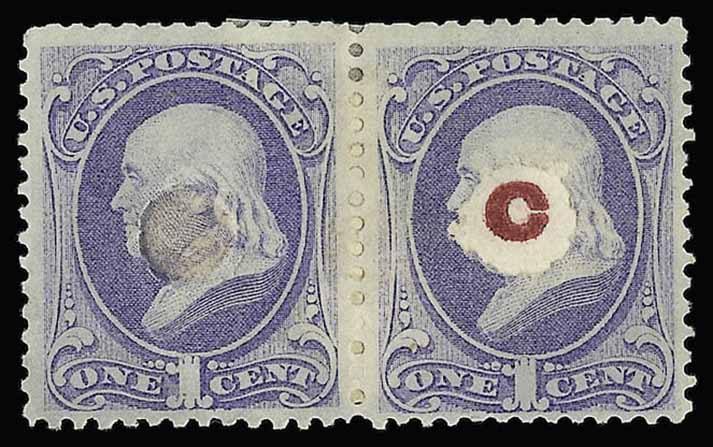 After printing but before gumming a wafer of fulminate of mercury was to be placed into a depression pressed into the stamp from the reverse, and then covered over with a small, round slip of paper glued into place. After this treatment the sheet was to be gummed and perforated. The percussion cap idea was also applied to a revenue stamp, probably prior to the postage stamp proposal. |
|
Send note to Staff
|
| Edited by essayk - 05/22/2014 12:04 pm |
|
|
Rest in Peace
United States
4052 Posts |
|
|
Quote:
From the PMG report of 1863: ... It is not believed that the department has ever suffered any considerable loss ... I see a few possibilities: - It was true that, as of 1863, this was a non-problem; - Selective economic hardship (some of the farmers who went off to war were captured, wounded, missing, dead) made washing stamps a broadly discussed economy measure (see the 1862 NYTimes article that I cited above); - Other countries experienced the problem; although the UPU treaty was signed in 1874, it was preceded by decades of bilateral treaties that would have exposed each postal agency to the problems of their colleagues in other countries. It would be odd if the NYTimes report of the 1929 bust of a nationwide stamp-washing ring was the first time this was a problem. Cheers, /s/ ikeyPikey |
|
Send note to Staff
|
|
|
Pillar Of The Community
United States
2547 Posts |
|
|
Brian,
My material has not been published but I am working my research note and images into a book format and it is now about 750 pages. As for patents, I have identified 86 different patents to this point.
Essayk,
Very interested in collaboration.
ILS,
After the Memorial Day weekend I will post some more.
IkeyPikey,
Thanks for the NY Times reference. |
|
Send note to Staff
|
|
|
Pillar Of The Community
United States
5894 Posts |
|
|
Just fantastic. Can't wait to see more.  Mr. Drews is held in high regard in my neck of the woods. His donation of philatelic literature to the Northern Philatelic Library was quite substantial and really filled in alot of places that needed filling in. |
|
Send note to Staff
|
| Edited by smauggie - 05/23/2014 2:25 pm |
|
|
Moderator

United States
12330 Posts |
|
|
Great information, thank you. A few questions...
Are current anti-counterfeiting costs considered 'paranoid'? (BEP spent about $1M in the early 1990s on research for the new banknotes and the new security measures adds about 2 cents per bill.) If you could find and calculate right numbers, how do you go about quantifying 'paranoia'? Divide the total cost of the annual anti-counterfeiting measures into the per capita income?
And how was technology in the day, whether it was printing capabilities becoming more widespread or the increased availability of chemicals that removed cancelations , factored in when determining a level of 'paranoia''. Ditto for general economy, would how we perceive the cost of anti-counterfeiting measures not change in those times when the economy is very, very poor?
don
|
|
Send note to Staff
|
|
|
Rest in Peace
United States
4052 Posts |
|
|
I would never suggest that a mention in the press is proof that anything is real. OTOH, I would be willing to accept that mentions in the press are evidence that something was part of the continuing public conversation. The long history of "stamp washing" may not prove that it was the proximate cause of the grill experiments, but it certainly explains why many researchers concluded, and the common wisdom became, that the grills were an attempt to defeat the removal of cancellations. That having been said, here are a few more items from the New York Times archives. My comments are in {brackets}. === The Fraud Emporer Wore No Clothes {In fairness to those who think that stamp-washing could not have been a rational basis for the grills, we have:} June 13, 1859 <== it was already old news! Headline: The Alleged Post-office Frauds - A "Herald" Canard Exposed. Summary: The Herald's story about a heavy fraud upon the Post-office Department, by the use of counterfeited and washed postage-stamps, is disproved ... http://query.nytimes.com/mem/archiv...D85F4D8584F9{Includes the clever observation that, on any given day, Congress' franking privilege was costing the POD more than any year's worth of fraud.} === Letter of City Postmaster Abram Wakeman re Redemption of Soiled Postage Stamps October 11, 1862 {The context here is that the public was invited to turn-in soiled, defaced, defective stamps, much of that damage having come from their use as postal currency, and the inevitable problem that one man's soiling was another man's imperfectly removed cancellation.} .. But it is said these frauds complained of are mostly the result of imperfect cancellation, and that the Department is in fault in not providing a more perfect method ... http://www.nytimes.com/1862/10/11/n...defaced.html=== Fraud Prevention Proposal October 16, 1862 Headline: How to Prevent Fraud in the Cancellation and Use of Postage Stamps ... Let the stamps be printed in "weak ink,' while the canceling is done with "strong" ink ... If frauds have been committed, they are small in amount, and are wholly owing to the carelessness of the employees of the Department ... http://www.nytimes.com/1862/10/16/n...-stamps.html=== {from what might have been the forerunner of today's Metropolitan Diary} January 4, 1863 -- A little Yankee girl in Northampton, Mass., a few days since, went into a grocery store and procured some article, in payment for which she produced postage stamps. The man of trade took the stamps, and while examining one of them more minutely than the rest, the little girl spoke up promptly and said: "That's {a} good {one}, for we have washed all the black off." === Redemption of Soiled Postage Stamps January 18, 1863 Headline: Redemption of Soiled Postage Stamps Sub-Headline: About a Quarter of a Million Dollars Redeemed at the New-York Post-office -- Only Two Days More for the Redemption. {a friendly editorial warmly complimenting the City Postmaster on the conduct & progress of the postage-currency-for-postage-stamps swap, above} http://www.nytimes.com/1863/01/18/n...ew-york.html=== REPORTS of ARRESTS, TRIALS, SENTENCES {What follows are ~dozen reports of arrests, trials, sentences. Most of the cases had to do with revenue & documentary stamps, but not all.} === 18670526 May 26, 1867 A boy named Andrew J Taylor was charged with attempting to sell washed stamps. http://query.nytimes.com/mem/archiv...D85F438684F9=== 18670619 June 19, 1867 Andrew J Taylor, indicted for offering for sale a three dollar internal revenue stamp, which had been canceled and the cancellation washed off, was put on trial. http://query.nytimes.com/mem/archiv...D85F438684F9 ... {but I don't see it} === 18670620 June 20, 1867 Headline: Frauds in Stamps It is stated that a large business is done in selling revenue and postage stamps which have been already once used, the cancelation of them being washed off in some way. An individual, who had offered a stamp of this kind for sale was brought before the United States Circuit Court a day or two ago, and pleading guilty was fined $50. http://query.nytimes.com/mem/archiv...D85F438684F9 ... {the snarky commentary is a bonus} === 19000923 September 23, 1900 TRUJILLO AGAIN ARRESTED.; Brokers Sue to Recover $1500 for ... Angel M Trujillo, who was arrested recently by Government agents charged with "washing" internal revenue stamps, is again in custody ... http://query.nytimes.com/mem/archiv...405B808CF1D3=== 19060909 September 9, 1906 EFFECTIVE BLOW STRUCK AT WASHED STAMP GAME; Stock Transfer Stamps to be Replaced by New Issue. THESE CAN'T BE "DOCTORED" Secret Service Men Expect to Round Up Dishonest Dealers When They Offer Old Stamps. The action of the State tax officials in recalling, as announced yesterday, all of the stock transfer tax stamps now in the hands of the public, has more behind it than the desire of the Tax Commissioner to substitute a better quality of stamps than those which the petty crooks in Wall Street have found an easy source of profit by washing. http://query.nytimes.com/mem/archiv...405B868CF1D3=== 19270206 February 6, 1927 WASHED CANCELED STAMPS.; Gang Returned Them to Paris to Pay Merchants' Bills. By washing the postal cancellation marks off postage stamps and sending them in payment of bills a gang of crooks has been doing a good business recently in ... http://query.nytimes.com/mem/archiv...D85F438285F9=== 19290602 June 2, 1929 BOGUS STAMP TRAIL LEADS TO CANADA; Agent Sifting $4,500,000 Fraud Also Charges "Wash"' Ring Bought Stolen Postage. TWO MORE ARE HELD HERE Additional Arrests Revealed in Boston and Chicago--Buyers to Be Investigated. The fraudulent trade in the resale of pre-canceled stamps, which it is alleged has cost the government upward of $4,500,000 during the past year, was not confined to the United States, further investigation revealed Yesterday, but was active in many ... Government agents also charged that the bogus stamp ring, beside washing the cancellation marks from stamps and selling them for a second use, made a ... http://query.nytimes.com/mem/archiv...D85F4D8285F9=== 19360610 June 10, 1936 STAMP RACKET CHARGED; Canceled Documentary Stamps Washed and Resold in Boston. Evidence several busines men in a stamp racket, which is said by investigators ... Sales of "washed" $1 to $20 documentary stamps used on deeds and transfers ... http://query.nytimes.com/mem/archiv...D85F428385F9=== 19360709 July 9, 1936 TRIAL GIVES JUDGE PHILATELY LESSON; Leibell Hears Dealer ... Judge Leibell and tho Jury also learned that stamp collectors value ... The face value of the "washed" stamps found in his possession ranged from $2 to $10. http://query.nytimes.com/mem/archiv...D85F428385F9=== 19381001 October 1, 1938 TAX STAMP RACKET OF $1,000,000 BARED; 3 Cigarette Manufacturers and a Retailer Indicted by Federal Grand Jury A so-called washed-stamp racket, by means of which the government is said to have been defrauded of $1,000,000 a year in taxes on cigarettes, was revealed yesterday when a Federal grand jury indicted three manufacturers, a retail dealer and a corporation. http://query.nytimes.com/mem/archiv...D95F4C8385F9=== 19390124 January 24, 1939 HUGE STAMP FRAUD LAID TO NINE HERE; Resale of Washed Tax Tokens for $3,000,000 Yearly Is Charged to Ring Nine men, including four employee of two steamship lines and a stamp dealer, have been rounded up as members of a ring that is said to have defrauded the government of $3,000,000 to $5,000,000 annually in the sale of washed documentary stamps. http://query.nytimes.com/mem/archiv...D85F4D8385F9=== 19390125 January 25, 1939 FRAUDS NEAR $25,000,000; Government Loss Estimated in Sale of Washed Stamps The Federal inquiry into the use of washed documentary stamps, such as are affixed to passenger lists, manifests, real estate documents, marine insurance ... http://query.nytimes.com/mem/archiv...D85F4D8385F9=== 19391001 October 1, 1939 Two Are Convicted of Selling Washed Revenue Stamps Two men were convicted late Friday night of conspiracy and defrauding the government through the sale of washed internal revenue documentary stamps, ... http://query.nytimes.com/mem/archiv...D95F4D8385F9=== 19400331 March 31, 1940 U.S. SEIZES DEALER IN STAMP FRAUDS; Accuses Ex-Attache of a German Consul of 'Washing' Documentary Issues JERSEY CITY SHOP RAIDED Suspect Said to Have Cheated Government of $10,000 a Year by Sales to Lawyers NEWARK, N.J., March 30--Secret Service men today seized a former German consular agent accused of using the wizardry of chemistry to renovate canceled documentary stamps, stolen from court ... Secret Service men and revenue agents had been tracking the washed stamps for a year. Their trails led into blind alleys, it was reported, until Mayor Harry ... http://query.nytimes.com/mem/archiv...66838B659EDE=== 19400912 September 12, 1940 RICH PHILATELIST INDICTED IN FRAUD; Lawyer, Former Bank Head, Accused of Selling Used Documentary Stamps A philatelist's hobby led to an indictment yesterday against Harold D. Watson, attorney and former bank president, on a charge of conspiracy to defraud the Federal Government of taxes through the fraudulent re-use of documentary stamps. Watson, according to the indictment, took the stamps for 60 per cent of their original ... It is an outgrowth of an inquiry into the "washed stamp racket," begun ... http://query.nytimes.com/mem/archiv...D85F448485F9=== 19420624 DEALER CONVICTED IN STAMP FRAUD; Guilty of Selling Canceled Articles, After 'Washing' Them, at Discount FACES 10 YEARS IN PRISON Sharp Eyes of Postal Clerk Bring Discovery That Traps the Culprit The alertness of a postal clerk, combined with the scientific sleuthing of a stamp detective, resulted yesterday in the conviction of a dealer in "washed" and "pieced" stamps. The clerk, Benjamin Goldberg of the postoffice at 103 Prince Street, noticed almost imperceptible irregularities in stamps on packages he was handling and started the hunt that led to George Pappas in his stamp shop at 40 West Eighteenth Street. http://query.nytimes.com/mem/archiv...D85F468485F9=== 19420630 June 30, 1942 SENTENCED IN STAMP CASE; Seller of 'Washed' and 'Pieced' Issues Gets 18 Months George Pappas, convicted last week of selling "washed" and "pieced" stamps, was sentenced yesterday to eighteen months imprisonment and fined $500 by ... http://query.nytimes.com/mem/archiv...405B8288F1D3=== CONCLUSION The long history of "stamp washing" may not prove that it was the proximate cause of the grill experiments, but it certainly explains why many researchers concluded, and the common wisdom became, that the grills were an attempt to defeat the removal of cancellations. As to 'paranoia', if we adjust the dollar values to current dollars - using, I would suggest, the per capita incomes of the times - and I think that we will find a legitimate financial interest in reducing the re-use of paper stamps. Moreover, let us remember that, in The Good Old Days, the oath that the 'laws be faithfully executed' was an important part of the social contract; part of willingly paying your bills is knowing that everyone else has to pay theirs; therefor, it was important for the POD to stop the re-use of postage stamps as a matter of public trust. === BONUS! May 26, 2011 {drugs hidden under stamps on prisoner mail} http://www.nytimes.com/2011/05/27/u...smuggle.htmlCheers, /s/ ikeyPikey |
|
Send note to Staff
|
|
|
Pillar Of The Community
United States
1946 Posts |
|
|
ikeyPikey, would you say that POD concern over postage stamp reuse is the best way to account for the level of experimentation we can document for the period of roughly 1860-1890? |
|
Send note to Staff
|
| Edited by essayk - 05/24/2014 12:42 pm |
|
|
Bedrock Of The Community
United States
10824 Posts |
|
|
The government was also very concerned over the reuse of revenue stamps right from the beginning of the adhesive era in 1862. There was a wide range of experimental revenue essays created to combat this, but none were actually used. During the life of the First Issue they instructed Butler & Carpenter to make the dark stamps lighter and the light stamps darker in an attempt to make the cancels more difficult to wash off without being noticed. This is especially noticeable on the various red and blue colored values, although all values show it to some degree. It was enough of a problem that it resulted in the Second and Third Issues being printed in 1871 on a gray silk paper known as Willcox Chameleon Paper, in which the vignette and frame were printed in two different inks. One ink turned the paper pink if an acid was used to clean the stamp, and the other turned it pink if an alkali was used.
|
|
Send note to Staff
|
|
|
Pillar Of The Community
United States
2547 Posts |
|
|
The POD had been working with reuse prevention to some degree for the introduction of postage stamps but the great diversity was probably largely caused by the Internal Revenue Bureau's call for reuse prevention ideas on Dec 24, 1867. This seems to be the starting point for the real big push. It should be noted that this date is after the POD's decision to start embossing (grilling) regular postage stamps.
There were numerous processes used with postage stamps but the greatest diversity of reuse techniques was applied to revenue stamps. |
|
Send note to Staff
|
|
|
Replies: 24 / Views: 9,379 |
|
|
To participate in the forum you must log in or register. | |
Disclaimer: While a tremendous amount of effort goes into ensuring the accuracy of the information contained in this site, Stamp Community assumes no liability for errors. Copyright 2005 - 2026 Stamp Community Family - All rights reserved worldwide. Use of any images or content on this website without prior written permission of Stamp Community or the original lender is strictly prohibited.
Privacy Policy / Terms of Use Advertise Here |
| Stamp Community Forum |
© 2007 - 2026 Stamp Community Forums |
| It took 0.42 seconds to lick this stamp. |
 |
|




 Posted 05/21/2014 1:53 pm


