Stamp Community Family of Web Sites
Thousands of stamps, consistently graded, competitively priced and hundreds of in-depth blog posts to read


Stamp Community Forum
 
Username:
Password:
Save Password
Forgot your Password?

This page may contain links that result in small commissions to keep this free site up and running.

Welcome Guest! Registering and/or logging in will remove the anchor (bottom) ads. It's Free!

Let's Take A Look At Proofs

Next Page    
 
To participate in the forum you must log in or register.
Author Previous TopicReplies: 41 / Views: 8,727Next Topic
Page: of 3
Pillar Of The Community
United States
1944 Posts
Posted 01/05/2016   9:03 pm  Show Profile Bookmark this topic Add essayk to your friends list Get a Link to this Message
The following exchange started to take place in another thread ( https://goscf.com/t/47078 ) but deserves separate treatment. So I decided to start this thread to take up the subject.

dsmith426 asked:

Quote:
Ok, I'll ask a question. I'm a younger person exploring the possibility of getting into this hobby. I really like the look of early stamps. Could you explain what are 'plate proofs?' and how the public originally obtained them?

My initial response needed clarification (see link) hence the need for this thread. I have put his questions in quotes.


Quote:
essayk,

It's not clear to me what you mean by..

"that was NOT intended for normal distribution to the public through sale by the Post Office Department or USPS"

My first read of this made me think that it wasn't available to then public for purchase. My second read of this made me think that is was available to the public but not from your local post office. My third reading I started to redefine what normal distribution really means and also how is it tied to the public or if 'the public' isn't important in your definition.

So please clarify what is meant in the quotation.


Proofs were never made available for sale to the general public at post offices. However, occasionally the government would release some proofs to the public, particularly to stamp collectors. However, because proofs were not valid for postage, they were not sold. Other channels of distribution were used to get them out. They were given to those who knew how to write in and request them. Some proofs could be obtained by writing to the Post Office Department in Washington. Some proofs were favor items from Senators or Congressmen. Some proofs leaked out of the production system, through various classes of employees. What the government did not demand back was fair game for collectors.

Here is a pic of some of the special envelopes used to send proofs to those who requested them during the period 1879-1893:
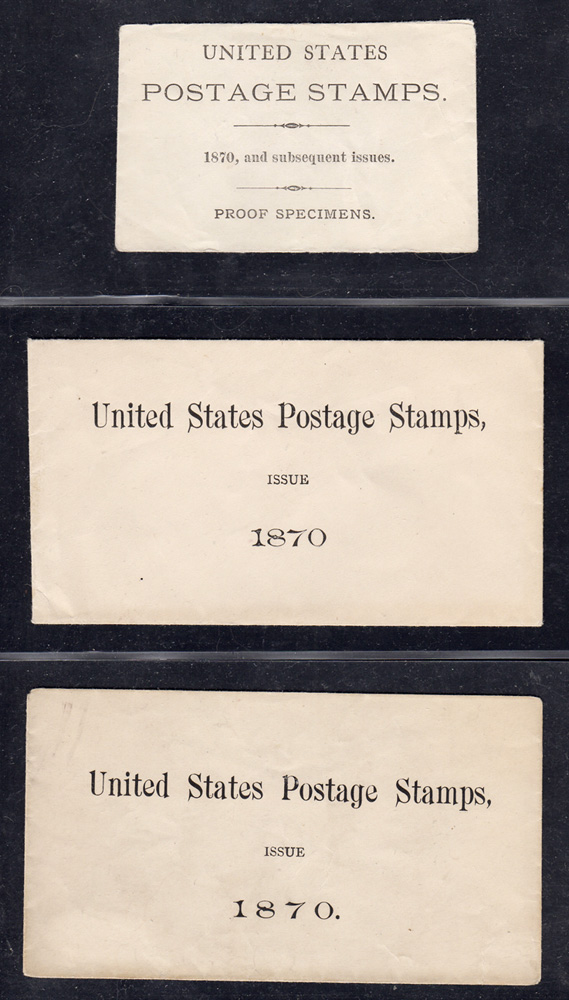


More will be said about these below.

Since revcollector has already given good responses to your original set of questions (see link), I will only add explanatory comments or my alterations to what he has already said.


Quote:
(1) if proofs are printed from sheets
(a) are proofs ubiquitous in the marketplace?
(b) do people collect them by the sheet or blocks like normal stamps?


The only proofs that could occur in sheet form are plate proofs, which are printed from multiple subject plates. Proofs printed from the master dies that had the original engraving used to make the plates also exist, and these were printed one at a time, with only one example of the design to a sheet.

I infer that your question "(a)" asks about the abundance of proofs in the marketplace (it's not a question of ubiquity):
The number of proofs for any stamp is but a tiny fraction of the number of examples of that same design as stamps. Proofs are all "rare" in terms of number, but usually do not have extraordinary value because of limited demand. Stamps that were issued in a quantity of 2500 would be considered great rarities, but most proofs in that number are regarded as very common.

There are very few full panes or sheets of plate proofs still in existence. Blocks vary considerably in size and availability. However, proofs are collected in all the same ways unusued stamps might be, including plate items, autographed items, and favor items.


Quote:
"(2) Since they are printed from plates at anytime does that mean there are proofs from worn out and/or damaged plates?"


When plate proofs are printed after the stamp ceases to be current, they are generally pulled from a new plate specifically fashioned for making reprints. Later printings from die proofs are in the latest state of the original die, with but few exceptions. Proof impressions, whether from die or plate, will be some of the finest impressions known for the state of a stamp from among any that exist. Nonetheless, proof impressions showing damage to a plate do exist. Proof collectors generally do not place a premium on them, and they may even be regarded as of secondary interest except to particular specialists. As always, there are notable exceptions, such as the 1869 inverted-center plate proofs.


Quote:
"(4) Is there any way for someone to know when a proof was printed?"


This varies greatly. I have some proofs with marginal notations by the PMG that date them to month, day, and year. Others to year only. Plate proofs on cardboard were made available in 5 emissions, with variations, and these have been arranged by earlier students according to the characteristics of each set by year of issuance. In most cases, proof items have been studied long enough to have a history of when they were first created. But that history is neither absolute nor complete in all respects.

Here, for example, is a set of plate proofs on cardboard which were arranged on album page by the great proof researcher, Clarence Brazer.
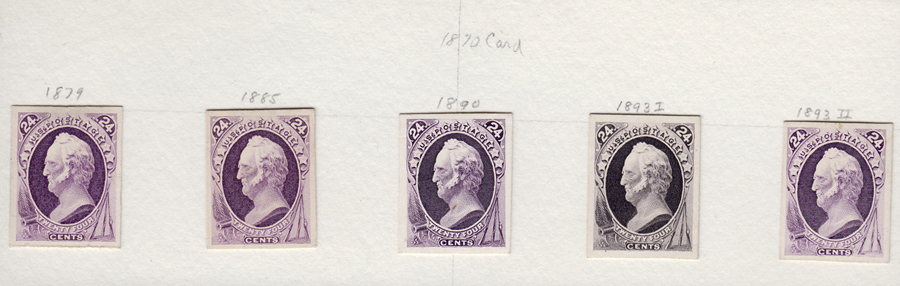


They are arranged chronologically for the five different emissions of card proofs from 1879-1893/4. These correspond to the envelopes above plus two more.


Quote:
"(5) What is more valuable to a collector(s) a proof or a trial color proof"


revcollector has said that this depends on how one is trying to collect, and that really is the heart of it. Collectors are willing to pay more for items they "need" than for things they don't actively collect. Obviously, if they enter into a new collecting domain, they will tend to "need" more things. But with proofs (and essays) the people who need them most are those who are doing special studies of the origins of the stamps in which they specialize. Often these are people who exhibit. Usually they are well informed about their specialty.

For many collectors proofs are a good substitute for sets of stamps that are peripheral to their main interest. For example, my primary collecting interest is in the US Banknote issues. But for the 1847, 1851, 1861 and 1869 issues I have sets of plate proofs on India paper which I use to give me first hand examples of their designs and colors. So I am able to do direct comparisons of some of the 1861 premier gravures with their second issue counterparts and see the detail differences directly. (alas I do not have all the premiere gravure items even as proofs).


Quote:
(6) A scenario question: for a set of trial color proofs (which we know these specific ones are for a fact are actual ones produced prior to the choice of color) is the one which is the same color of the printed stamps automatically change the status of that specific 'trial color proof' to a 'proof' or does it stay a 'trial color proof' as it was born that way (ie. the defining moment is fixed to the time of printing only)"


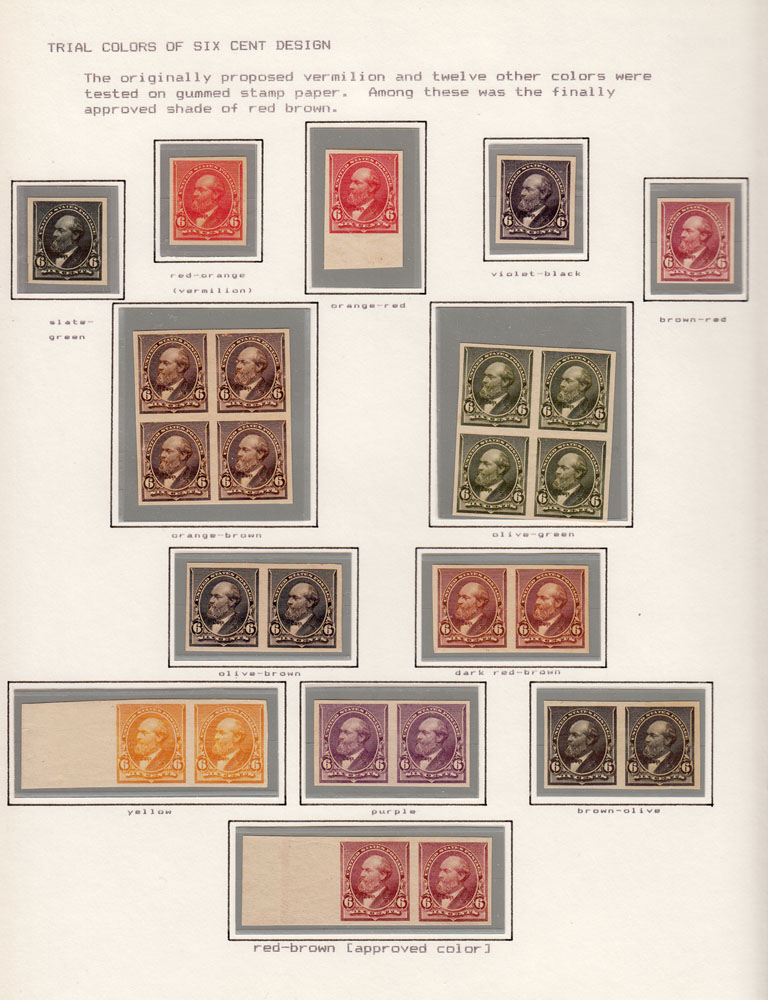
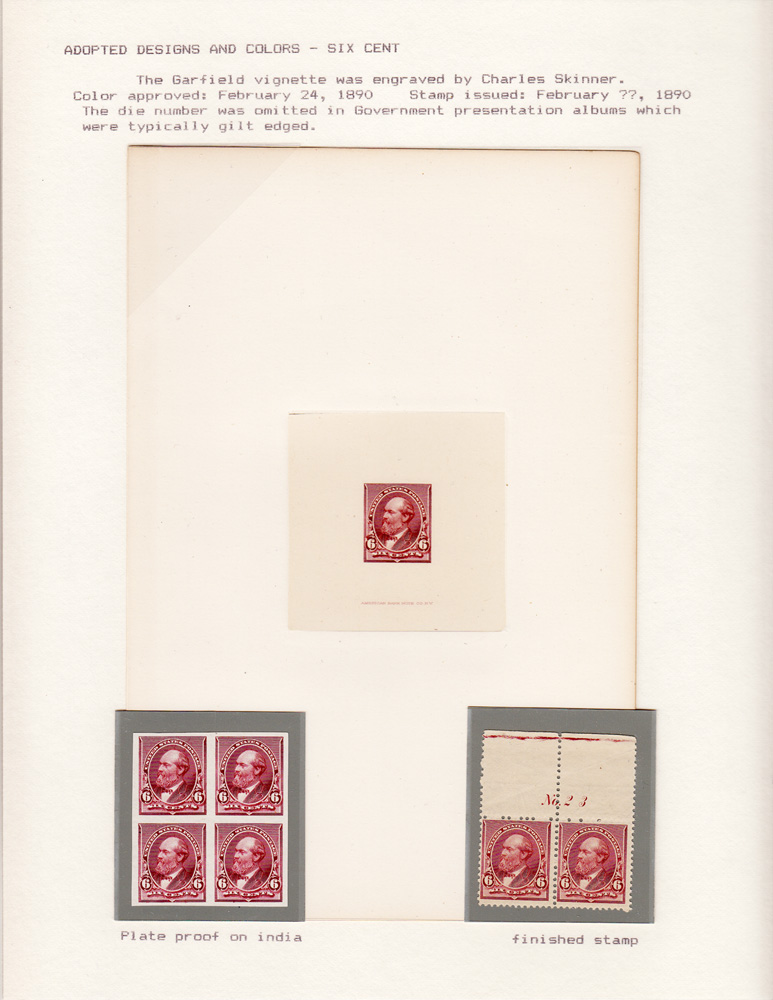
Here are two pages from an old exhibit I did which speak to your question. The 6c of 1890 had 13 trial color proofs on stamp paper prior to the approval date. The first page shows all the colors, one of which was approved. The second page shows the approved color alone. When the color is selected, all prints in that color are treated as issue proofs and not trial colors.


However, from your questions I'm not sure you are thinking about the term "trial color" in the broad sense in which that is defined by philatelists with reference to US material. Here are some examples of proofs that were pulled to spot check the plate for areas needing final touchup. They were created after the stamp was already in production in its normal color.
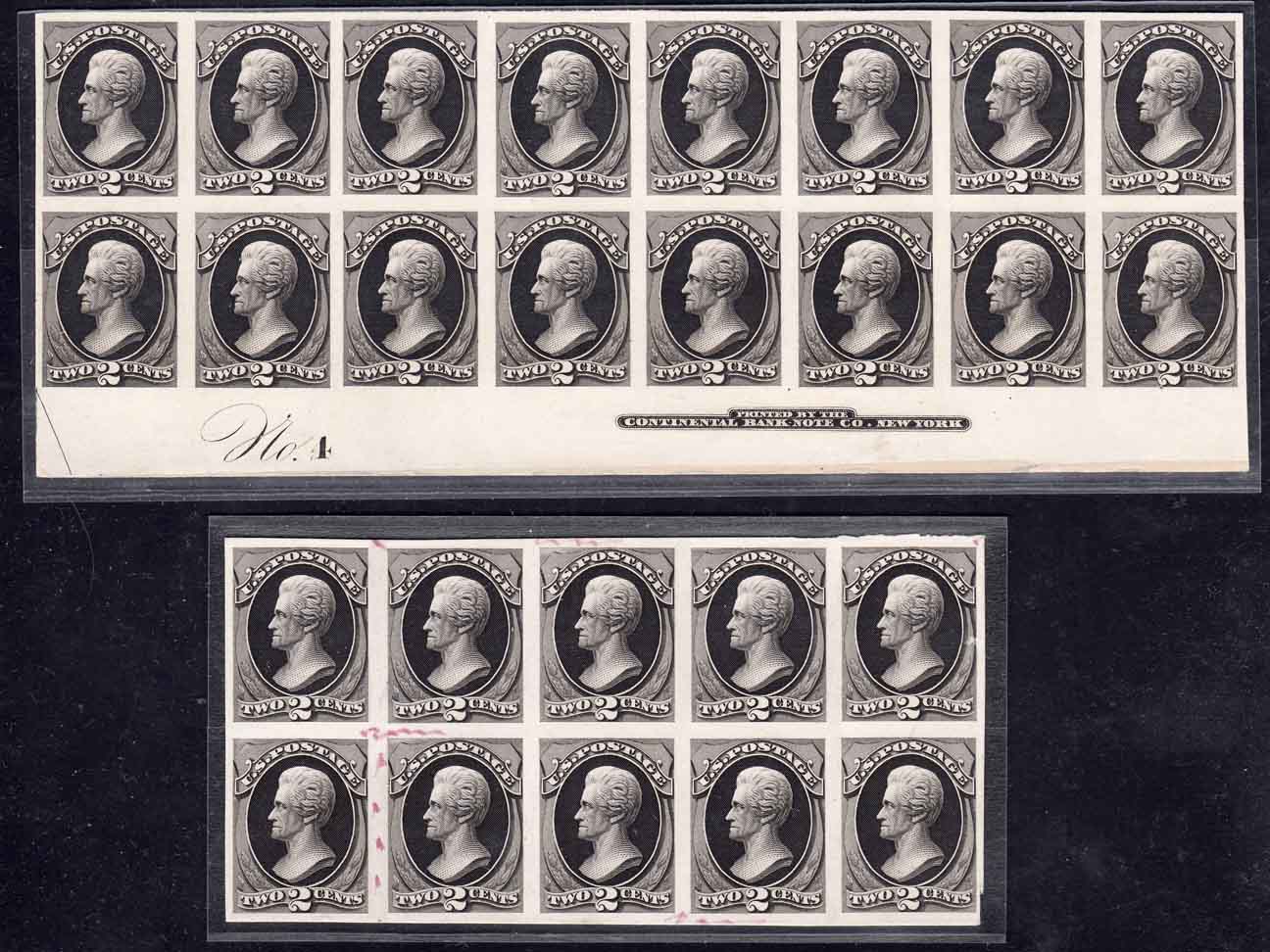


These proofs were not testing black as a potential color for the stamps. It was used because it was easier to spot plate anomalies win black prints. The lower block has crayon markings to indicate where problems needed attention. The upper block is not marked up, but is a collectable part of the sheet for such a trial color. This also addresses your earlier question about collecting fashion for proofs like this.
Send note to Staff

Pillar Of The Community
United States
1033 Posts
Posted 01/05/2016   9:48 pm  Show Profile Bookmark this reply Add rgstamp to your friends list  Get a Link to this Reply
great information-- learning a ton! Much appreciated for the educational post

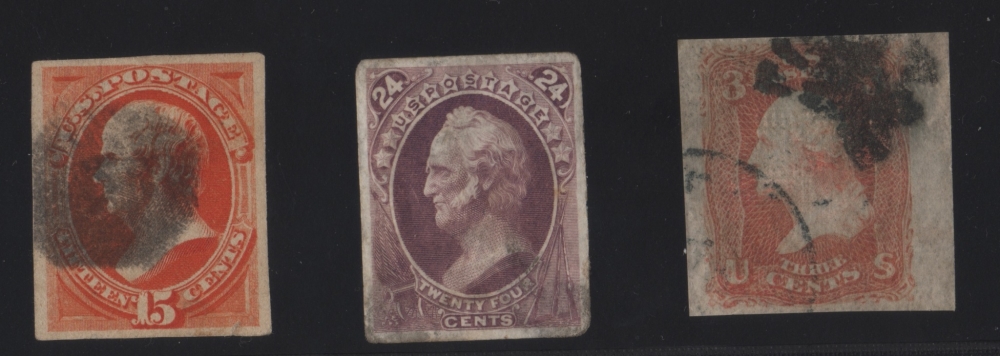
Question: Why do some proofs have cancels? Were these proofs really used for postage? are they fake cancels??? Why would anyone use a proof as postage?

I believe proof at right is used 94p5 (f grill on stamp paper)
left is 152p (orange) on India??? I'm not sure. not sure if on card.
middle is 164p ???? paper is real thin??? color is killing me-- looks a dull red (not purple or violet)

All look cancelled????

HELP!!

Send note to Staff  Go to Top of Page
Bedrock Of The Community
United States
10633 Posts
Posted 01/05/2016   10:00 pm  Show Profile Bookmark this reply Add revcollector to your friends list  Get a Link to this Reply
None of these are proofs. The 94 was a straddle margin example with wide margins that was trimmed. The 15 cent is probably a 152 that has been trimmed, and the 24 is a 153 that was trimmed; it usually comes on a very thin hard paper. The 153 is very volatile and comes in a variety of shades.
Send note to Staff  Go to Top of Page
Bedrock Of The Community
United States
10633 Posts
Posted 01/05/2016   10:02 pm  Show Profile Bookmark this reply Add revcollector to your friends list  Get a Link to this Reply
The 15 cent could also be a 189 that was trimmed if the paper is very thick. Holding it up to the light should make it obvious if it is.
Send note to Staff  Go to Top of Page
Pillar Of The Community
United States
1033 Posts
Posted 01/05/2016   10:26 pm  Show Profile Bookmark this reply Add rgstamp to your friends list  Get a Link to this Reply
revcollector: i'm perplexed.

I own copies 94 (mint and used), 152, 189, and 153 (24c purple)--- the paper is entirely different on all 3 examples shown here compared to usual stamps-- the 94 is on super thin paper (stamp paper I think???) These "stamps versus proofs" have enormous margins and would be more valuable if they were perforated. Why would anyone trim them???.. Moreover, they have great impression, especially the 24 cent compared to the real stamps. I have seen the 94p5 auctioned on ebay at least twice and it looks exactly like the one above with same thin paper appearance.

These stamps have been sitting in my stock book for years and I always assumed they were proofs of some kind ( of low value). Now you are saying they are stamps of low value. Perhaps you are right?
Send note to Staff  Go to Top of Page
Valued Member
United States
175 Posts
Posted 01/05/2016   10:40 pm  Show Profile Bookmark this reply Add eaglebub7 to your friends list  Get a Link to this Reply
Very informative thread, thanks essayk and revcollector.
Send note to Staff  Go to Top of Page
Bedrock Of The Community
United States
10633 Posts
Posted 01/05/2016   10:55 pm  Show Profile Bookmark this reply Add revcollector to your friends list  Get a Link to this Reply
The 94 was trimmed because the right side would have been a natural straight edge to begin with and it might have been done decades ago when it was nothing more than a minor curiosity in an attempt to create a major curiosity. The probability is that it would only have been an 85J in any case, not a particularly valuable stamp. The 153 might be a proof, but the stamp is a much better item to own, and the right edge looks like it might have leftover perf indentations. Of course that might just be the scan. The paper on all of these issues was not all that consistent and it does vary to a considerable degree.
Send note to Staff  Go to Top of Page
Pillar Of The Community
United States
1033 Posts
Posted 01/05/2016   11:00 pm  Show Profile Bookmark this reply Add rgstamp to your friends list  Get a Link to this Reply
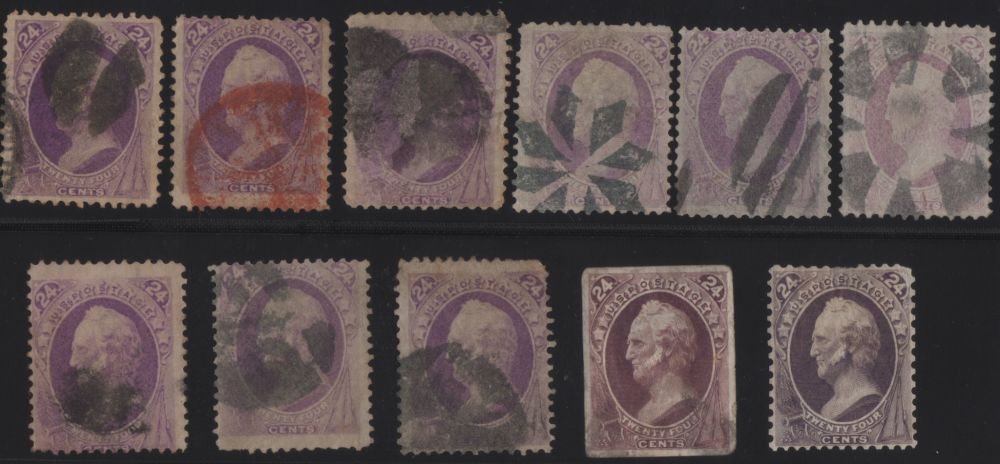
ok… here is scott #153 --the 24 cent ---multiple copies-- purple color (bright, dull, etc)

bottom 2 stamps on right have very deep proof-like impression and look different to me-- MUCH CLEARER impression!!
Obviously , the imperf is the one I posted above (dull red/perhaps some brown there) has a deeper impression. The last bottom one is mint, no gum, reperfed all the way around, very soft/thin paper. It is violet (NOT purple)-- I assumed it was worthless 164p reperfed to fake scott #200 (crazy rare $$$$$)

The mint stamp at bottom right has the same proof like impression as the imperf one, but they are different colors. I assumed they were both cheap proofs.

UGGGGGGG


Send note to Staff  Go to Top of Page
Bedrock Of The Community
United States
10633 Posts
Posted 01/05/2016   11:35 pm  Show Profile Bookmark this reply Add revcollector to your friends list  Get a Link to this Reply
Bottom mint stamp is clearly a proof with perfs added. In this comparison the imperf also looks like a proof. Dirty, but not used.
Send note to Staff  Go to Top of Page
Valued Member
United States
211 Posts
Posted 01/05/2016   11:47 pm  Show Profile Bookmark this reply Add dsmith426 to your friends list  Get a Link to this Reply
essayk,

Thank you. In part one of your answer (in the other thread) you said there were items called experimentals. What are those?
Send note to Staff  Go to Top of Page
Pillar Of The Community
United States
1033 Posts
Posted 01/05/2016   11:54 pm  Show Profile Bookmark this reply Add rgstamp to your friends list  Get a Link to this Reply
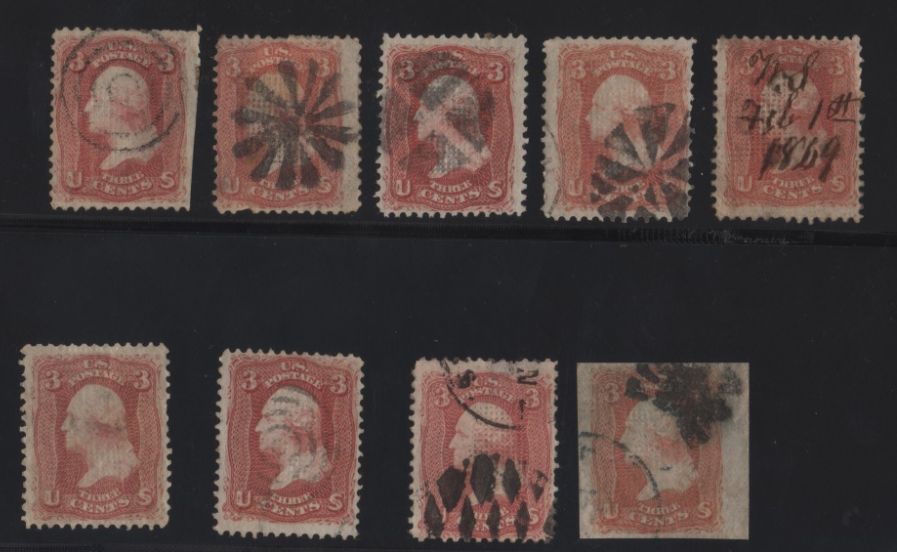
ok -- here is scott #94. rose/red

f grill

possible proof is bottom stamp on right. It is on a totally different paper (super-thin relative to others) can't tell paper quality by a scan so not sure this exercise is helpful, but you can tell that paper looks more translucent?

Send note to Staff  Go to Top of Page
Pillar Of The Community
United States
1944 Posts
Posted 01/06/2016   12:15 am  Show Profile Bookmark this reply Add essayk to your friends list  Get a Link to this Reply

Quote:
Question:
Why do some proofs have cancels?
Were these proofs really used for postage?
are they fake cancels???
Why would anyone use a proof as postage?


Allow me to respond to your set of questions first and then some comment on your material. The first and last questions in this group are closely related.

Proofs that have authentic cancels were used, or attempted to be used, as postage. Used proofs do exist. I have seen them on cover at auction, and here are a couple from my collection:


As for the question of why do this, look closely at the 2c proof here, and you will see part of the year date for 1888. There was a lot of funky material philatelically inspired and prepared in the last two decades of the 19th century and into the 20th. Used proofs, especially on stamp paper, stamp bisects, questionable precancels. Successful postal usage was an acid test for legitimation. Anything tied to cover with a legitimate cancelation and no penalty markings could (and would) be represented as a rare stamp variety.

Plate proofs on stamp paper, as we now know, were all too often represented as rare imperforate "errors," and given catalog status as such if some of them could be shown to have been used. India paper plate proofs would be rebacked and offered as stamp paper imperforate error stamps. This is one of the reasons that many, dare I say "most," collectors avoided proofs altogether for the first half of the 20th century. I think you get the picture.

As to the status of your threesome, without being able to see the actual stamps I am reluctant to say much about them with any sense of certainty. But I will share what I can.

I tend to agree with revcollector about the 1867 3c grilled item, particularly if it has an F grill. Stamp paper proofs of that issue are well known, including a variety on "very thin paper" which was issued in perforated form. These are not terribly rare, but need to be collected in pairs because the large margins at the edges of the sheets, and along the center gutter between the two panes, allowed for a lot of margin even after their perfs were trimmed off. Straddle pane copies of perforated issued stamps used to get trimmed to emulate an imperforate "error." We have illustrated that on this forum before. So it is difficult to verify that a single like yours never had perforations.

Your two banknote items could be a bit different story, particularly that 24c. The paper will tell you everything, if you know how to interpret it. The 15c looks like it might be on stamp paper, even soft paper, and if so I would dismiss it as a trimmed normal stamp. However, if it could be shown to be in India paper them it is a used plate proof.

There is a brightness to the paper of the 24c that suggests it could be on India paper. Also the color shade is more typical of proofs than stamps, but that is not certain with online images. You might send it in for a cert and if it is a proof they will tell you. But if it is a trim job on stamp paper, you will have wasted your money on a cert. A cheaper and more useful way to master your uncertainty is to buy an India paper proof single on ebay and use it as a reference piece.
Send note to Staff  Go to Top of Page
Pillar Of The Community
United States
1944 Posts
Posted 01/06/2016   12:41 am  Show Profile Bookmark this reply Add essayk to your friends list  Get a Link to this Reply

Quote:
you said there were items called experimentals. What are those?


To me these are some of the most interesting US stamps we can have.

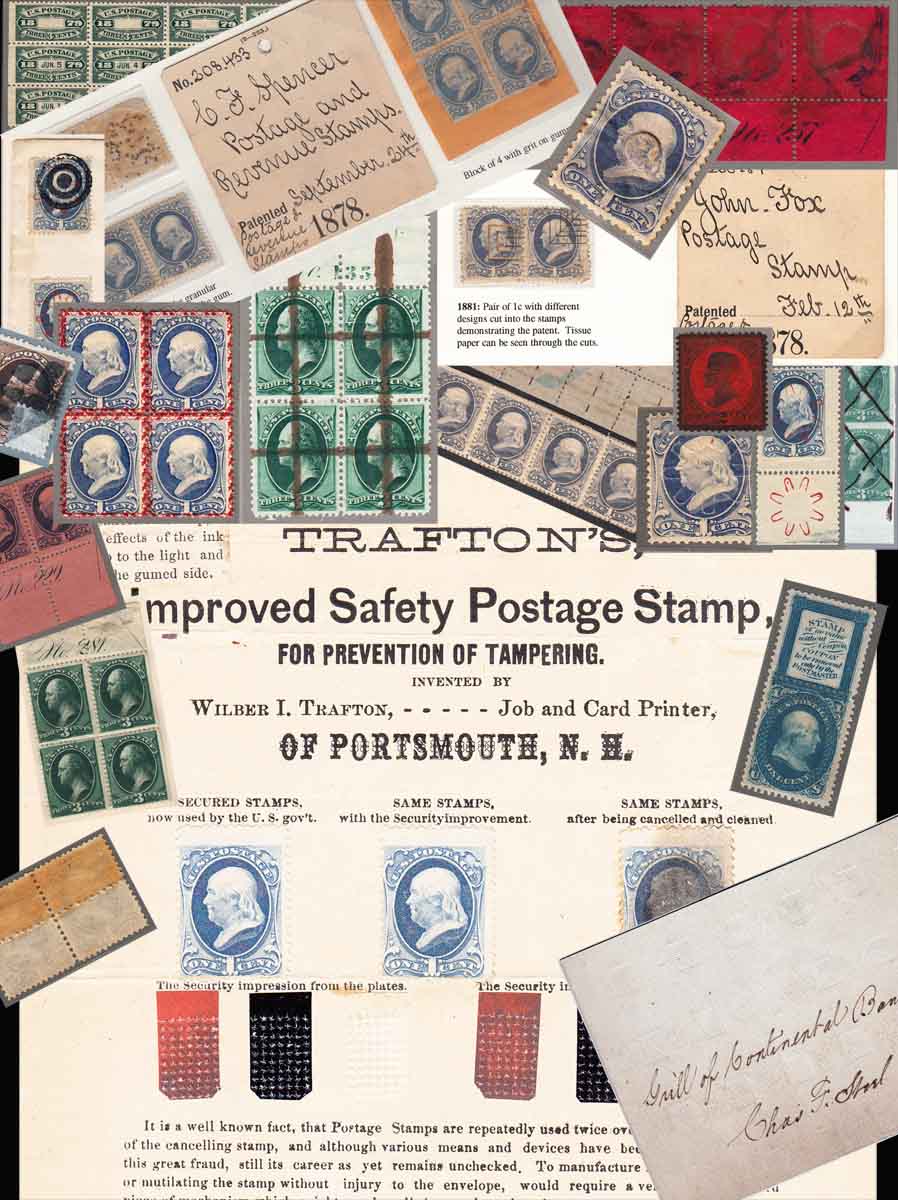
In the mid-19th century two issues bothered the Post Office Department and the stamp producers they had contracted: counterfeiting, and cleaning used stamps for reuse. The first of those issues was a holdover from the production of paper currency. The second was a paranoia that was fueled in part by the desires of inventors to make some money, by hyping a solution to an "egregious" problem. These enterprising entrepreneurs secured patents for all manner of design and production devices to assure that no stamp would have a second life, and in some cases the stamp producers prepared models to the patent specifications. A few got trial runs as issued stamps. This whole mass of material comes under the category of "experimentals." It is late now but I will put up some examples another time.

Edit: Here is a composite I put together to give you some sense of the kind and range of material we call "experimentals."

Click for a closer look.


Send note to Staff  Go to Top of Page
Edited by essayk - 01/06/2016 4:16 pm
Valued Member
United States
211 Posts
Posted 01/06/2016   11:02 pm  Show Profile Bookmark this reply Add dsmith426 to your friends list  Get a Link to this Reply
Essayk,

I want to thank you again for the time you placed into your excellent detailed explanations. I greatly appreciate it. Can I ask you to expand on what you mean by premiere gravure? I was unable to find a definition by using google.

Thank you
Send note to Staff  Go to Top of Page
Pillar Of The Community
United States
791 Posts
Posted 01/07/2016   08:42 am  Show Profile Bookmark this reply Add 1typesetter to your friends list  Get a Link to this Reply
Send note to Staff  Go to Top of Page
Pillar Of The Community
United States
1944 Posts
Posted 01/07/2016   09:05 am  Show Profile Bookmark this reply Add essayk to your friends list  Get a Link to this Reply

Quote:
Can I ask you to expand on what you mean by premiere gravure?


Twitter answer: premier gravure = the first U.S. postage issue of 1861, no longer recognized as such.

A whole lot of philatelic history is encapsulated in those few words.

The expression is French (from the Latin) and came into the hobby early in the game when French influence was still formative for the hobby as a whole. In essence it means "First Printing" and that is precisely the sense in which it is applied to the set of stamps to which it refers.

Early on, collectors had observed that the U.S. postage issue of 1861 had two printings, differing in certain minor details of design. Evidence of usage allowed both to be dated back to August of 1861, but the first printing is limited to that month alone, hence another appellation as "August Issues." The relative paucity of the stamps of the so-called "premiere gravures" made them exceptionally rare, and commanded big prices. This necessarily attracted the attention of experts who devoted considerable energy to accounting for the existence of an issue that was so short lived and only differed from the more widely available stamps in minute design details.

A substantial debate raged within the hobby for the first half of the twentieth century about these stamps, most of which were great rarities, but few of which even existed in used condition. The fact that SOME were known to be used seemed to establish the entire set as an early issue of the series. As the auction realizations rose higher and higher the need to safeguard investment played a role in keeping up the rhetoric. However, by the end of the century the evidence was finally clear that the so-called "August Issues" were not formally a stamp issue; rather, they are a late stage set of design proposals for such an issue. The catalog listing of the premiere gravures was changed, and they were moved from the front of the catalog to a new section in the back of the book as stamp "essays."

With that I have introduced you to the all important first cousin of proofs, and the first tier in the stages of stamp creation: essays -> proofs, and essays -> experimentals.
Send note to Staff  Go to Top of Page
Edited by essayk - 01/07/2016 09:18 am
Page: of 3 Previous TopicReplies: 41 / Views: 8,727Next Topic  
Next Page
 
To participate in the forum you must log in or register.

Go to Top of Page

Disclaimer: While a tremendous amount of effort goes into ensuring the accuracy of the information contained in this site, Stamp Community assumes no liability for errors. Copyright 2005 - 2026 Stamp Community Family - All rights reserved worldwide. Use of any images or content on this website without prior written permission of Stamp Community or the original lender is strictly prohibited.
Privacy Policy / Terms of Use    Advertise Here
Stamp Community Forum © 2007 - 2026 Stamp Community Forums
It took 0.38 seconds to lick this stamp. Powered By: Snitz Forums 2000 Version 3.4.05