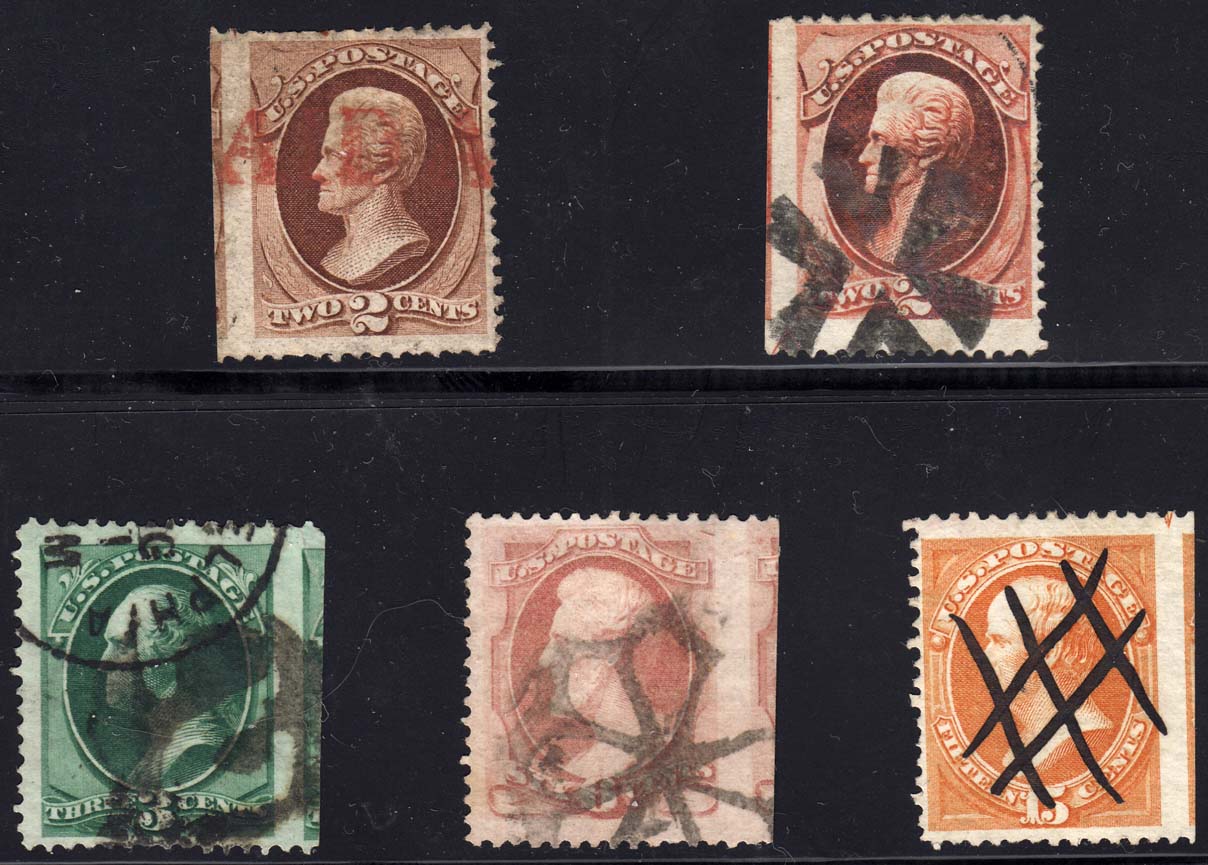
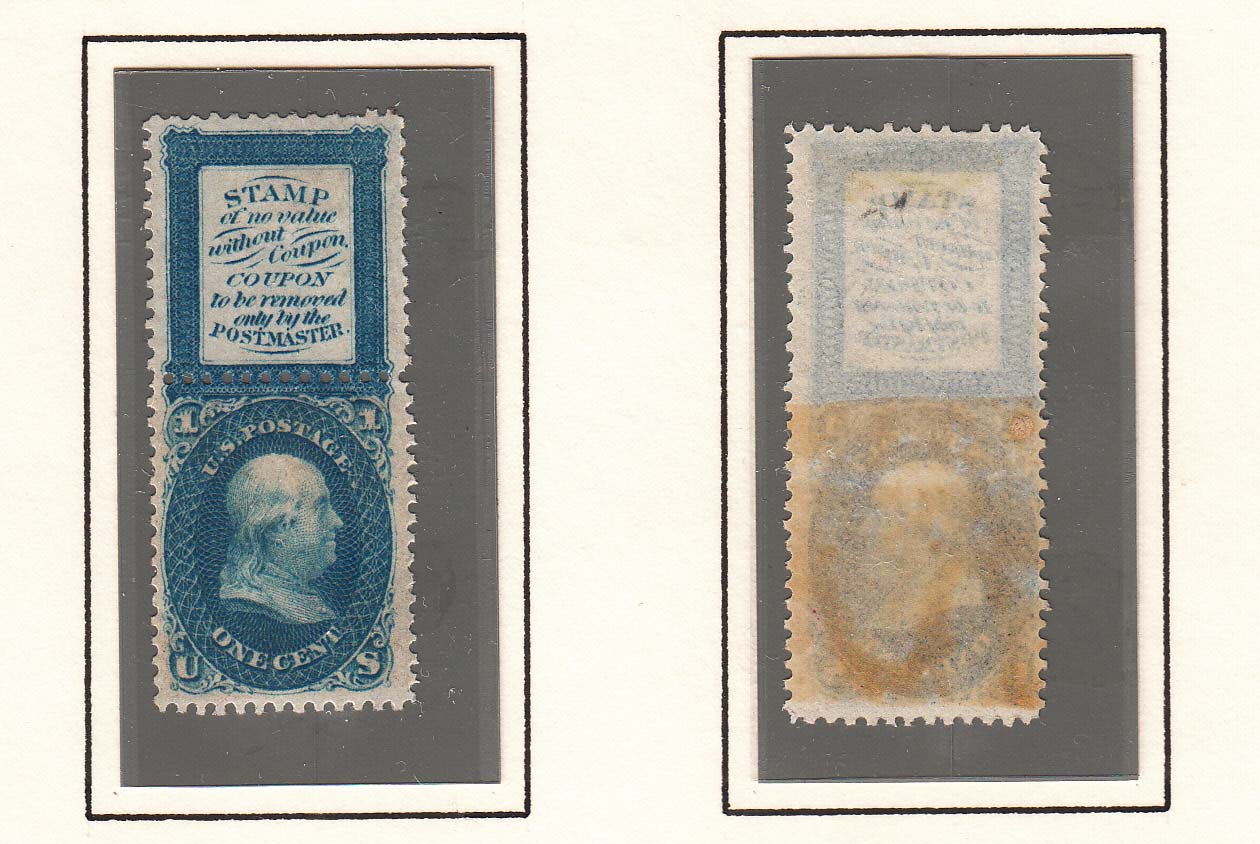
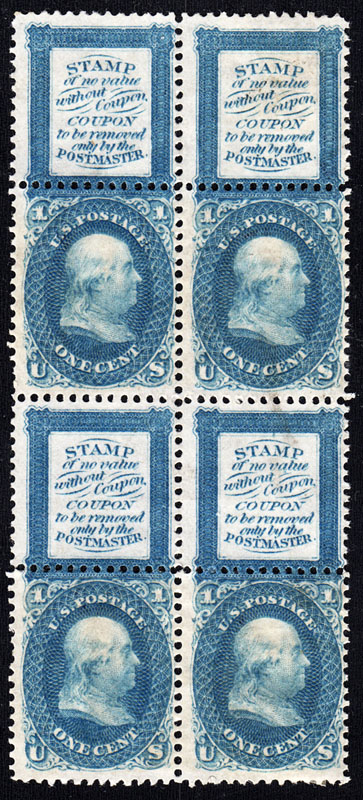
Now that I have attended to my icy front steps it is time to devote some attention to the latest developments here. And for starters I want to shout out a word of encouragement to Mr. Smith for the spadework he has done in finding references and images for putting a case together. Now I wish to refine it, but with all respect for what he has tried to do. Good job my friend!
Your detective work is good, but in your interpretations you are jumping to some conclusions, some of which may have merit, but some of it is mistaken. Please recall that before you told me what you were reading you had reported that a portrait of Jackson was preferred for the 5c and that a plate had been made for that. Your question to me concerned what that might look like. As it turns out this is very far from the events described in the correspondence as referenced by Ms. Clark of the NPM. My task now is to help sort out fact from fancy.
Though not named as such, the article by Ms Clark is a 1997 first glimpse of what came to be called "the Travers Papers," which had been donated to the NPM by the late Jack Rosenthal for the national collection. The contents of these papers have subsequently been edited and published, first in book form for the issue of 1847, and now online at the USPCS website for the rest. I am familiar with them in a general way, especially for the period of the Bank Note issues, but since I am not a student of the issue of 1847 I only get into details of its discussion on occasion.
You can find out more about all this at the USPCS archive here:
http://www.uspcs.org/travers-papers/Two letters from 1845 argue for the utility of a Federal postage stamp, for which an act of Congress would be required. After a gap of two years, the correspondence begins in earnest with two items from March 20, 1847:
March 20, 1847: New York City
The firm of Rawdon, Wright, Hatch and Edson (RWH & E) submit rough designs for the proposed five- and ten-cent stamps. The stamps would be sold to the Post Office Department at the rate of 25 cents per thousand.
March 20, 1847: New York City
RWH & E submit the five- and ten-cent stamp designs to J. W. Brown, the Second Assistant PMG, for his approval. They inform him that they have followed his suggestion and used the head of Benjamin Franklin in place of the head of Jackson, which had originally been requested by the PMG. If the PMG still preferred Jackson it could be used instead. The firm was making steel dies of the designs so that the stamps could be produced immediately in the event that the designs were approved.
According to this correspondence:
1. the suggestion of the PMG to use a Jackson portrait was just that, and it did not go very far.
2. the recommendation to use a bust of Franklin came from the 2nd ass't PMG, and was incorporated into the design submissions by R,W,H & E.
3. RWH&E were willing to use a bust of Jackson instead of Franklin if the PMG preferred, but intimated that either way the same frame would be used.
Preparation of the steel dies would proceed on the assumption that their proposal would be approved, starting with the frames alone.
Here is an image of the earliest surviving design stage of the frame for the 5c, which was ultimately approved. It is taken from the sale catalog for the "Belmont" collection by Siegel in 1981.
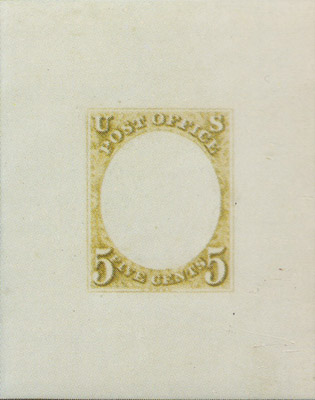
As for the suggestion of the Postmaster General that a vignette of Jackson be used for the new stamps, the correspondence is silent about exactly when that preference was expressed. Jackson had died in 1845, and as things go in Washington, there may have been some immediate sentiment to memorialize the man with a lasting tribute. But the correspondence does not tell us the motive of the PMG for the thought, nor its intensity. The suggestion of the 2nd assistant PMG apparently had more going for it.
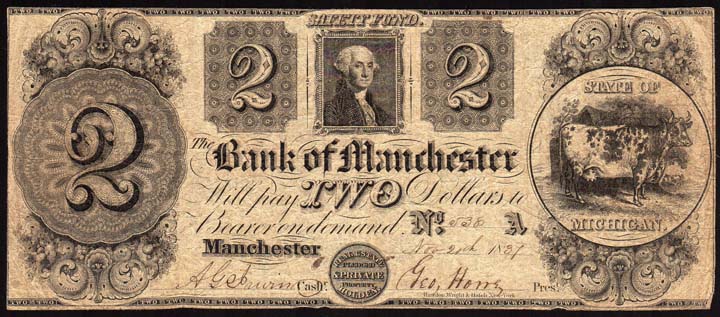
It has long been known that the Franklin vignette used in the design for the 5c of 1847 was originally designed and engraved by Asher B. Durand, who never worked for RWH&E. He created a stock die for use on banknotes about 1830 or earlier while in partnership with his brother and others as Durand, Perkins & Co. The assets of the company were liquidated in 1832, and that is when the stock die of Franklin was acquired by the newly formed Rawdon, Wright, Hatch & Co. (immediate predecessor to RWH&E). Ms. Clark referenced a use of this Franklin vignette in a note of the Bank of Manchester, Michigan, and a corresponding use of the Washington stock die on another note of the same bank. Here is the note for the Franklin:
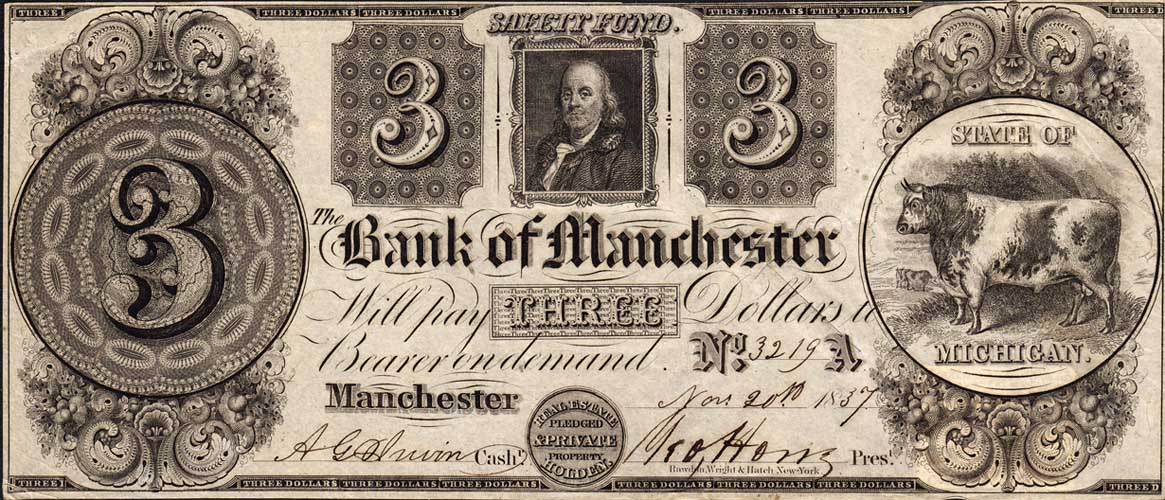
Note that it is dated to November of 1837. That is comparatively late for this vignette. Here is a much earlier note from the Merchants and Planters Bank at Magnolia (Florida) which is dated to December 20, 1832. This is within a few months of the first organization of RWH&Co. and is the earliest use of this vignette by them.
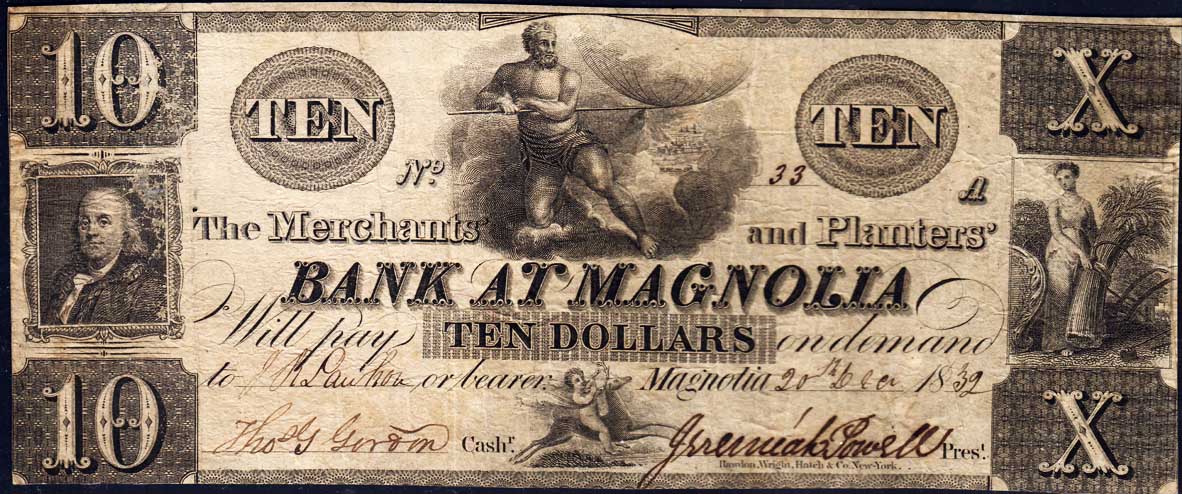
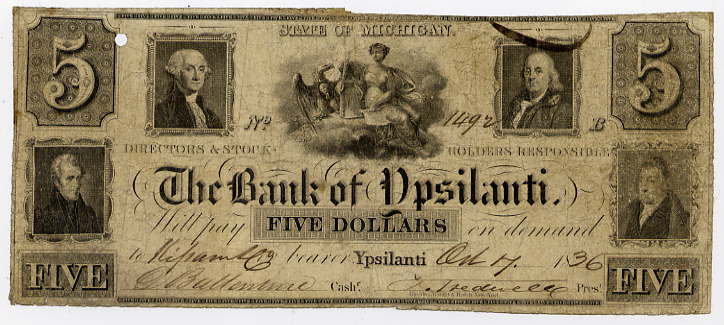
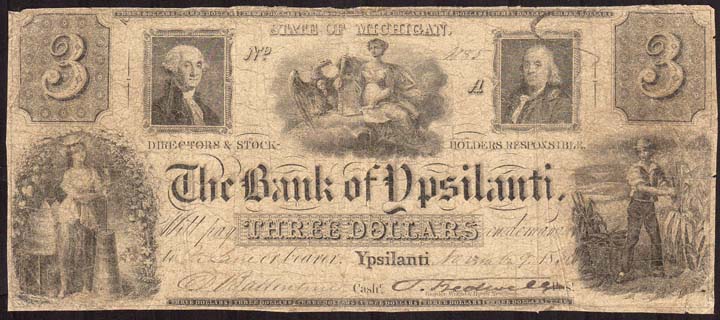
The Travers Papers make it clear that the engravers had planned from the outset on a vignette of Franklin, and this was the vignette they planned to use in the frame as given above. However, if the PMG insisted on a vignette of Jackson, they were prepared with a stock vignette of the same vintage as the Franklin (which is illustrated on the 1836 Ypsilanti note above) to place him in the frame. This I believe is your thinking as well.
In all this I see no evidence, nor the basis for any claim, that the engraving of a new die for a postage stamp showing a vignette of Jackson ever took place, let alone the claim that a plate was fashioned from such a die.
Edit: Let me here add the note that the year dates on the notes in this post, and the vast majority of all others, were added in pen to the notes at the time of their usage, not at the time of their printing. Some notes do bear printed dates as part of their designs, but when these are added in pen, as here, they are the work of the bank officials who authorize them for use as currency. This means that a note might have been produced months or even years prior to their usage. Because the banks issuing the notes paid a tidy sum to have them prepared, generally speaking not much time went by before they get a date written on. But these dates only give us a
terminus post quem for the date of production of the note itself.





 Posted 01/07/2016 10:14 am