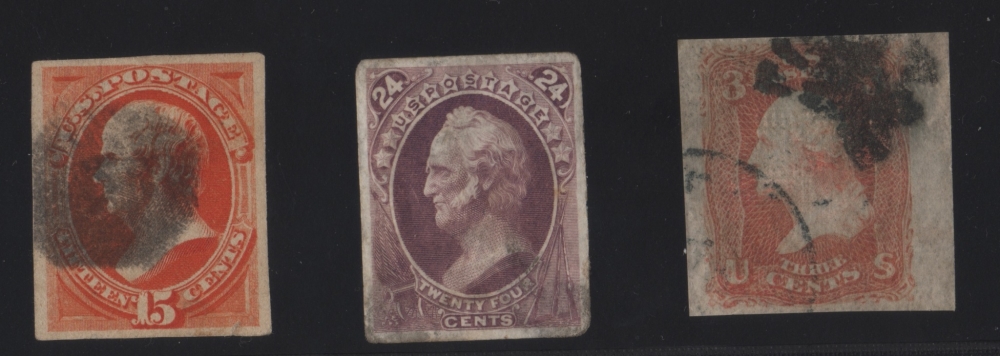
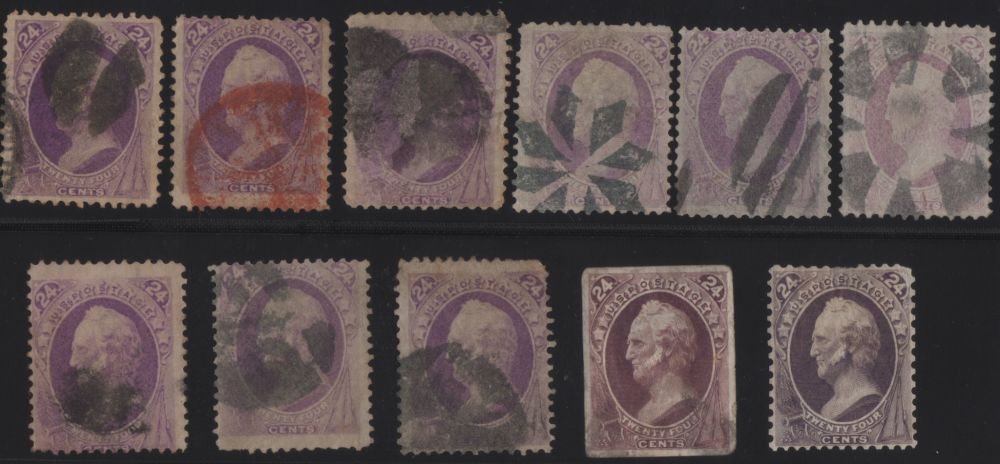
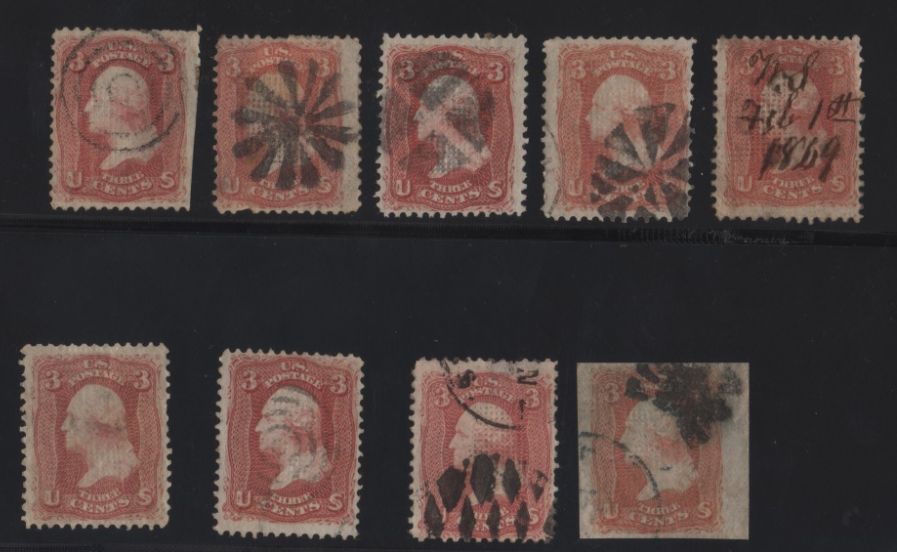
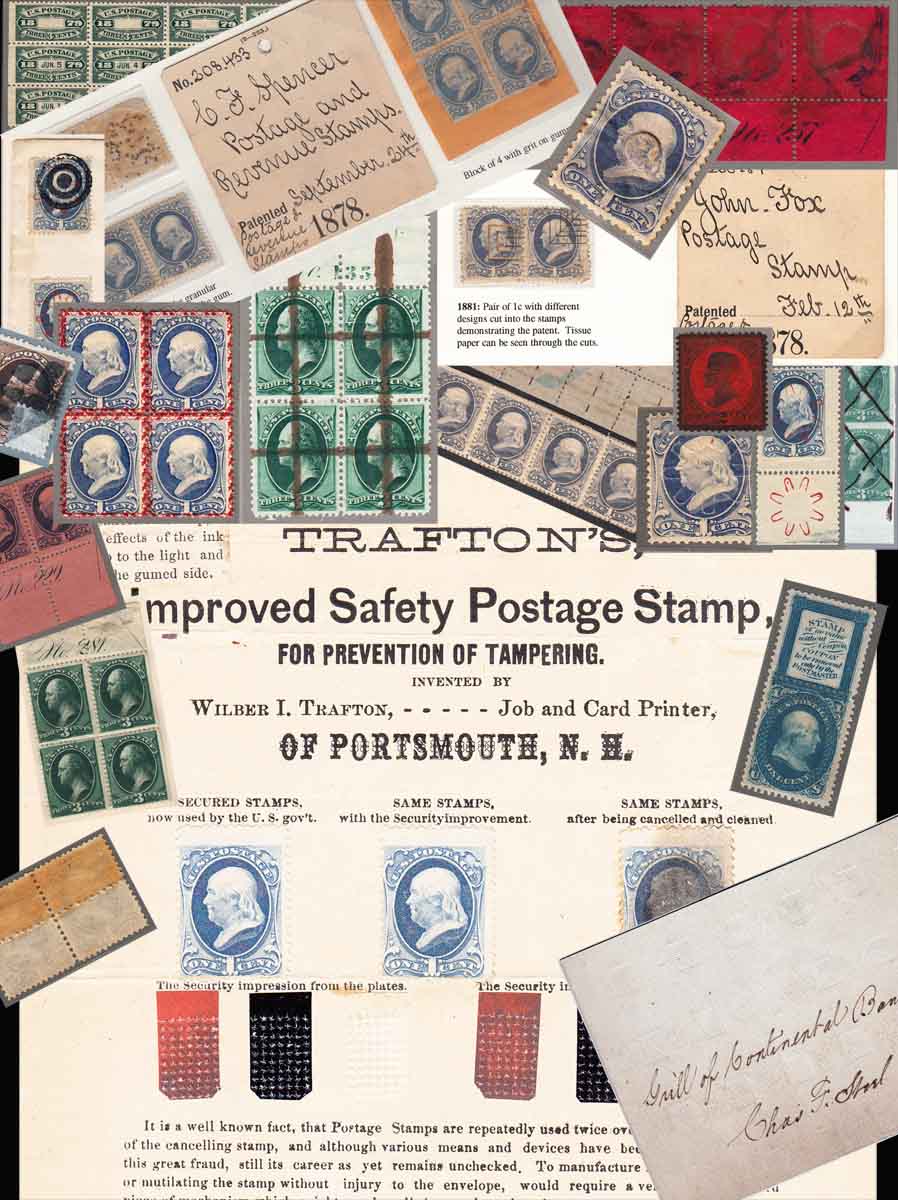
The following exchange started to take place in another thread (
https://goscf.com/t/47078 ) but deserves separate treatment. So I decided to start this thread to take up the subject.
dsmith426 asked:
Quote:
Ok, I'll ask a question. I'm a younger person exploring the possibility of getting into this hobby. I really like the look of early stamps. Could you explain what are 'plate proofs?' and how the public originally obtained them?
My initial response needed clarification (see link) hence the need for this thread. I have put his questions in quotes.
Quote:
essayk,
It's not clear to me what you mean by..
"that was NOT intended for normal distribution to the public through sale by the Post Office Department or USPS"
My first read of this made me think that it wasn't available to then public for purchase. My second read of this made me think that is was available to the public but not from your local post office. My third reading I started to redefine what normal distribution really means and also how is it tied to the public or if 'the public' isn't important in your definition.
So please clarify what is meant in the quotation.
Proofs were never made available for sale to the general public at post offices. However, occasionally the government would release some proofs to the public, particularly to stamp collectors. However, because proofs were not valid for postage, they were not sold. Other channels of distribution were used to get them out. They were given to those who knew how to write in and request them. Some proofs could be obtained by writing to the Post Office Department in Washington. Some proofs were favor items from Senators or Congressmen. Some proofs leaked out of the production system, through various classes of employees. What the government did not demand back was fair game for collectors.
Here is a pic of some of the special envelopes used to send proofs to those who requested them during the period 1879-1893:
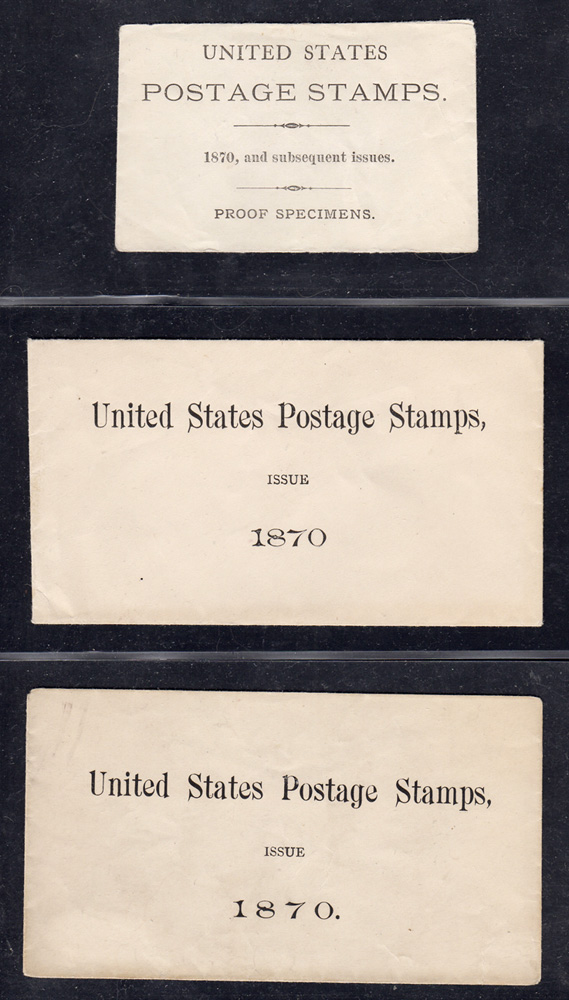
More will be said about these below.
Since revcollector has already given good responses to your original set of questions (see link), I will only add explanatory comments or my alterations to what he has already said.
Quote:
(1) if proofs are printed from sheets
(a) are proofs ubiquitous in the marketplace?
(b) do people collect them by the sheet or blocks like normal stamps?
The only proofs that could occur in sheet form are plate proofs, which are printed from multiple subject plates. Proofs printed from the master dies that had the original engraving used to make the plates also exist, and these were printed one at a time, with only one example of the design to a sheet.
I infer that your question "(a)" asks about the abundance of proofs in the marketplace (it's not a question of ubiquity):
The number of proofs for any stamp is but a tiny fraction of the number of examples of that same design as stamps. Proofs are all "rare" in terms of number, but usually do not have extraordinary value because of limited demand. Stamps that were issued in a quantity of 2500 would be considered great rarities, but most proofs in that number are regarded as very common.
There are very few full panes or sheets of plate proofs still in existence. Blocks vary considerably in size and availability. However, proofs are collected in all the same ways unusued stamps might be, including plate items, autographed items, and favor items.
Quote:
"(2) Since they are printed from plates at anytime does that mean there are proofs from worn out and/or damaged plates?"
When plate proofs are printed after the stamp ceases to be current, they are generally pulled from a new plate specifically fashioned for making reprints. Later printings from die proofs are in the latest state of the original die, with but few exceptions. Proof impressions, whether from die or plate, will be some of the finest impressions known for the state of a stamp from among any that exist. Nonetheless, proof impressions showing damage to a plate do exist. Proof collectors generally do not place a premium on them, and they may even be regarded as of secondary interest except to particular specialists. As always, there are notable exceptions, such as the 1869 inverted-center plate proofs.
Quote:
"(4) Is there any way for someone to know when a proof was printed?"
This varies greatly. I have some proofs with marginal notations by the PMG that date them to month, day, and year. Others to year only. Plate proofs on cardboard were made available in 5 emissions, with variations, and these have been arranged by earlier students according to the characteristics of each set by year of issuance. In most cases, proof items have been studied long enough to have a history of when they were first created. But that history is neither absolute nor complete in all respects.
Here, for example, is a set of plate proofs on cardboard which were arranged on album page by the great proof researcher, Clarence Brazer.
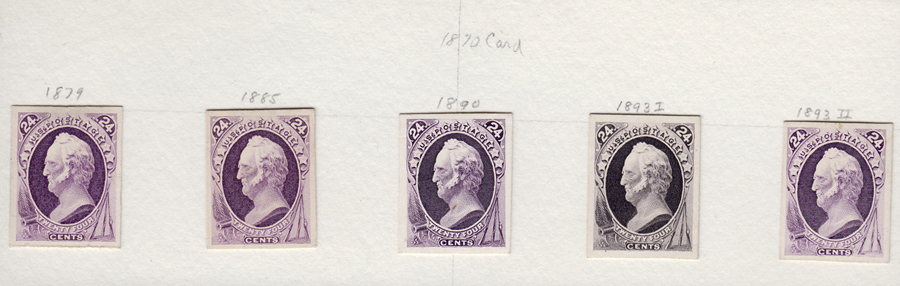
They are arranged chronologically for the five different emissions of card proofs from 1879-1893/4. These correspond to the envelopes above plus two more.
Quote:
"(5) What is more valuable to a collector(s) a proof or a trial color proof"
revcollector has said that this depends on how one is trying to collect, and that really is the heart of it. Collectors are willing to pay more for items they "need" than for things they don't actively collect. Obviously, if they enter into a new collecting domain, they will tend to "need" more things. But with proofs (and essays) the people who need them most are those who are doing special studies of the origins of the stamps in which they specialize. Often these are people who exhibit. Usually they are well informed about their specialty.
For many collectors proofs are a good substitute for sets of stamps that are peripheral to their main interest. For example, my primary collecting interest is in the US Banknote issues. But for the 1847, 1851, 1861 and 1869 issues I have sets of plate proofs on India paper which I use to give me first hand examples of their designs and colors. So I am able to do direct comparisons of some of the 1861 premier gravures with their second issue counterparts and see the detail differences directly. (alas I do not have all the premiere gravure items even as proofs).
Quote:
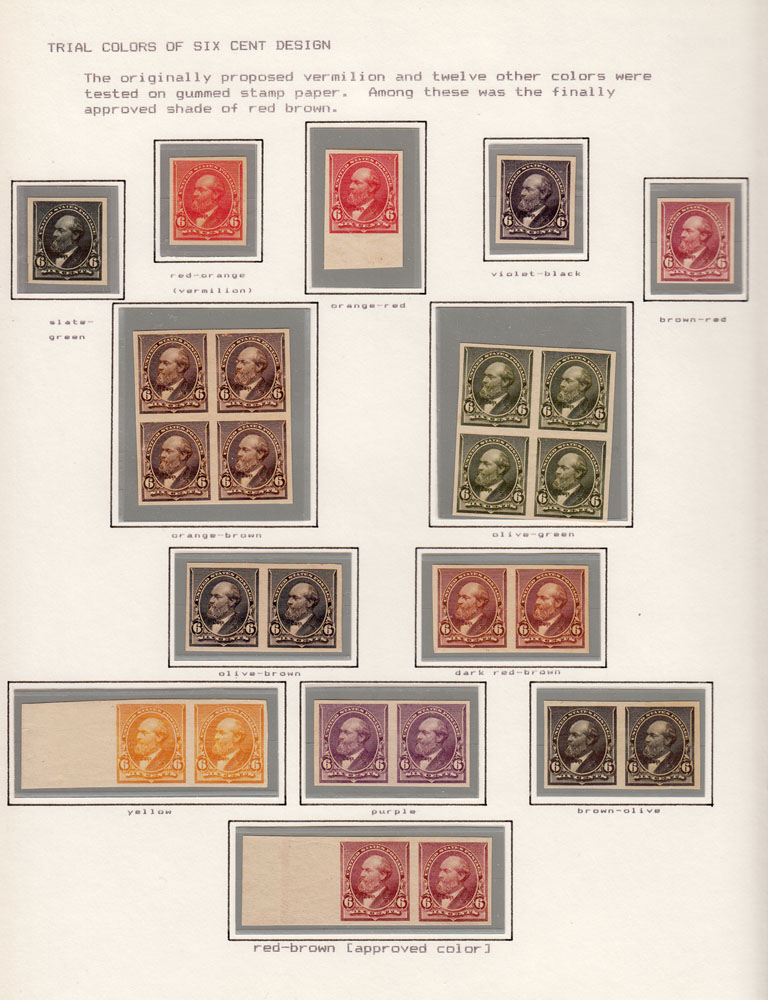
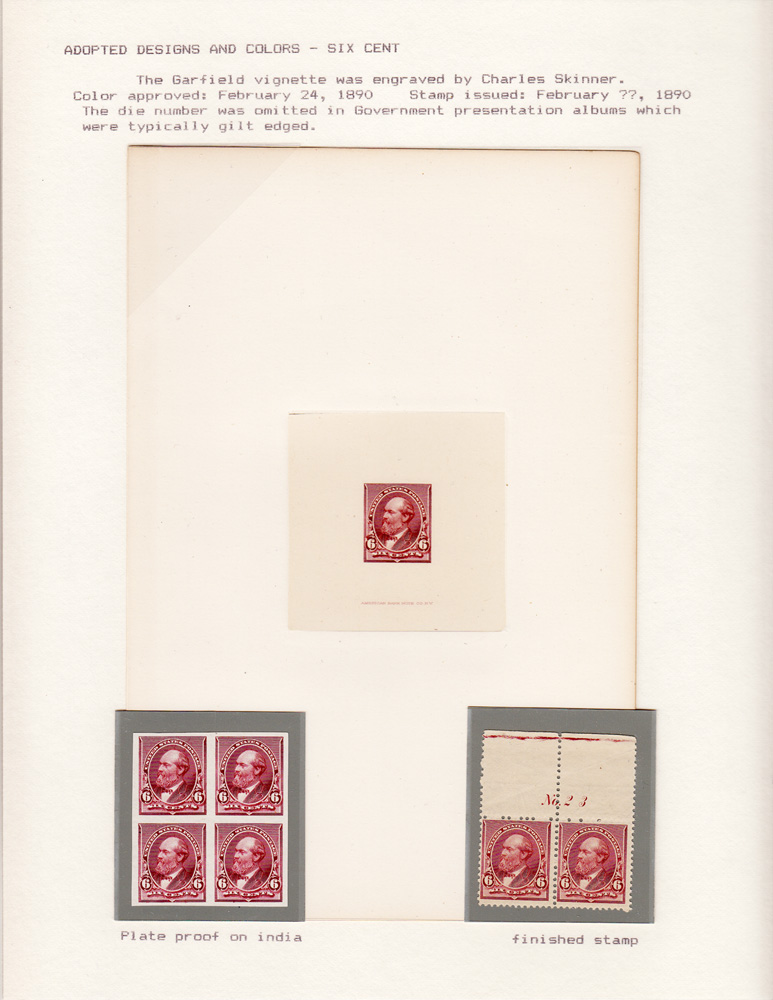
(6) A scenario question: for a set of trial color proofs (which we know these specific ones are for a fact are actual ones produced prior to the choice of color) is the one which is the same color of the printed stamps automatically change the status of that specific 'trial color proof' to a 'proof' or does it stay a 'trial color proof' as it was born that way (ie. the defining moment is fixed to the time of printing only)"
Here are two pages from an old exhibit I did which speak to your question. The 6c of 1890 had 13 trial color proofs on stamp paper prior to the approval date. The first page shows all the colors, one of which was approved. The second page shows the approved color alone. When the color is selected, all prints in that color are treated as issue proofs and not trial colors.
However, from your questions I'm not sure you are thinking about the term "trial color" in the broad sense in which that is defined by philatelists with reference to US material. Here are some examples of proofs that were pulled to spot check the plate for areas needing final touchup. They were created after the stamp was already in production in its normal color.
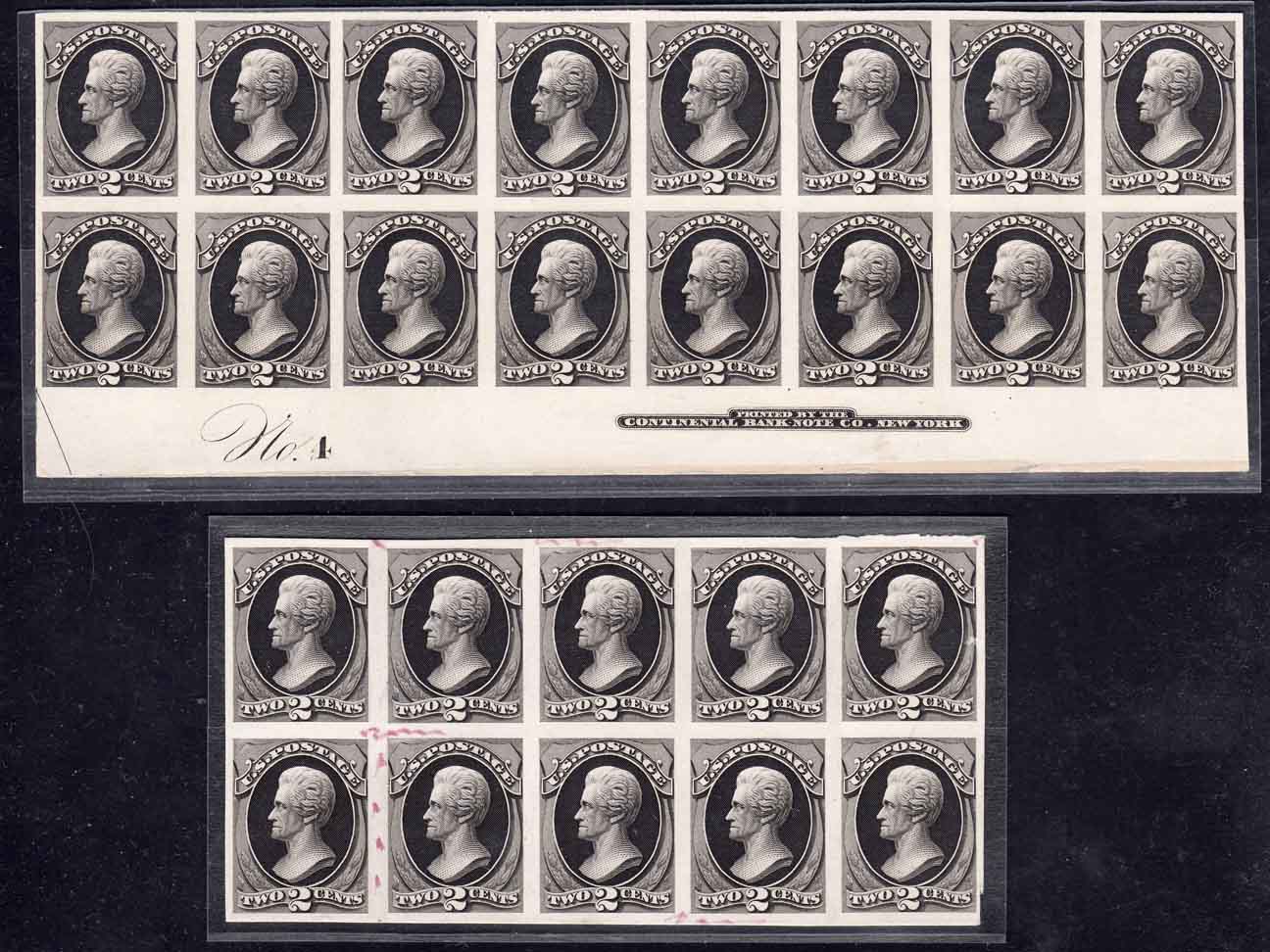
These proofs were not testing black as a potential color for the stamps. It was used because it was easier to spot plate anomalies win black prints. The lower block has crayon markings to indicate where problems needed attention. The upper block is not marked up, but is a collectable part of the sheet for such a trial color. This also addresses your earlier question about collecting fashion for proofs like this.





 Posted 01/05/2016 9:03 pm