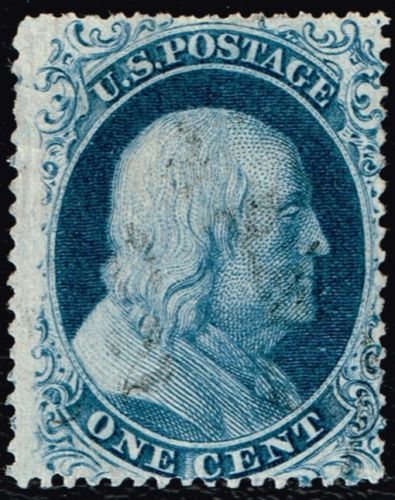
lukusw - hard to be sure on that one. It might be, but probably not enough left to tell due to bad centering.
If I recall correctly, position 3L4 is the one most frequently a IIIA. I had an imperforate and a perforated copy, and I want to say that both were IIIA's, although I never sent them to the PF ... they had pretty big breaks, easily > .2mm to satisfy the criteria.
I parted with my stuff over 10 years ago, so my memory may be a bit funny, but I'm pretty sure that the perforated one I had was a IIIA as well. That is telling, since on plate 4, usually the perforated impressions tend to be better than their imperforate counterparts. I haven't ever seen any evidence of plate re-entry, aka double-transfers, so I'll continue to run with Ashbrook/Neinken's explanation. That is that the sheets were printed, then stacked LIFO (last in first out), and used from the top. So the imperforates, used first, were the most worn printings, followed later by the perforated ones, which, at the bottom were better printings. Its a simplistic explanation, which may not be precisely correct, but it seems as though something like that may well have occurred.
Why does that matter for this discussion? Well, if the perforated impression is an earlier printing than the imperforate impression, which seems likely based upon empirical evidence of plate 4 stamps, then if the the perforated one has a broken bottom line, that says that the line was really weak, and that its likely that many, maybe even most 3L4's had a broken bottom line. I don't know what the percentage of 3L4's that are Ty II vs Ty IIIA are.
|





 Posted 11/16/2016 4:19 pm