| Author |
 Replies: 27 / Views: 9,724 Replies: 27 / Views: 9,724 |
|
Valued Member
Canada
379 Posts |
|
|
How to make the difference between those 2 printing method? The color? the size?...  |
|
Send note to Staff
|
|
|
|
|
Pillar Of The Community
3865 Posts |
|
|
For Canada unlike U.S. stamps one cannot use the size of the design because the rotary are wet printed and the flat plate are dry printed for Canada Arch/Leaf and Medallion issues. For U.S. stamps, both are wet printed so that the rotary design is slightly larger in size than the flat plate one. The gum on rotary shows horizontal lines in the back (gum breaker ridges) to prevent stamp curling while the gum on the flat is smooth and shows embossing. The perfs on rotary are usually 11.25 x 10.95 while those on flat are 10.95 x 10.95 due to different perforators used. The only exception is the 195d which is actually a rotary press dry printed stamp that resembles a flat printed stamp because its gum is smooth and it has embossing on the back but its perforations are 11.25 x 10.95 as a rotary press stamp and not 10.95 x 10.95 as a flat plate stamp. The rotary press plate block stamps usually have small trimmed corner margins with horizontal margin being smaller than the vertical margin and horizontal perfs do not run all the way through the vertical margin. The flat plate plate blocks have large margins and the perforations run all the way through them. For Arch/Leaf and Medallions, all booklet stamps except one (164ai rotary press) are flat plate. For Arch/Leaf sheet and Medallion sheet stamps, the 1 cent, 2 cents and 3 cents are all rotary press. For the Arch/Leaf, the violet 5 cents exist in both rotary and flat. All of the other sheet stamps are flat. All Arch/Leaf and Medallion coils are rotary press coils gauging 8.75 vertically. The 3 cents overprinted surcharge on 2 cents and the 3 cents Economic Conference are also rotary press. (It would be helpful if the Canada specialized catalogue had all of this information.) |
Send note to Staff 
|
| Edited by jogil - 11/15/2013 11:39 am |
|
|
Valued Member
Canada
379 Posts |
|
|
jogil : can you show us with pictures/scans the difference between a flat print and a rotary print? (one of KGV issues) |
|
Send note to Staff
|
|
|
Pillar Of The Community
3865 Posts |
|
|
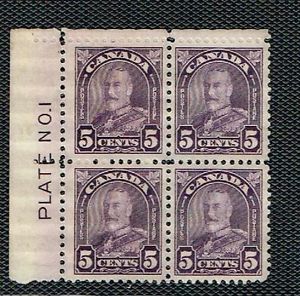 (wet) rotary press front (# 169) [11.25 x 10.95] (horizontal gum breaker ridges) 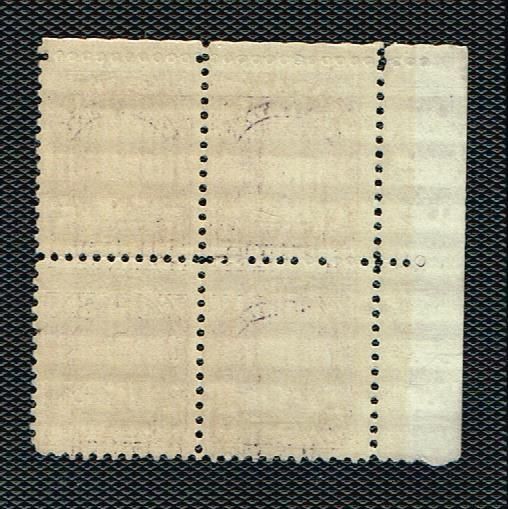 (wet) rotary press back (# 169) [11.25 x 10.95] (horizontal gum breaker ridges) 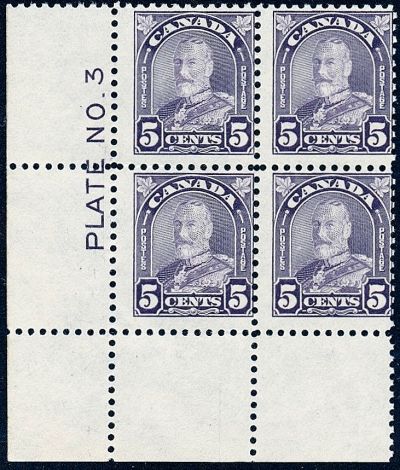 (dry) flat plate front (# 169a) [10.95 x 10.95] (smoooth gum) 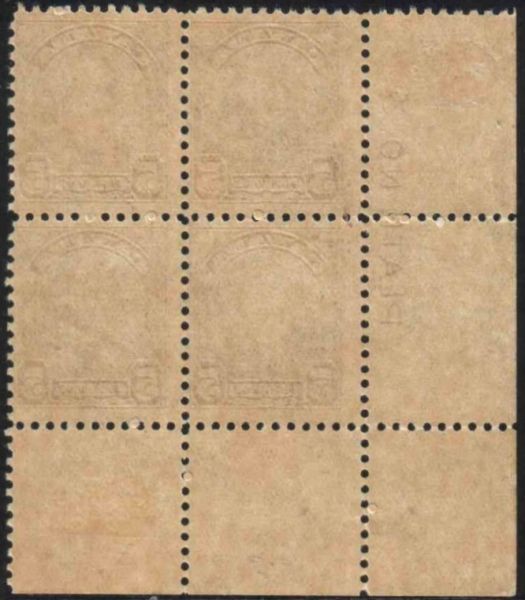 (dry) flat plate back (# 169a) [10.95 x 10.95] (smooth gum) |
|
Send note to Staff
|
| Edited by jogil - 11/15/2013 8:25 pm |
|
|
Valued Member
Canada
379 Posts |
|
|
great images, thanks, very visual  Do you have references so I can read more on the #195d and the different methods of printing? |
|
Send note to Staff
|
|
|
Pillar Of The Community
3865 Posts |
|
|
A very good reference is "The Medallion Issue 1932", by Douglas M. Casey. |
|
Send note to Staff
|
|
|
Valued Member
Canada
379 Posts |
|
|
jogil : You are wright when you mention that there was no flat plate printing process for the Unitrade #195d. I have found this handbook : "The Medallion Issue, 1932 by Douglas M.Casey" ...next is a copy of what Mr. Casey included in the handbook regarding the printing, specifically for the Unitrade #195 (195d) 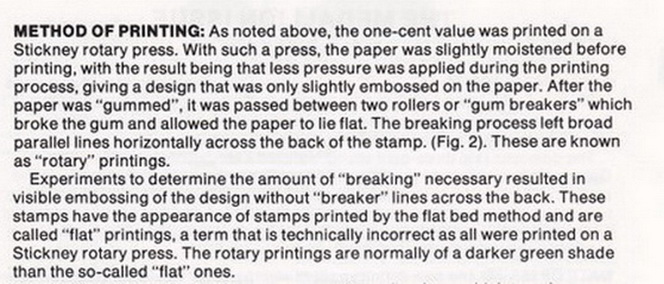 |
|
Send note to Staff
|
|
|
Pillar Of The Community
3865 Posts |
|
|
Valued Member
Canada
379 Posts |
|
|
I collect the complete issue plus the varieties, the many shades of the 1c 2c 3c 4c and 5c...
Right now I am going through a couple of hundred of the green 1 cent stamp. So far, I have found over 30+ different precancel style (max 70 styles), some with missing ink during the printing, misprinting... I do not specialize with the pre cancel but this time it's quite unique because of the quantity in hand.
I have found 1 stamp with an obliteration from my own town (Chambly, QC).
Some perfin (because they are in the bunch)...
I am looking for the #198i 4c brownish ochre shade and #199ii "blue-nose" re-entry.
The Unitrade catalogue is my reference for the collection but when it gets more specific like this thread, I dig a little bit deeper, I want to know more... and this web site is fantastic. The people in this forum are very generous with their knowledge, I have learn a lot because of people like you who did not hesitate to share |
|
Send note to Staff
|
|
|
Valued Member
Canada
379 Posts |
|
|
Pillar Of The Community
Canada
1084 Posts |
|
|
Valued Member
Canada
379 Posts |
|
|
jogil : still looking for a 2014 Unitrade cat?
I have 2 brand new, one for sale for $30 |
|
Send note to Staff
|
|
|
Pillar Of The Community
3865 Posts |
|
|
Thank you for your compliments. The catalogue price that you quote is great, but I am afraid that the shipping cost to Toronto would greatly add to it. |
|
Send note to Staff
|
| Edited by jogil - 11/20/2013 09:14 am |
|
|
Pillar Of The Community
3865 Posts |
|
|
Interestingly, the first (Stickney) rotary press sheet stamp was U.S. # 542 from 1920. However, the first such rotary press stamp to have the corner block of 4 plate block with corner plate number was U.S. # 543 from 1921 since # 542 had the plate numbers on the sides so it was collected in blocks of 6 like the U.S. flat plate plate blocks and # 543 has both types of plate blocks since there was a change over from side numbers to corner numbers for rotary press issues. 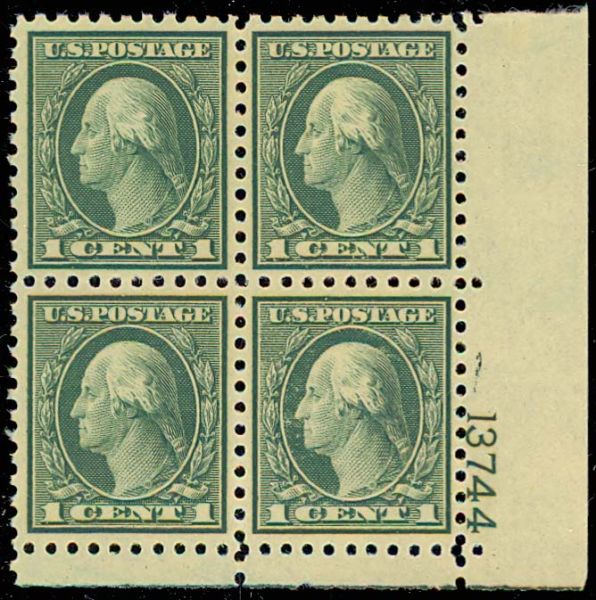 Bileski states that the BABN 1930 issues were the first to have the four corner matched plate numbers, but it was first actually done by the BEP as shown in the above 1921 issue. |
|
Send note to Staff
|
| Edited by jogil - 11/23/2013 01:36 am |
|
|
Pillar Of The Community
Canada
1084 Posts |
|
|
Today I was experimenting with converting pdf files to text using Google Drive/Google Docs. I have done this with other programs and generally believe it is faster to type if you are a good typist given OCR today. Rather than jettison it, it struck me that the flat vs rotary article from BNATOPICS 1945, v2n1 by W.R. Hoffman suited this thread. In some respects it is similar to Koala's post above but for historical perspective here it is: Quote:
Regarding the so-called flat and rotary printing of Canadian postage stamps in recent years, all 20th Century postage stamps have been printed on presses which are rotary in action. - that is, the plates are curved and are attached to Cylinders which describe a. complete circle during the printing process.
The Canadian Bank Note Co., who had the contract for printing postage stamps prior to 1930 and after 1935, use their own type of press which prints from curved plates by a rotary motion on individual dry and gummed sheets of paper ...according to the size of the stamps which are being printed. These presses, it is understood, are largely of the Company's own design and development, and apparently do not have any particular name. In the case of stamps issued in roll form. or "coils", two semi-cylindrical plates are used on a small press which prints the stamps on a continuous web of paper.
When the British American Bank Note Company took over the contract in 1930. they printed the l cent, 2 cent and 3 cent stamps, also some of the 5 cent, on the "Stickney" press, which prints from two semi-cylindrical plates on a continuous web of dampened paper that is gummed and dried on the press immediately after printing.
The following items were printed on the "Stickney" press from 1930 to 1935:
King George V - 1930 1c, 2c, 3c & 5c. Plates #1 & #2.
King George V - 1932, "Medallion" 1c, 2c & 3c.
On some of the Stickney press printings the "ridged" gum peculiar to this type of printing. was due to the action of two ridged steel rollers which "broke up" the gum when the web of paper was cut into sheets of 400 stamps and perforated in order to flatten out the roller-paper and make it stack readily into piles of 400/on sheets. This pressure was reduced almost to the vanishing point, as the manufacturers had found that when the web of paper was properly seasoned and not dried out too much, this process. which did not add to the appearance of the stamps, was not so essential as the manufacturers of the press had supposed. In some instances the sheets, although printed on the Stickney press. show very little of the "ridging", and this has given rise to the theory that there are some printings of the 1 cent, 2 cent and 3 cent values by the flat press method.
The only positive. means of identifying "flat" from Stickney "rotary" press printings, is the type of edge at the top and bottom of the 400/on sheet. On the Stickney press printings the edges are wavy or rough-cut, as made by a wavy-edged rotary knife - side edges are guillotined.
On the "flat" or' non-Stickney printing, the top, bottom and side edges are all straight cuts, all guillotined. These are collectible items, give them any name you choose. |
|
Send note to Staff
|
|
|
Pillar Of The Community
3865 Posts |
|
|
One of the best ways to distinguish between them is by perforation measurement.
Canada:
Rotary press 11.25 x 10.95 (Kiusalas 11-70 by Kiusalas 11-72)
Flat press 10.95 x 10.95 (Kiusalas 11-72 by Kiusalas 11-72)
U.S.A.:
Rotary press 11.25 x 10.5 or 10.5 x 11.25 (Kiusalas 11-70 by Kiusalas 10.5-75 or Kiusalas 10.5-75 by Kiusalas 11-70)
Flat plate 10.95 x 10.95 (Kiusalas 11-72 by Kiusalas 11-72) |
|
Send note to Staff
|
| Edited by jogil - 11/23/2013 07:09 am |
|
|
Replies: 27 / Views: 9,724 |
|




 Posted 11/15/2013 08:12 am


