This stamp was printed by Lowe-Martin. At the time Lowe-Martin used a die cutting mat that produced 100 unique stamps per mat, in a 10x10 grid.
For this particular stamp (51c Flower), two different die cutting mats were used to produce the coils of 100 stamps. Thus, there are 200 unique stamps that can be identified - 100 per die cutting mat.
To find the exact position of the stamp in the 10x10 grid one must have a 'plating' set of rolls available. That would require having strips of 10 from the 10 different rolls (for each die cutting mat).
Scott number 2128 is for a single stamp from the first die cutting mat used for this stamp (identified as Pattern 6 in the Robin Harris' Lowe-Martin Serpentine Die Cutting document:
http://www.adminware.ca/LoweMartin/). [i.e. it was the sixth die cutting mat identified to have been employed by Lowe-Martin.]
Unitrade number 2128vi is for a single from the second die cutting mat used on this stamp (identified as Pattern 7).
The die cutting measurement is a partial method of identifying the possible pattern and position of a stamp. However, one must also use the 'nib' locations found on each stamp to 'plate' a specific position.
Pattern 6 had die cut measurements that range from 7.00 to 7.70: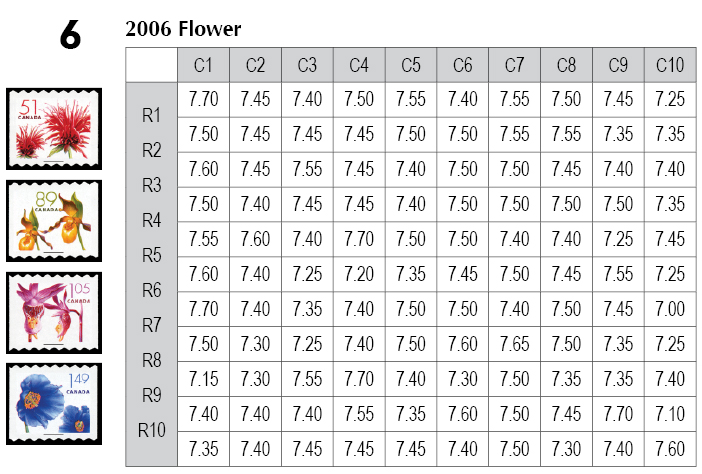 Pattern 7 had die cut measurements that range from 7.20 to 9.30
, with the majority being over 8. In particular, one row of die cutting gave a measurement of 7.20-7.50 with the adjacent side being 8.40-9.30 ... a so-called 'compound' die cut.
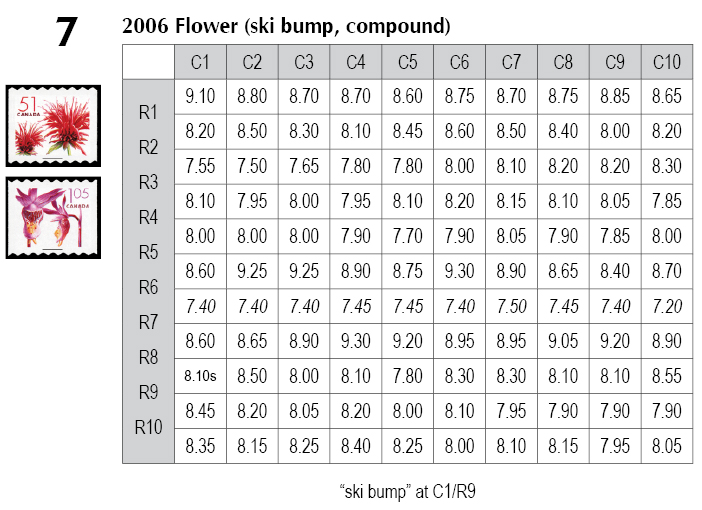
A stamp can come from Pattern 7 even if it does not have the compound die cut. Here are 4 examples of this stamp. The left stamp is from Pattern 6 while the other 3 (including a compound example) are from Pattern 7:
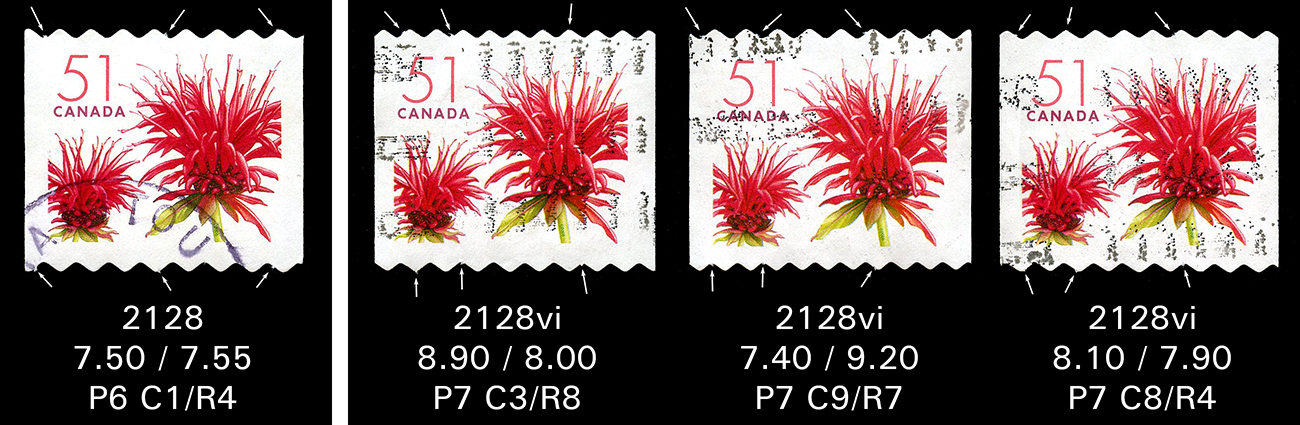
The arrows in the diagram above point out the 'nibs'.
Just to re-iterate: it is a
combination of
both the die cutting
measurement and the '
nibs' that are required to plate a stamp.





 Posted 02/18/2014 2:27 pm


