| Author |
 Replies: 23 / Views: 3,827 Replies: 23 / Views: 3,827 |
|
Pillar Of The Community
3865 Posts |
|
|
|
Canada 362 is an interesting stamp given that there are several different paper and perforation combination varieties.
Canada 362 with plates 1-3 was printed on horizontally ribbed paper. Plate 2(n) also comes with narrow selvage. Plates 1-3 gauge 11.94 with rough looking smaller perforation holes.
Canada 362i with plate 4 was printed on vertically ribbed paper. Plate 4 gauges 11.85 with clean looking larger perforation holes.
There is one important and scarce variety in between 362 and 362i that has not been catalogued.
It is a scarce plate 4 that was printed on vertically ribbed paper which gauges 11.94 with rough looking smaller perforation holes. So far only upper right plate blocks of these have been found.
What distinguishes this scarce 11.94 perforation stamp from plate 4 from the much more common 11.94 perforation stamps from plates 1-3 is that it has vertically ribbed paper instead of horizontally ribbed paper while it is distinguished from the much more common 11.85 perforation stamp from plate 4 by its 11.94 perforation.
Summary:
362 (plates 1-3), horizontal ribbed paper, perf 11.94
362 variety (plate 4), vertical ribbed paper, perf 11.94
362i (plate 4), vertical ribbed paper, perf 11.85
The scarce transition stamp to look for has vertically ribbed paper and exact matching Kiusalas 12-66 perforations.
|
|
Send note to Staff
|
| Edited by jogil - 12/04/2016 09:24 am |
|
|
|
|
Rest in Peace
7742 Posts |
|
|
jogil...It is s hard with a perf gauge seeing the difference between 12.0 and 11.94...I have 21 of these stamps...Are you just using agauge 8 - Vertical ribbed. 11- Horizontal ribbed. 2 - cant tell. I do see the difference in perfs when I put 2 close together as shown below... 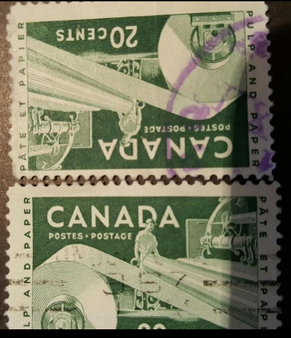 |
Send note to Staff 
|
|
|
Pillar Of The Community
3865 Posts |
|
|
I use a Kiusalas gauge. Those that match Kiusalas 12-66 are from the old perfs. Those that don't match are the new perfs and some say are closer to Kiusalas 12-67
The stamps you show are probably 362 (horizontal ribbed) top with 11.94 perfs and 362i (vertical ribbed) bottom with 11.85 perfs. However, check the paper ribbing direction.
The stamp to look for is vertically ribbed with matching Kiusalas 12-66 perfs. |
|
Send note to Staff
|
| Edited by jogil - 12/04/2016 09:26 am |
|
|
Rest in Peace
7742 Posts |
|
|
Pillar Of The Community
3865 Posts |
|
|
You have the 362 top one and 362i bottom one. The one to look for has the Kiusalas 12-66 perfs of the top one and the vertically ribbed paper of the bottom one. |
|
Send note to Staff
|
| Edited by jogil - 12/04/2016 09:27 am |
|
|
Rest in Peace
7742 Posts |
|
|
jogil..I use a Unitrade guide and it is very, very difficult to determine if you are looking at 12.0 or 11.94...just too close...  Robert |
|
Send note to Staff
|
|
|
Pillar Of The Community
3865 Posts |
|
|
wert: there appears to be no exact 12 except for LQ and SQ as far as I know for line perforated stamps and these also do not match Kiusalas 12-66 but more like 12-65.5 just like the 11.85 does not match Kiusalas 12-66 but more like 12-66.5
You could just use your top reference stamp for 11.94 and your bottom reference stamp for 11.85 since using reference perf stamps like you did can make it easier which is something I also do. |
|
Send note to Staff
|
| Edited by jogil - 12/04/2016 09:42 am |
|
|
Rest in Peace
Canada
5701 Posts |
|
|
Robert, I agree with you, it is virtually impossible to distinguish between 11.85 and 11.94 on a linear perforation gauge. The same goes for the Kiusalas gauge. While it is better since it has the printed "holes" instead of the lines, most of these do not match the actual perforation gauges of early Canadian stamps, including the small queens. Here is a table with actual perforation gauges seen on some Canadian stamps (including the small queens and the stamps shown by Robert). As you can see, only 12.5 (K63) and 11.75 (K67) match perfectly. The values show the Kiusalas rounded numbers and the actual numbers to one decimal place. 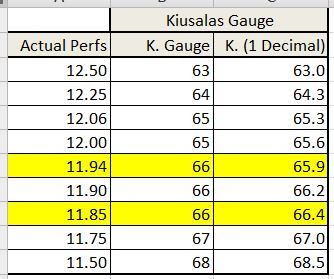 I have created my own Canadian perforation gauge that has the gauges in the "Actual Perfs" column. I drew it in AutoCad and printed it out. When measuring the 11.85 and 11.94 stamps, the difference clearly shows. Once I have scanned the results, I will show them here. |
|
Send note to Staff
|
|
|
|
Pillar Of The Community
3865 Posts |
|
|
BeeSee: Do you have my perforation 1962 booklet? In it I have some perforation gaugings listed as follows:
201 pins/holes with a 4.03125" (4 1/32") wheel diameter and 12.664545" wheel circumference gives around perf. 12.50
197 pins/holes with a 4.03125" (4 1/32") wheel diameter and 12.664545" wheel circumference gives around perf. 12.25
194 pins/holes with a 4.03125" (4 1/32") wheel diameter and 12.664545" wheel circumference gives around perf. 12.06
193 pins/holes with a 4.03125" (4 1/32") wheel diameter and 12.664545" wheel circumference gives around perf. 12.00
192 pins/holes with a 4.03125" (4 1/32") wheel diameter and 12.664545" wheel circumference gives around perf. 11.94
[192 pins/holes with a 4.046875" (4 3/64") wheel diameter and 12.713633" wheel circumference gives around perf. 11.90]
192 pins/holes with a 4.0625" (4 1/16") wheel diameter and 12.762720" wheel circumference gives around perf. 11.85
189 pins/holes with a 4.03125" (4 1/32") wheel diameter and 12.664545" wheel circumference gives around perf. 11.75
185 pins/holes with a 4.03125" (4 1/32") wheel diameter and 12.664545" wheel circumference gives around perf. 11.50
It would appear that our measurements seem to match with each other which means that they support each other. |
|
Send note to Staff
|
| Edited by jogil - 12/05/2016 4:35 pm |
|
|
Rest in Peace
Canada
5701 Posts |
|
|
Yes I have your book Jogil, it has been invaluable  . I will eventually have all the wheels drawn on my Canadian Gauge. In addition to the easy identification of the 11.85 and 11.94 gauge, I have confirmed that the Small Queen gauge that is commonly called 12.1 is actually 12.06. I was able to determine this because I have a strip of 3 and a couple of pairs, and the perforations line up perfectly on my 12.06 gauge, but not on the 12.1 I drew. The longer the strip, the better to show this. Also note there is an error on my table: the perf 12.00 K gauge is actually rounded up to 66, not down to 65. |
|
Send note to Staff
|
|
| Edited by BeeSee - 12/05/2016 5:37 pm |
|
|
Pillar Of The Community
3865 Posts |
|
|
BeeSee: I have just emailed you a file that I have put together over time on Canadian line perforations that may be helpful. I have a similar file on U.S. line perforations too since many of the perforating machines used by both countries were the same. |
|
Send note to Staff
|
| Edited by jogil - 12/05/2016 5:50 pm |
|
|
Moderator

United States
12330 Posts |
|
|
Nice works guys, gotta love CAD jockeys!
But I am still concerned about discussions surrounding perforations out to two decimals points without having some context regarding moisture content of the stamp. Have you guys tried measuring the same stamp in both conditions (wet vs. dry) to see just how much growth shrinkage there is (depending upon the grain of the paper)? Should not any highly detailed perf work contain some kind of 'stamp moisture content' specifications?
Don |
|
Send note to Staff
|
|
|
Pillar Of The Community
3865 Posts |
|
|
51studebaker: Generally mint stamps are preferred over used, especially multiples for this. Also, most Canadian stamps were dry printed after January 1926. |
|
Send note to Staff
|
| Edited by jogil - 12/05/2016 5:54 pm |
|
|
Rest in Peace
Canada
5701 Posts |
|
|
Don, the two decimal places are needed for drawing the gauge accurately. If a known a perforating wheel is 12.06, I want to measure a stamp perforated with it on a 12.06 Gauge, not a 12.0 or 12.1. On the small queen stamps I have checked, the perforations have been pretty consistent with Jogil's wheel information. I think that is because most of the sheets were perforated well after the stamps dried. Of course there may be anomalies, but I have found very few in my samples. |
|
Send note to Staff
|
|
|
|
Moderator
United States
12330 Posts |
|
|
jogil,
Understood. But lots of folks work with used stamps and independent of how they might have originally been manufactured; I suspect that stamp paper can change dimensions depending upon current moisture content. In informal testing I was surprise at just how much stamps could shrink/grow with changes in moisture content. This is probably not significant when discussing a single decimal point but I am less sure once we move to two decimal points.
I only mention it because I feel it is a worthy topic for additional discovery.
Don |
|
Send note to Staff
|
|
|
Pillar Of The Community
3865 Posts |
|
|
Don, you are right that perforations and their gaugings are not an exact science since there are several variables involved that can affect things, especially on older wet printed stamps. |
|
Send note to Staff
|
|
|
Replies: 23 / Views: 3,827 |
|




 Posted 12/04/2016 07:45 am


