| Author |
 Replies: 697 / Views: 136,238 Replies: 697 / Views: 136,238 |
|
|
|
Pillar Of The Community
Australia
4034 Posts |
|
|
 Hi Rod! Now that I am back on terra firma I'd like to give a better answer to no crown on top 1 1/2d red. There are four in single wmk & one in sm wmk. The image is an example of a single wmk. I have resisted the temptation of looking at it magnified. I will post it & then have a good look. In the distance I can still hear my words: " Space cadet, calling earth; come in S.C.F."  KGV |
Send note to Staff 
|
| Edited by KGV Collector - 02/23/2010 10:21 pm |
|
|
Pillar Of The Community
Australia
4034 Posts |
|
|
Two Pence Orange Issue Issued1920 ~ 1922 Die I single wmk perf 14.25 X 14 comb ~ 7 shade groups. Image: example wooly perfs or fluffy perfs. |
|
Send note to Staff
|
|
|
Bedrock Of The Community
Australia
38679 Posts |
|
|
Very nice triplet there KG5, very impressive.
May I take a copy of your scan please?
It can keep my example company :)
Fluffy or Woolley perfs, are considered "rough perfs" in catalogues,
your example illustrates how bad they can get.
I have never read anything in explanation either.
The KG5 had very small tolerances with their perforations, on the whole
('scuse the pun) the employees did a very good job.
I believe I read somewhere those of the fairer sex, carried out the perforations .
|
|
Send note to Staff
|
|
|
Pillar Of The Community
Australia
4034 Posts |
|
|
Yes, Rod. Feel free. Stamp one is position23R 58, no crown. Position 23R 60 end stamp. Sctratch from beard to bottom frame. Can see small white dot under beard . Under magnification the scratch only runs to the oval.
I've not heard of rough perf description & I've not come across an explanation. Always thought it was a paper flaw, but who knows. Thanks. KGV. |
|
Send note to Staff
|
| Edited by KGV Collector - 02/24/2010 6:36 pm |
|
|
Bedrock Of The Community
Australia
38679 Posts |
|
|
Serendipity came knocking  I went looking for the "rough" perf examples, and you may be right, I cannot, at a rough glance spot any "rough perf" listings in the KG5 range, I may be importing the Stanley Gibbons vernacular from my Indian Studies. Here is the 3 states that Gibbons quote in their preamble 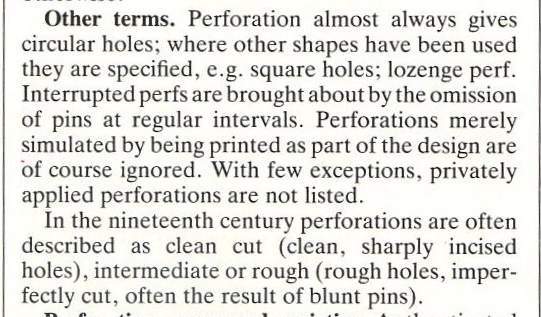 Now for the serendipity whilst browsing, I spotted the reference to "top of crown missing" (begin drum roll.....) Copper electros !! I feel like Livingstone discovering the Zambesi 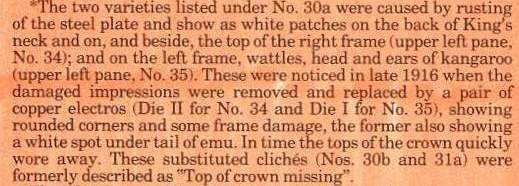 |
|
Send note to Staff
|
|
|
Pillar Of The Community
Australia
4034 Posts |
|
|
Rod your Ref base is totally amazing. You seem to be able to shed
light on anything. Thanks mate.
Blunt pins seems to stand out for me on rough perfs.
Varieties info is great stuff. It just shows what the stamp printers of the day have thrown at us. The substituted cliches are tricky little devils and repairs become totally confusing. Will look and think on this info some more. Thanks again. KGV
|
|
Send note to Staff
|
|
|
Pillar Of The Community
United States
7106 Posts |
|
|
Bedrock Of The Community
Australia
38679 Posts |
|
|
The flow of knowledge.... from the first tentative steps of those stamp collectors in the 1850's, and before, even the lady that wallpapered her room with penny black's, the knowledge flows, we caretake it, and pass it on. Just imagine the profound shock, by the Perth WA Stamp dealer, Wim Smits, when a lady indicated one day in his shop, she had a door stop at home that had stamps on it. Turned out to be the lithographic stone that included the famous "inverted swan"...or so the story goes. One of Wim's adverts from the 1960's I should imagine. 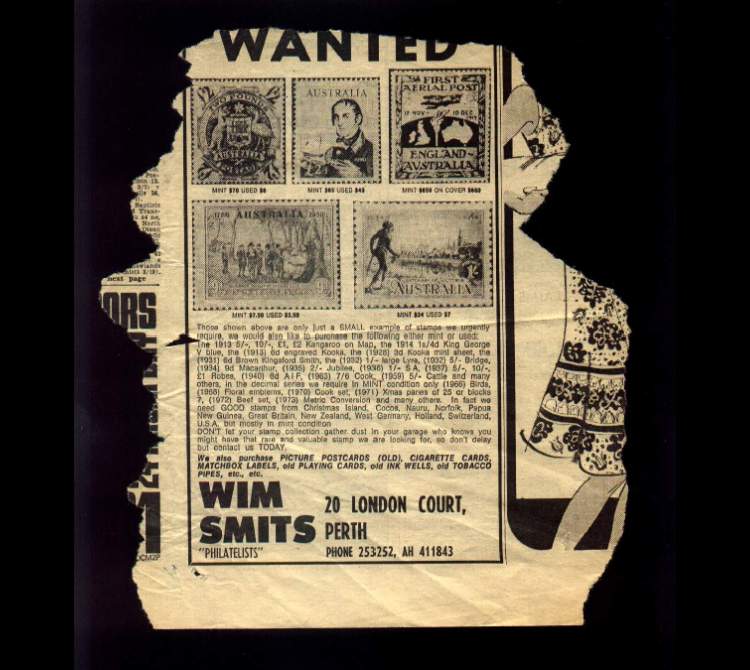 |
|
Send note to Staff
|
|
|
Pillar Of The Community
Australia
4034 Posts |
|
|
Re: Rough perforations
The blunt pins are starting to make sense to me.A blunt pin would stretch the paper so it would be in a larger state than normal. The paper mesh would be pulled apart and give that flawed paper look. They would also stretch the perf holes and not totally cut out the hole. I wonder if many sheets were perforated at once making the bottom sheets very vulnerable to the rough perf effects. I know that very coarse meshed paper is easly detected.The paper is very noticeably coarse without the perfed area being the only point seen in this state.I wonder. KGV |
|
Send note to Staff
|
|
|
Bedrock Of The Community
Australia
38679 Posts |
|
|
I think you are spot on there KG5. I cannot recall ever reading on how many sheets were punched at once, you would think it common sense, if with blunt pins, more than one sheet was punched, the operator would default to a single sheet to preserve the pins. Blunt pins can indicate the state of the country at the time as well, eg at war, under time of fiscal stress etc etc. I know of a case in Hungary,IIRC, during severe economic stress, pins were replaced with Piano wire. I am sure someone has addressed perforations of the KG5, we just have to find it. Leaving the "line perforators" aside now, coming to the "comb " perforators, (you shall have to know which ones were comb perfed) Here is the famous Aussie "Grover" perforator, working and stripped apart to reveal the pins. You can see and be amazed at the very fine tolerances required betwixt pin and die. 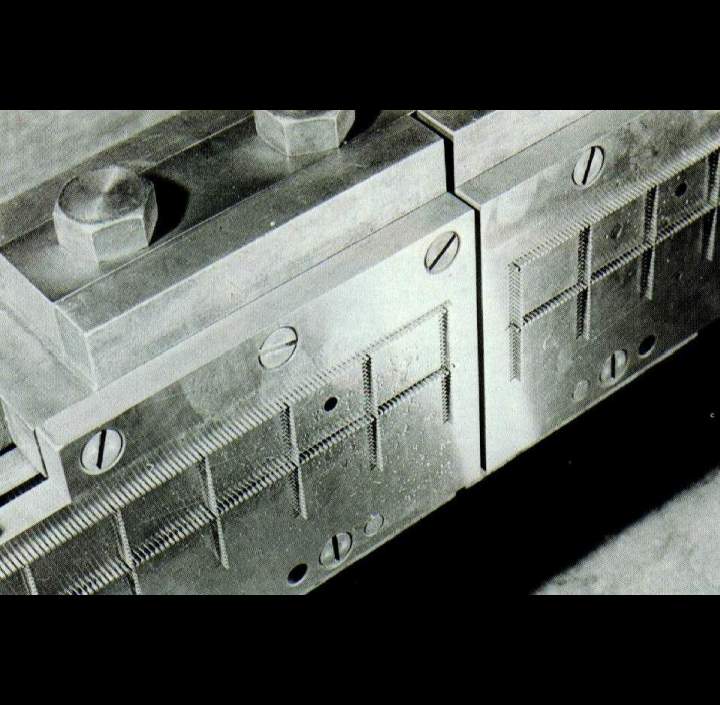 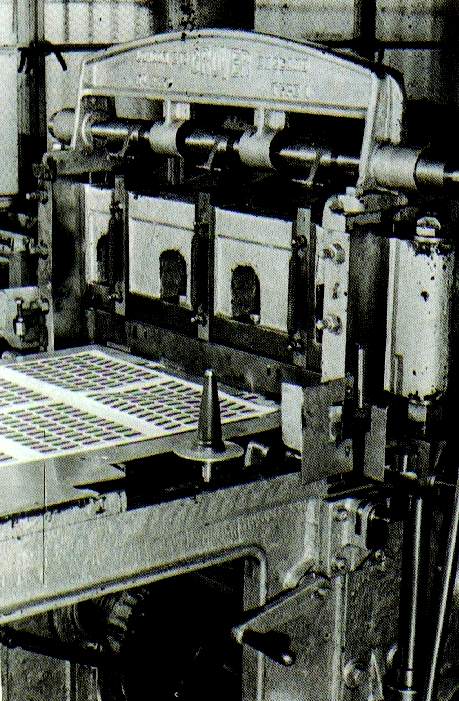 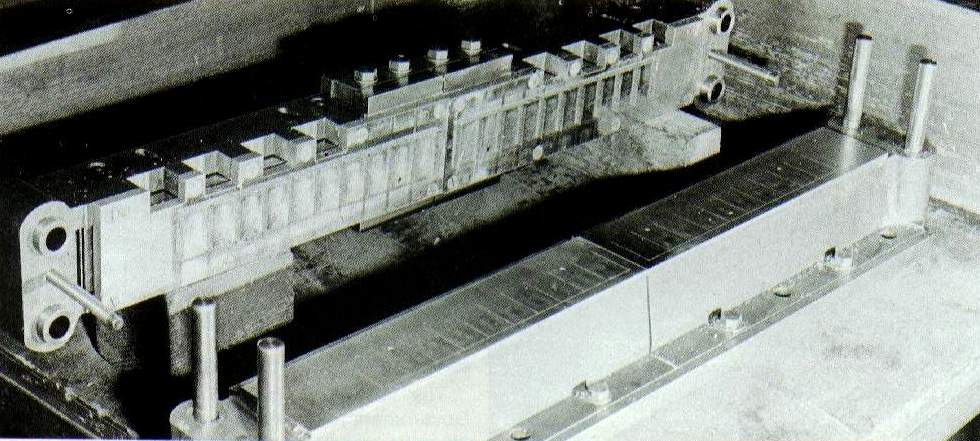 |
|
Send note to Staff
|
| Edited by rod222 - 02/25/2010 09:20 am |
|
|
Pillar Of The Community
Australia
4034 Posts |
|
|
That's a dream come true! A perforation machine exposed! Looks like it would shuffle one sheet through at a time. Otherwise the sheets would have to be clamped together. It's amazing that we have perfs around our stamps. No wonder the boss stamp printer of the day said, " Stamp printers cannot be taught; they must be born with this gift." Thanks heaps, Rod.
You wouldnt have a picture of a printing press in your info base. Humbly, KGV |
|
Send note to Staff
|
|
|
Bedrock Of The Community
Australia
38679 Posts |
|
|
Hi KG5, glad you liked the images being a marine engineer by trade, I have a broad understanding of the machinery here, but nothing in-depth. What I think occurs, (and not shown) is that there is an intermediary plate, between the pin hammer and the die. The stamp sheet/s lie on the bed, between location pins, On one rotation of the mechanics, the sheet/s advance one "comb" The intermediary plate descends and clamps the sheet/s, then the pin hammer plate descends and punches the paper. The pin hammer plate then rises, (and the intermediary plate remains momentarily, other wise the paper would grab on the pins) Then the intermediary plate rises, and the sheet auto advances another "comb" I hope this makes sense, but this would explain the possibility of puncturing several sheets at a time. I have images of the printing press for the first "Sydney Views" and the Jumelle press, but nothing re the KG5, in fact I am ignorant of just what press was used for the sidefaces. Perhaps you know, otherwise we shall have to go web crawling. |
|
Send note to Staff
|
|
|
Pillar Of The Community
Australia
4034 Posts |
|
|
Two Pence red brown issues. Issued 1924 ~ 1926 Die I single wmk perf 14.25 X 14 comb ~ 5 shade groups. Issued 1927 Die I sm wmk perf 14.25 X 14 comb ~ 3 shade groups. Issued 1928 ~ 1930 Die II sm wmk perf 13.5 X 12.5 comb ~ 3 shade groups. Watermarks & perforations determine dies. |
|
Send note to Staff
|
|
|
Pillar Of The Community
Australia
4034 Posts |
|
|
Thanks Rod for your explanation of perf machine. It leaves multiple sheets open. The process had to be a fast one as 500 million Penny reds were used per year alone. You have painted a very good picture of the workings of a perf machine.
Re:printing- John Ash, stamp printer, with quality in mind, changed from letterpress to recess- printing in early 1930s.
I have read somewhere,the first printing machine had 6 large wheels on each side for the print of the sheet. As the wheels turned they would wobble a bit and the top of stamp frame changed, sheet positions of stamps can be discerned this way
Sorry I have so little info. KGV |
|
Send note to Staff
|
|
|
Bedrock Of The Community
Australia
38679 Posts |
|
|
Replies: 697 / Views: 136,238 |
|




 Posted 02/23/2010 10:08 pm


