|
This page may contain links that result in small commissions to keep this free site up and running.

Welcome Guest! Registering and/or logging in will remove the anchor (bottom) ads. It's Free!
To participate in the forum you must log in or register.
| Author |
 Replies: 697 / Views: 136,239 Replies: 697 / Views: 136,239 |
|
|
|
Pillar Of The Community
Australia
2027 Posts |
|
|
I collect KGV, Australian KGV's are a mystery to me. I have a representative collection, and enjoy looking for the varieties, but this thread makes my brain hurt with the amount of knowledge on display. Well done everyone  |
Send note to Staff 
|
|
|
Pillar Of The Community
Australia
4034 Posts |
|
|
jubilee: Thank you very much for your comment. It's been a very exciting joint effort. And very humbling. KGV.
Rod:I checked the quantities of penny reds & it amazes me. Yep, 120 stamps per sheet! 480 on which I think is printed by one machine at one time
Total printed- 1,581,270,720 from 1914-1921 Penny reds only!
1d red extract:
" It was at once apparent that Harrison could not hope to maintain supplies of an engraved 1d base rate stamp, of which about 500 million were required per annum." Taken from The Australian Commonwealth Specialists Catalogue King George V edited by Geoffrey Kellow & published by Brusden~White 2007. |
|
Send note to Staff
|
| Edited by KGV Collector - 02/26/2010 03:57 am |
|
|
Pillar Of The Community
Australia
4034 Posts |
|
|
Printing Plates of the KGV era.
A brief explanation:
J.B Cooke & T.S Harrison [the stamp printers] used copper electro plates, probably with a protective nickel coating which wore very quickly & was riddled with constant printing flaws ~ a very interesting period for the KGV collector.
1926 the stamp printer A.J. Mullett changed the existing electro plates with steel plates [possibly an alloy "delta metal"] which wore very slowly. Most of the uncommon denominations were continued to be printed by copper electro plates to the end of the KGV printings. |
|
Send note to Staff
|
| Edited by KGV Collector - 02/26/2010 06:18 am |
|
|
Bedrock Of The Community
Australia
38679 Posts |
|
|
That's 10 million per week,
How many penny reds to a sheet? KG5
480 (4 panes of 120)
So that's 3,000 sheets a day.
I make that 6 sheets a minute roughly, hence the perforator had to be doing multiple sheets
We have to find out if they had multiple Grovers.
It's becoming an interesting journey :)
|
|
Send note to Staff
|
|
|
Pillar Of The Community
Australia
4034 Posts |
|
|
It sure is mate your help will never be forgotten it has helped me a great deal and I reckon a lot of other people as well. KGV
We would never of got this up and running in aussie. Trying not to say to much. KGV |
|
Send note to Staff
|
| Edited by KGV Collector - 02/26/2010 06:33 am |
|
|
Bedrock Of The Community
Australia
38679 Posts |
|
|
KG5
I have found an overview of the complete printing process
by the Printer himself John Ash.
It will run into possibly 5 pages.
Do you want it on this thread? or would you rather me start a new
thread
The article is called "Avoiding Varieties" 1930
Its cynosure is on the typographical prints I believe, and
Mr. Ash is quoting 800,000,000 stamps per year.
It's fascinating stuff.
|
|
Send note to Staff
|
|
|
Pillar Of The Community
Australia
4034 Posts |
|
|
I would very much enjoy this information no matter where it is posted. It sounds like it would fit very nicely here. But I will respect your decision. Humbly KGV |
|
Send note to Staff
|
|
|
Pillar Of The Community
Australia
2027 Posts |
|
|
Quote:
Mr. Ash is quoting 800,000,000 stamps per year.
It's fascinating stuff. Let's put that number in context. The nearest population stat I could find was for 1931, when the population was 9.7 million. That's over 82 stamps per man, woman and child in the country.  |
|
Send note to Staff
|
|
|
Bedrock Of The Community
Australia
38679 Posts |
|
|
Copyrighted Australian Stamp News April 1930
reproduced with permission.
Avoiding Varieties. (Part 1)
JOHN ASH
(Australian Note and Stamp Printer.)
The educational and artistic sense of a country might almost be read in the history of its stamps, for have we not
got the European and other countries depicting great deeds, art and music? In fact, almost everything of moment
is now recorded by a special issue of stamps, which, all goes to prove that we live in more enlightened times.
My interest in stamp production is to give the Postmaster-General a stamp which, in the first place, will be
Secure against forgery, and, in the second place, of such a quality that it will be a credit to Australia. It would be
idle for me to attempt to justify the appearance from time to time of. "varieties" which are brought to the
public's notice; suffice it to say that every endeavor is made to minimise variation in quality, shade and
perforation.
The philatelic public who read the "A.S.M." and other magazines, are thereby well informed as to the methods
of making dies, plates and paper, but there are other processes which may interest the reader, and I propose to
dwell for the present on these small but essential details, which are really the crux of good stamp production. I
feel sure you will at least recognise how very important is this preliminary work, and the care which is required
to ensure freedom from "varieties."
The machines used for the typographical printing of stamps are similar to those in use for fine art. printing,
except that they are specially strengthened for long and constant running, which is essential, in producing 800
million stamps a year for the Commonwealth.
All being ready, the plates are issued to the machinist from the strongroom. After the plate is duly fixed down
on the machine, "blind" impressions (without the plate being inked) are taken on colored paper, the weak places
in the impression being interlaid with paper under the plate until a uniform and even impression on all stamps is
secured. This, however, is only the beginning of what is termed "make ready." Further impressions are taken
with the plate inked in order to test the perforation. Great care has to be exercised in getting the impression or
printing cylinder to its correct circumference, even one thin sheet of paper too many on the cylinder will cause a
stretch on the gummed paper, materially affecting the perforation of the sheet; the larger the cylinder, the greater
the difficulty.
|
|
Send note to Staff
|
|
|
Rest in Peace
Canada
6750 Posts |
|
|
To all who participate in this thread: This is a most fascinating thread, even to one such as myself who has had a perhaps cursory glance at a few King George V Australian stamps. A rather in depth study such as this has turned into being is a most illuminating and enjoyable study for others also. Thanks for doing this. To put jubilee's note in further context: Quote:
Let's put that number in context. The nearest population stat I could find was for 1931, when the population was 9.7 million. That's over 82 stamps per man, woman and child in the country. There would have been a lot of mail generated by businesses, invoices going out every month perhaps and also other organizations such as churches, stamp clubs, direct mail advertising and other business correspondence generated on a daily basis. We think now to email and telephone and text, but to businesses at that time, written correspondence was The means of communications, if you were involved in anything other than local trade and custom. |
|
Send note to Staff
|
|
|
Bedrock Of The Community
Australia
38679 Posts |
|
|
Copyrighted Australian Stamp News April 1930
reproduced with permission.
Avoiding Varieties. (Part 2)
JOHN ASH
(Australian Note and Stamp Printer.)
During the process of "making ready," a trial sheet is sent to the engraver, so that he can bring his eagle eye to
bear on the faults in the, plate. Every stamp is minutely examined, and the fault indicated on the proof before
the engraver orders the plate to be returned for correction. It is; .during this examination that he discovers the
"varieties" which have crept in during the previous printing. Great care is required to see that adjustments are
made which will effectively remove the blemishes from the stamp. Sometimes the plate is in the engraver's
hands for two or three days at a time, but the printer is not idle during this period. Much skill is required to
bring out the light and shade on each stamp and to ensure that there are no broken lines. Consequently, the
machinist takes this opportunity to perform important work, technically called "cutting the overlay," that is,
building up on a printed sheet of stamps to bring out the solid and to lighten the shaded parts of the stamp, and
in assisting the engraving by reducing the high lights in the face and other parts of the stamp, thus having the
effect of putting life into the picture and making it more pleasing to the eye.
The Australian stamps, as most people know, are printed on sheets of watermarked gummed paper, 480 set on.
It is no sinecure to be able to get the whole of the stamps to appear with the same even color on every sheet
which is passed through the machine. How many people realise that this "making ready" process occupies about
a week for each value! Nevertheless this is a fact, but any shirking of this operation only results in trouble
during the production period. It is then that, "making ready" being complete, the machinist "prepares his
rollers," also seeing that the ink flows evenly from the fountain. This is important in order to maintain a good
even color. The machine is then tested with some colored trial sheets of paper to see that the printing is right,
particular attention being taken to see that there are no broken lines.
Everything being ready for printing, one ream (500 sheets) of paper is put up on the feeding table of the
machine, care being taken to see that the watermark is the right way up. I may say that each machine crew
includes a girl who is solely responsible for seeing that the watermark is the correct way up; it also is her duty to
mark the edges of the paper to show how they are to be laid into the machine. Specially selected girls are put on
this work to minimise errors. Paper makers, being human, are not infallible, but every error is reported to the
makers, the checking slip also being returned for identification purposes. Each operator signs the slip which
follows the work through the department.
The troubles of the machinist begin when he starts printing; particularly is this the case during the summer. He
has to contend with the hot north wind, when the paper on exposure curls up like a walking-stick, and, for the
same reason, it is almost impossible to get a sheet through the perforating machines. In winter, the printing
room temperature can be adjusted, as each machine is fitted with an arrangement which heats up the printing
ink and the plate, thus ensuring evenness of color, and regularity of production. Care has to be taken to see that
the temperature is as nearly uniform as possible, as variations in temperature affect the product. Mild, damp
days are the best for stamp production; it is then that the composition rollers are sharp and "tacky," picking up
the color cleanly, and depositing it uniformly all over the plate.
|
|
Send note to Staff
|
|
|
Bedrock Of The Community
Australia
38679 Posts |
|
|
(Part 3 and Final)
During the very hot days of Dcember, January and February, it is customary to have all the window blinds
drawn, and the floor frequently watered so as to minimise the bad effect of the heat, otherwise there could be
many breaks in the continuity of production. It is then the machinist is to be sympathised with, as he takes his
large magnifying glass to examine each stamp, in order to discern the "faults" quickly. This is repeated every
half-hour with frequent interruptions to wipe away the drops of perspiration which fall on the glass.
This then is a picture of the environment of the stamp printer, who is fighting against "varieties" every day of
his life; but from a sense of duty to the public, and pride of craft, he endeavors to keep his end up. Machinists
for this work are born and not made, for not only does it require skill, concentration and keen eyesight, but the
man to be successful must have an interest in his work and be a good judge of color.
When printing is completed, and the ink is sufficiently dry to handle the paper, the sheets of 480 stamps are
handed over to the cutter to split into 240 set size in order that they may be perforated. It is here that paper
stretch is most troublesome, and "varieties" are created. Perforating machines have, however, now been fitted
with micrometer gauges, which can be adjusted with the stretch of the paper, thus minimising the amount of
spoilage.
After perforation, the sheets are again examined for watermark, and then passed on for examination of faults.
The trained eye of the examiner quickly discerns changes in shade of color, or "spots" in the printing or in the
paper. When one thinks of the occasional piece of grit in the latter which sometimes indents the printing plate or
the "making ready," it will be seen the examiner cannot afford to take risks by neglecting her part of the work.
When examination is complete, the work is passed on to the checker, and then on to the packer, who is
responsible for sealing the bundles of sheets, which are now ready for sending to the Post Office.
From the foregoing, it will be seen how important a part the preliminary processes play in eliminating
"varieties," and the care that is essential for purposes of security, for not only has every engraven line to get its
proper value, but the impression as well as the color must be uniform in order to protect the issue and the
philatelist, for to be a "variety" it must also be a "rarity."
|
|
Send note to Staff
|
|
|
Bedrock Of The Community
Australia
38679 Posts |
|
|
KG5 Is this type of information, below, helpful in any way? Or, does the commentary wash away, or dilute, through the passage of time, and continual updates of the specialists catalogues? It is detailed, and I wonder if this depth is represented in the specialsts catalogue. Comments? 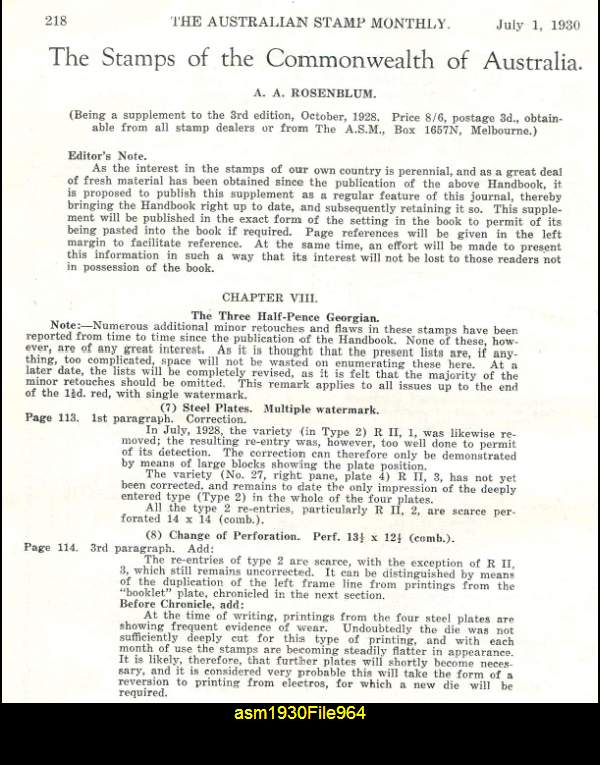 |
|
Send note to Staff
|
|
|
Pillar Of The Community
Australia
4034 Posts |
|
|
Two Pence Red Issues. Issued 1922 ~ 1924 Die I single wmk perf 14.25 X 14 comb ~ 9 shade groups. Issued 1930 Die II sm wmk perf 13.5 X 12.5 comb ~ 3 shade groups. Issued 1930 ~ 1931 Die III sm wmk perf 13.5 X 12.5 comb ~ 3 shade groups. Issued 1931 ~ 1937 Die III Cof A wmk perf 13.5 X 12.5 comb ~ 3 shade groups. Note: Die I is a single wmk Die II left frame thin & uniform, crown pearls differ in size & shape, vertical line of E in pence slightly extended at base. Die III measures 21.75 X 25 mm [Die II measures 22 X 25.5 mm] words of value even, frames thin & even, numerals are thicker & more even than die II. Note: wmk inverted are common because of booklet printings in sm wmk & C of A wmk. Image: top: 1st stamp dieI; 2nd stamp dieII; 3rd stamp dieIII. An Ash imprint pair postally used. |
|
Send note to Staff
|
|
|
Pillar Of The Community
Australia
4034 Posts |
|
|
Rod, what can I say! It is amazingly overwhelming to be able to go into the stamp printer room & have an insight on the daily workings of the printer & the other staff that produced these stamps. What a very special treat indeed. Thank you for spending so much time to post such invaluable information. Your very special area of collecting 1930s Stamp News magazines has been used in the most magnificent way. How much stamping information from the past has been lost because nobody collected it. But this one did not get away. I will treasure this extremely rare information & re~read it many times. It has so much straightened out the bits & pieces of information on printing I have that were by themselves hard to find. I cannot thank you enough. Extremely exciting info. KGV. |
|
Send note to Staff
|
|
|
Replies: 697 / Views: 136,239 |
|
|
To participate in the forum you must log in or register. | |
 Transvaal Postal History Help Earliest Stamp With In-Design Date? My First Stamps Help Newbie.help With Stamp Identification (J29) Inherited These Stamps, Are They Genuine? APS Membership Discount Metropex Stamp Show: Roseville, Minnesota October 23-24 Weird Covers, 1885,1886, And 1982 For Users Of Two-Post Blue International Albums What Is Your Experience With Binders. New Member Posting Image Of Avatar, Front And Back Of U2 Cut Square, Market Value Or References? Working On An Offline Collection George Washington 3 Cent 1861 With Print On The Back Hello From The Netherlands - New Member Then And Now, From Old Postcards New Member Wanting To Add An Avatar Sparks Auction Fees? 163 VF Nyfm Vertically Ribbed 163 XF Quartered Cork, Labeled Jumbo 136 VF Quadruple Split H Grill Nashville Philatelic Society-Your Invitation To Our Auction Night Meeting Monday, October 26, 2026 Nashville Philatelic Society-Your Invitation To Our Meeting Monday, October 19, 2026 Christmas Around The World 2026 C.e. In The Large Queen Cancel A More Condensed Album Page Experiment. US Scott #3 Postmarked Or Fake? Transvaal Postal History Help Earliest Stamp With In-Design Date? My First Stamps Help Newbie.help With Stamp Identification (J29) Inherited These Stamps, Are They Genuine? APS Membership Discount Metropex Stamp Show: Roseville, Minnesota October 23-24 Weird Covers, 1885,1886, And 1982 For Users Of Two-Post Blue International Albums What Is Your Experience With Binders. New Member Posting Image Of Avatar, Front And Back Of U2 Cut Square, Market Value Or References? Working On An Offline Collection George Washington 3 Cent 1861 With Print On The Back Hello From The Netherlands - New Member Then And Now, From Old Postcards New Member Wanting To Add An Avatar Sparks Auction Fees? 163 VF Nyfm Vertically Ribbed 163 XF Quartered Cork, Labeled Jumbo 136 VF Quadruple Split H Grill Nashville Philatelic Society-Your Invitation To Our Auction Night Meeting Monday, October 26, 2026 Nashville Philatelic Society-Your Invitation To Our Meeting Monday, October 19, 2026 Christmas Around The World 2026 C.e. In The Large Queen Cancel A More Condensed Album Page Experiment. US Scott #3 Postmarked Or Fake?
Disclaimer: While a tremendous amount of effort goes into ensuring the accuracy of the information contained in this site, Stamp Community assumes no liability for errors. Copyright 2005 - 2026 Stamp Community Family - All rights reserved worldwide. Use of any images or content on this website without prior written permission of Stamp Community or the original lender is strictly prohibited.
Privacy Policy / Terms of Use Advertise Here |
| Stamp Community Forum |
© 2007 - 2026 Stamp Community Forums |
| It took 0.25 seconds to lick this stamp. |
 |
|
|
|


 Posted 02/26/2010 01:37 am


