| Author |
 Replies: 26 / Views: 2,449 Replies: 26 / Views: 2,449 |
|
Valued Member
United States
166 Posts |
|
|
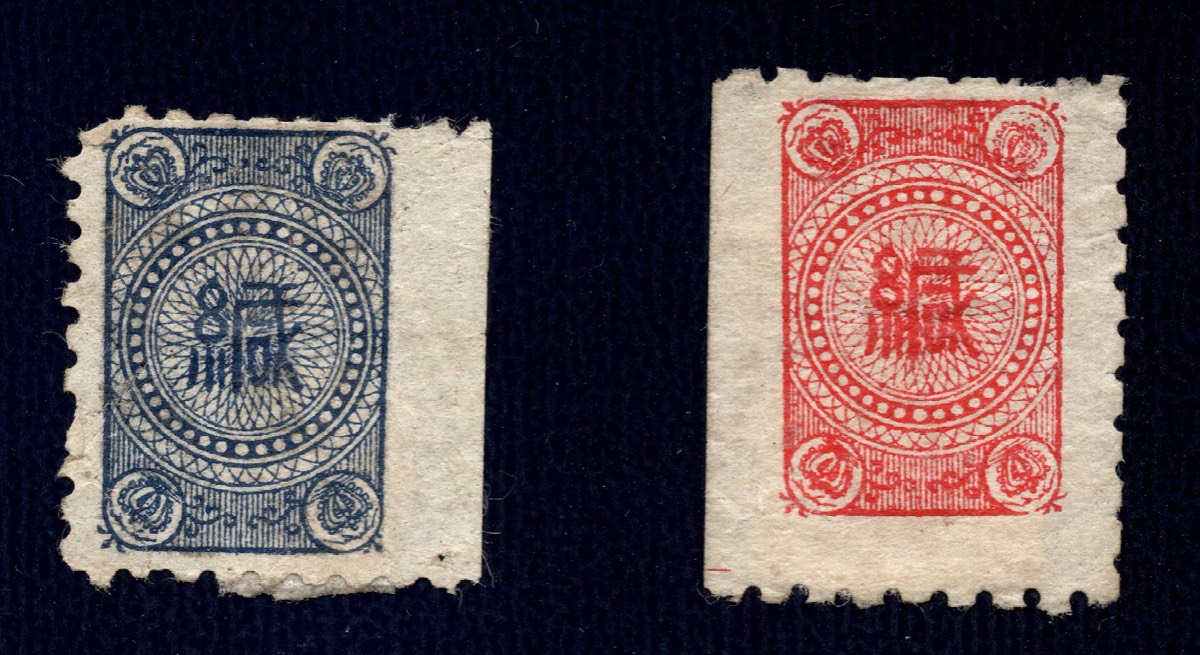 I tried searching everywhere I could think of. Let me know if I should rotate the images. Thank you for any assistance! |
|
Send note to Staff
|
|
|
|
|
Bedrock Of The Community
Australia
38679 Posts |
|
|
Nope. Has me stumped. Usually one can get a hint from the vignettes in the corners. They only look vaguely familiar. Perhaps Japanese Manufacturer's seals. I watch with interest.  |
Send note to Staff 
|
|
|
Valued Member
United States
166 Posts |
|
|
Yes, I looked through Japan, China, Korea, etc for similar designs and didn't find any that matched. |
|
Send note to Staff
|
|
|
Bedrock Of The Community
Australia
38679 Posts |
|
|
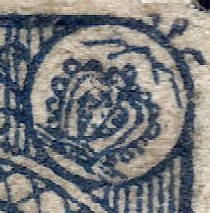
You offer great scans, but are you able to give us a closer crop on the corner instrument? It is piquing my interest. I know where it was vaguely familiar,  It was the Pomegranate argent image, hidden away on a Spanish stamp. |
|
Send note to Staff
|
| Edited by rod222 - 02/05/2022 8:36 pm |
|
|
Valued Member
United States
166 Posts |
|
|
Bedrock Of The Community
Australia
38679 Posts |
|
|
Thank you. Hmmm Faience perhaps? porcelain, Chinese Pottery? Jewellery ? I don't think that is a crown. Fascinating. Yours join Ken's brace, I don't think we ever solved that one either Bicycle wheels? 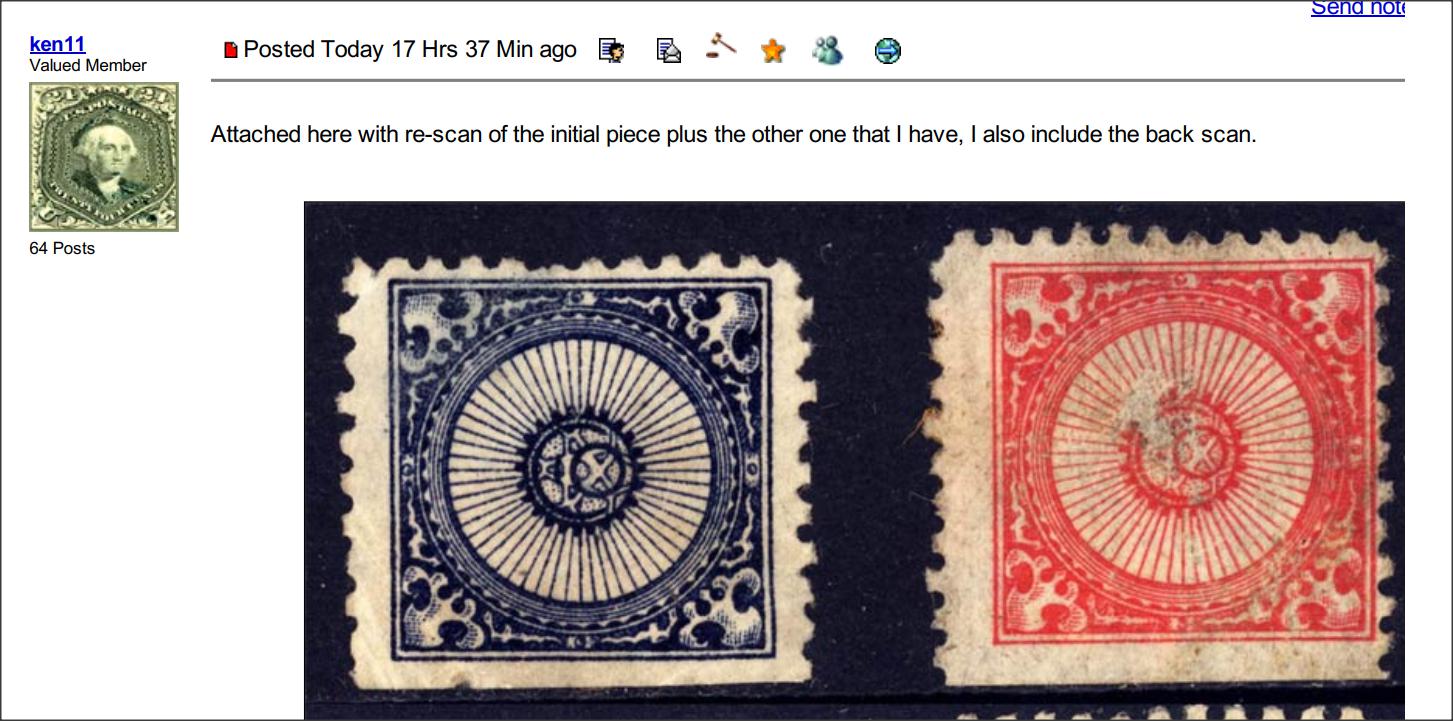 |
|
Send note to Staff
|
| Edited by rod222 - 02/05/2022 9:51 pm |
|
|
Valued Member
United States
166 Posts |
|
|
I'm hoping someone can read the inscription in the center of the stamp. |
|
Send note to Staff
|
|
|
Valued Member
United States
166 Posts |
|
|
A friend translated the writing as "It has multiple meanings depending on its context. Originally it means rope (to tie things together), also could mean letter, seal, etc." Not sure if we'll be able to track down any further information. |
|
Send note to Staff
|
|
|
Bedrock Of The Community
Australia
38679 Posts |
|
|
Great! but what language ! Rope manufacturer wouldn't be an absurd seal we have them for (Japan) hosiery and top hats etc. |
|
Send note to Staff
|
|
|
Valued Member
United States
166 Posts |
|
|
"Traditional Chinese" according to my friend. Another person said the post office in China would use a seal like this to close letters that "came open or had holes in them". I think they are saying the inscription is like a description of how to use the label. Maybe like printing the word stamp on a stamp. Unfortunately, I don't really have a way to verify this information. |
|
Send note to Staff
|
|
|
Valued Member
Finland
183 Posts |
|
|
Being traditional Chinese character doesn't yet prove it is Chinese. In Japanese they use lots of them but read them in Japanese. I have understood that these characters have also been used in lesser extent in Korean. So, options are still open. |
|
Send note to Staff
|
|
|
Valued Member
United States
102 Posts |
|
|
So, kuikka's comment is correct - Japanese Kanji was "borrowed" from Chinese characters, so they are the same - and in most cases, have the same meaning. (Pronunciation is different although the on-yomi readings were derived from the Chinese pronunciations and are in many cases similar... but that's waaay outside the scope of this message thread.) So, this can be either Chinese or Japanese. I know very little about Chinese, but I am very familiar with the Japanese language, the Kanji characters used in writing (along with the other two character sets: Hiragana and Katakana), and I am somewhat familiar with Japanese stamps. So... here is what I found. The Hasegawa Catalogue of Japanese revenue stamps includes other types of stamps, including telegraphs and postal seals. I was able to find this entry in the catalogue under Postal Seals: ![]() 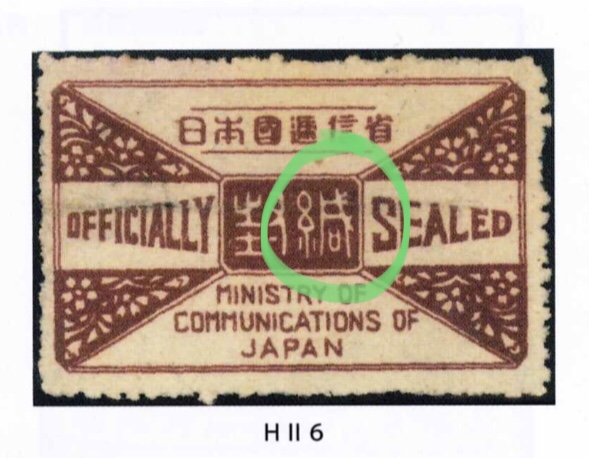 I circled in green the character on the right, which means "seal", as was proposed before. This is the same character as in the original stamp discussed at top. So, the stamps in the original post were not in Mr. Hasegawa's catalogue so they are not official Japanese government seals. What's more, these definitely look pre-WWII, and I would imagine that a chrysanthemum logo would have been on the stamp (typically at the top center) if it were Japanese. The other thing that makes me think these are Chinese is the corner emblems. These appear to be crowns, or could be a regional logo of some sort - but not likely for Japan, which was ruled by a series of emperors starting in 1878 (Meiji). I know this is hardly an acceptable way to convince anyone, but those just don't look - to me - like something any Japanese entity would produce. I can always be wrong of course! Until we can find this in a catalogue it would be difficult to prove but my guess is that these are Chinese envelope seals of some sort. I don't believe they are Japanese. Barry |
|
Send note to Staff
|
| Edited by Bcantin - 02/07/2022 02:08 am |
|
|
Bedrock Of The Community
Australia
38679 Posts |
|
|
Nice work Barry  Seals: My problem here is with the size, without measurement, they do appear tiny, which had me tending towards manufacture's seal. Imperf edges suggest origination from a pane. I've not come across any Manufacturer's seals from China before None listed in "The Seals and Labels of China" (Ed Bohannon) albeit, that seems more focussed on charity seals etc. Would Korea be out of the question? |
|
Send note to Staff
|
|
|
Valued Member
United States
166 Posts |
|
|
The red stamp is 18.5mm x 23.75mm and the blue one is 19mm x 21mm. The design on both is 12.25mm x 18.25mm. 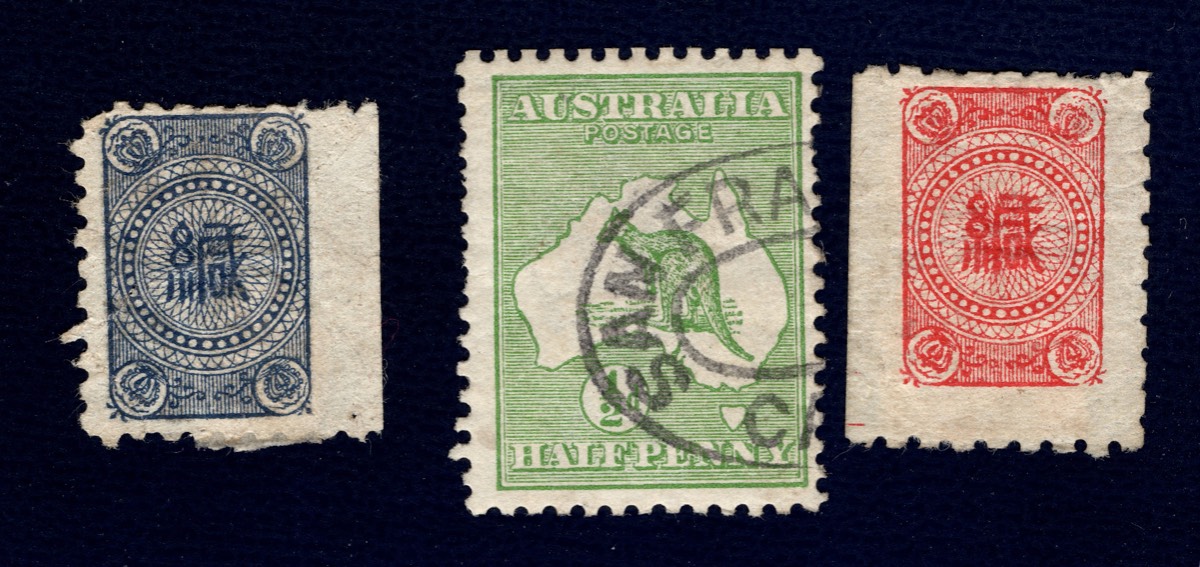 |
|
Send note to Staff
|
|
|
Valued Member
United States
102 Posts |
|
|
Good points Rod - and I may eat some of my words from earlier... because they might very well be Japanese after all. And honestly I had never considered Korean, because modern Korea uses Hangul writing - however, prior to WWII they used Kanji (the earliest Korean stamps used it as well) and the stylization on the stamp, with the circles, would be in line with Hangul. It would also be indicative of early Japanese font styles as well. Great thinking with Korea there! I don't have any resources for Korean seals but that is an excellent point... Edit: one other thing to add. I checked with a Japanese friend to see what he thought. He said that if the stamp IS Japanese, then it is very old (I know, it's such a relative term) because Japanese don't use that "style" of writing anymore... presumably referring to the font. His mother eventually recognized the character and he sent me these Kanji: 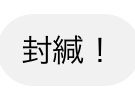 which means "sealed". I have asked for more clarification but he seemed to think this was the modernization of the character on the original stamp. Bear in mind that Korea was occupied by the Japanese for most of the first half of the 20th century, and that they used Japanese writing instead of their own Hangul (which was not Korea's primary writing method until after Korean independence, which occurred after WWII). So, assuming this stamp pre-dates WWII this could just as easily be Korean as Japanese! I am starting to eat my earlier words now. Happy to be wrong, if it points us in the right direction. |
|
Send note to Staff
|
| Edited by Bcantin - 02/07/2022 1:27 pm |
|
|
Valued Member
United States
102 Posts |
|
|
Kelump - I almost missed this little detail... but how fascinating that you chose an Australian stamp with a San Francisco postmark! |
|
Send note to Staff
|
|
|
Replies: 26 / Views: 2,449 |
|



 Posted 02/05/2022 6:29 pm