| Author |
 Replies: 19 / Views: 4,187 Replies: 19 / Views: 4,187 |
|
Pillar Of The Community
United States
6469 Posts |
|
|
I had the opportunity to pick up an R99c ($20 Probate of will, CV = $3,500) that is an upgrade for my existing copy at a fairly nice price. Other than a horizontal crease, it's actually a very nice example. This stamp is known for universally having horrific perf issues and this one is better than most. It came with a PSE cert, which as some may remember my rants of the past, I consider current PSE certs to be utterly worthless when it comes to U.S. revenues. Ever since they took expertization inhouse 7-8 years ago (I think?) and stopped sending material out to actual experts, they have issued some of the most egregiously horrific opinions I've ever seen. Under no circumstances would I ever recommend anyone buy a U.S. revenue with a current PSE cert... But this cert is from 2004, back when they actually farmed out expertization to people who knew a thing or two, and better yet, they listed the names of the expertizers on the cert... which I still maintain should be industry practice. Transparency in expertization is sorely needed. Other than Weiss, Crowe, and Sismondo (sadly all R.I.P.) who were single-person expertizers, everything else is obscured and anonymous. Only APEX will reveal who the expertizers were on a specific cert if you are an APS member and inquire. At any rate, two of the three names on the cert are known and respected as U.S. revenue experts: Richard Friedberg and Eric Jackson. (I know Randall Shoemaker's name and history but no idea as to his status or capabilities when it comes to revenues). Back to the stamp: while not mentioned on the cert, the stamp suffers from sulphurization at the periphery, so I thought I'd give it a quick and dirty H2O2 treatment (simply strokes of H2O2 via Q-tip, followed by a soak). I show the before and after side by side. While not a miracle cure, it *did* restore the color somewhat, especially at upper left and lower right. Could it be further improved by an extended exposure in a vapor chamber? Possibly. That might be something to try in future. 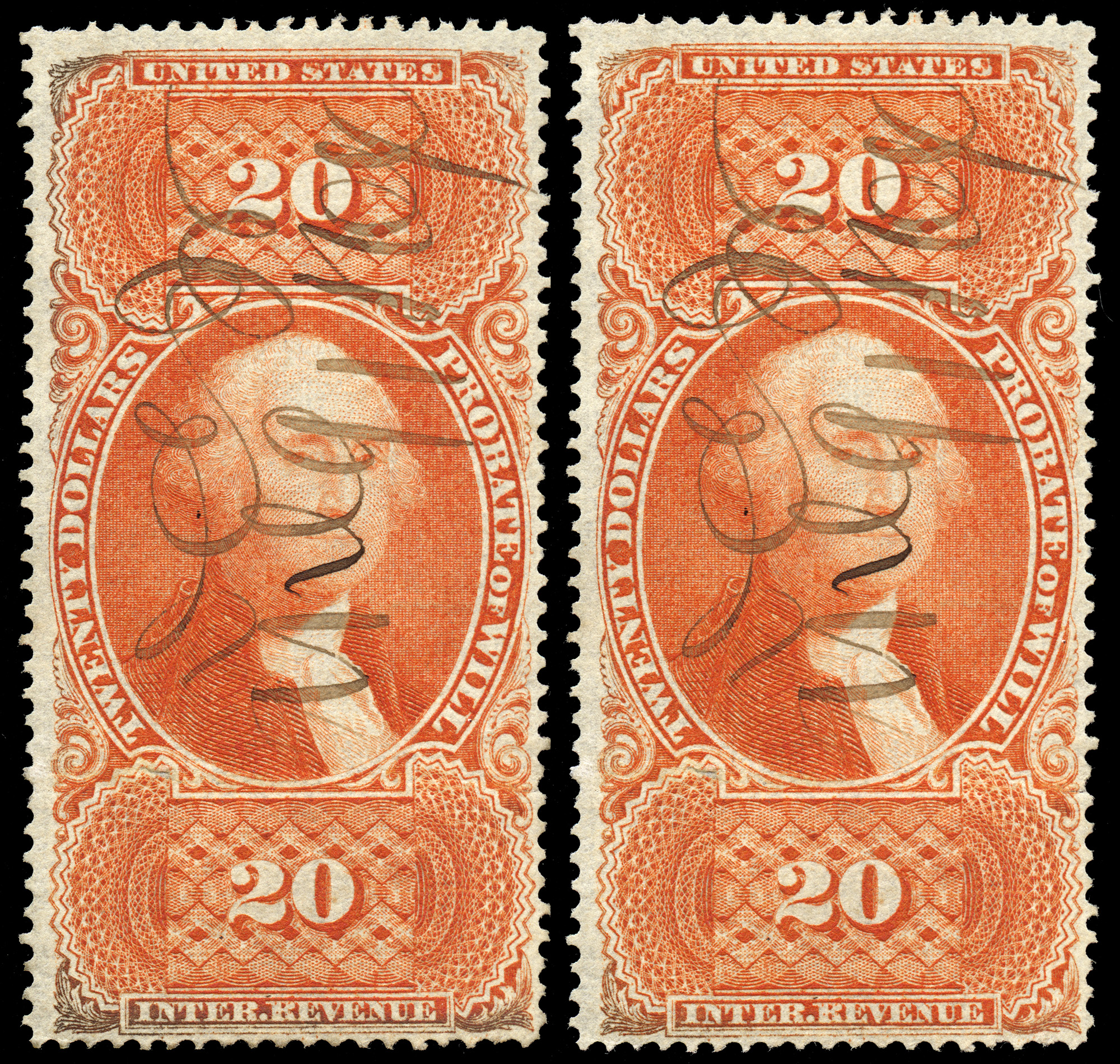 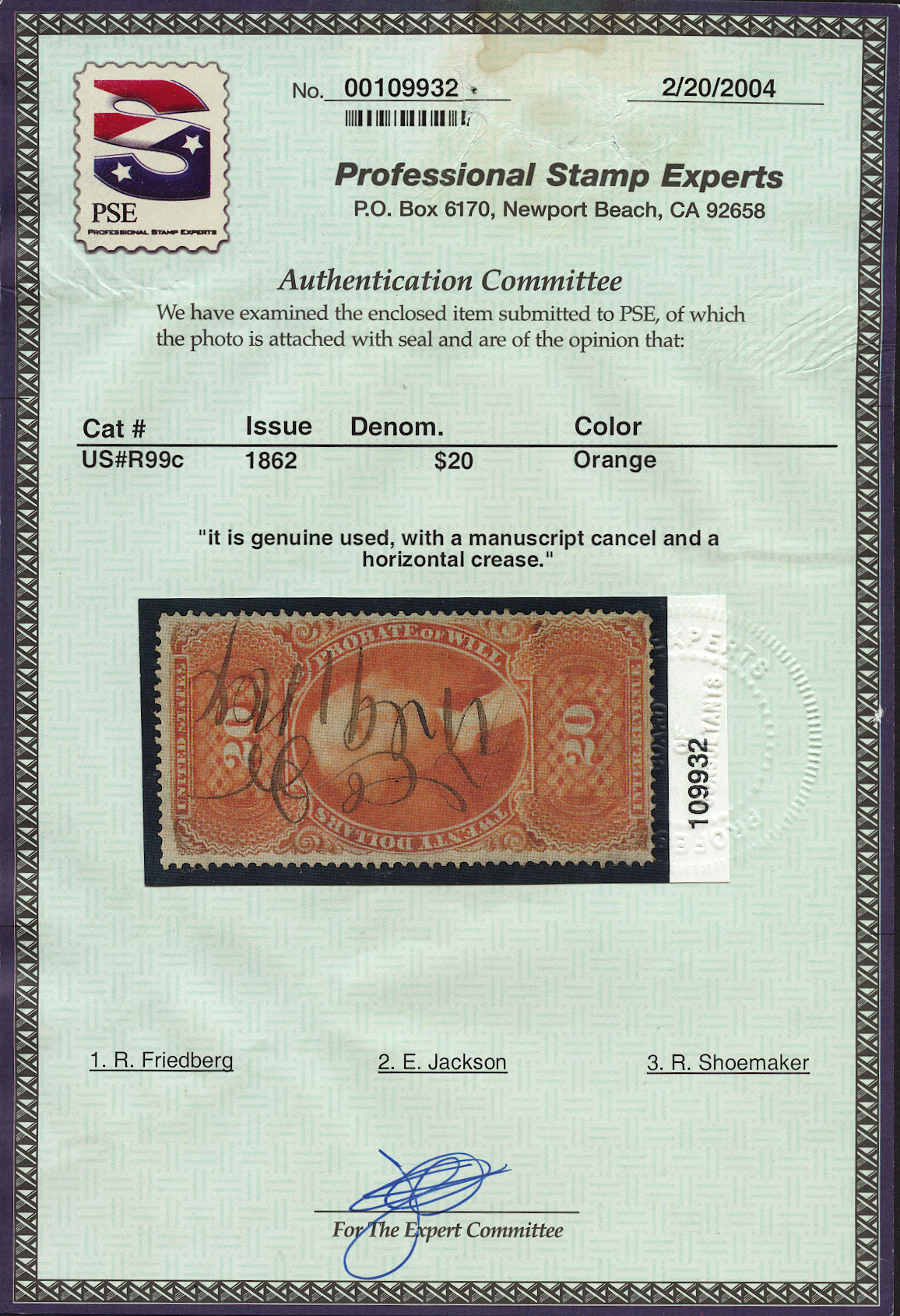 |
|
Send note to Staff
|
|
| Edited by revenuecollector - 09/07/2025 8:44 pm |
|
|
|
|
Pillar Of The Community
United States
4465 Posts |
|
|
Quote:
exposure in a vapor chamber No reason vapor treatment cannot be done now. Regarded by some as better that the Q-tip. No reason vapor treatment cannot be done now. |
Send note to Staff 
|
|
|
Pillar Of The Community

United States
1158 Posts |
|
|
I was skeptical about the hydrogen peroxide vapor technique but I tried it recently on a 116 with Hiogo cancel and I was pleasantly surprised with the results. 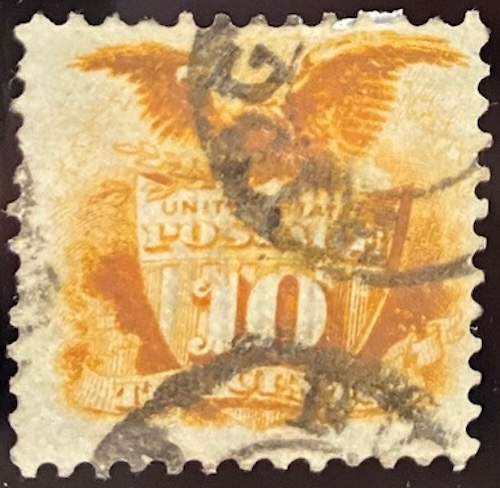 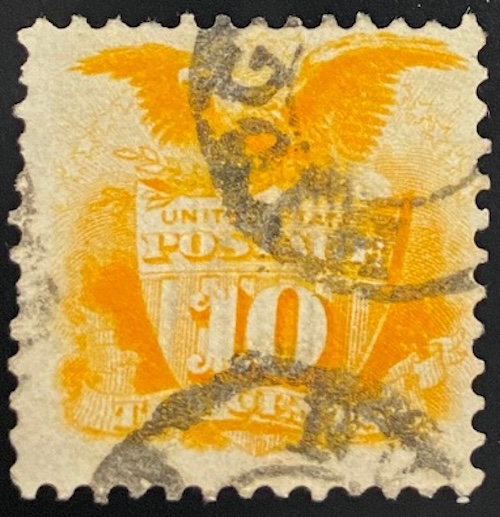 What I did was: - Fill a mason jar half full with fresh hydrogen peroxide (ordinary store-bought 3%). - Take a single-ply paper towel (actually I peeled apart a sheet of 2-ply paper towel), place it over the mouth of the jar and tie it in place with a rubber band. - Place the stamp(s) face down on the paper towel (not touching each other). - Let it sit for up to 24 hours to let the fumes do their magic. I should have checked on the stamp more frequently rather than waiting the full 24 hours. The yellow now pops so brightly it almost looks artificial. It might have been fine after just 8 hours. I did not put a lid on the jar, the paper towel was the only lid. Use in a well ventilated area if you are concerned about releasing hydrogen peroxide vapors into the air. I don't know if I needed to fill the jar half full. Maybe an inch of liquid may have been sufficient. I will try this approach again in the future as it is a lot easier than the Q-tip daubing technique, although it does use up a lot more hydrogen peroxide this way. |
|
Send note to Staff
|
|
|
Valued Member
262 Posts |
|
|
Valued Member
United States
469 Posts |
|
|
"Is the vapor chamber peroxide treatment usable for mint stamps?"
No.
A mint stamp will curl inexorably. One needs to use a open container(I use an old mayonnaise plastic top) with a plastic screen on top (I use an old piece of clean gutter guard) and maybe 10 or so drops of H202 and the evaporating peroxide does the work.After a period of time evaluate the evaporation rate and either add a few drops or leave it alone. I cringe when I read what others have done to their stamps.
In order to clear the stamp I air mine out for a day or two, the same when dipping with Ronsonol. 100 years from now people will curse those that did not air out their stamps, perhaps.
Cheers mark
|
|
Send note to Staff
|
|
|
Bedrock Of The Community
12759 Posts |
|
|
Pillar Of The Community
United States
811 Posts |
|
|
You can use a much shallower container and you only need a couple mm of h2o2 at the bottom. And you can do this with mint stamps and covers too. You can just dip used stamps in h2o2 for a much faster result. Contrary to advice from folks who have never done this, there is little to no chance dipping stamps in 3% h2o2 will bleach them out. I've left stamps in h2o2 overnight and they have not been damaged. I've used the vapor technique on mint stamps (3rd and 4th bureau) and I've not had the curling issue. |
|
Send note to Staff
|
|
|
Valued Member
United States
469 Posts |
|
|
My apology for lack of clarity. A vapor chamber or sweatbox of H2O2 will curl mint stamps. Mint stamps (mnh) treated with H2O2 vapors outside of a closed container or sweatbox will not curl mint stamps, but reverse the environmental sulpherization that tones certain shades of stamps.The enclosed container with H2O2 will also soften the gum of mint stamps such that they cannot be handled except with great caution. This has been my experience.
regards mark |
|
Send note to Staff
|
|
|
Valued Member
United States
154 Posts |
|
|
Valued Member
United States
469 Posts |
|
|
Don Was a moderator on this forum, Like Kirks or Parttime. He abhored treatment of stamps from their evolving state. In this case I think he would have been more accepting, as the treatment abrogates the damage of atmospheric sulfur across" the abyss of time" as Mark Twain wrote. Don's moniker was Studebaker 51. He had 10,000 posts or so on this forum. Clearly a love , or passion of his. May he Rest in Peace.
regards mark |
|
Send note to Staff
|
| Edited by GMC89 - 10/04/2025 6:30 pm |
|
|
Pillar Of The Community
United States
1883 Posts |
|
|
This topic is of considerable interest to paper money collectors, because gold certificates from 1869 to 1922 used the same ink on the back as orange revenues. With a larger surface area than stamps, these were often prone to greater sulfurization. I have a friend who may try a larger scale evaporation chamber. I'll post the result. |
|
Send note to Staff
|
|
|
Valued Member
United Kingdom
384 Posts |
|
|
Quote:
The enclosed container with H2O2 will also soften the gum of mint stamps such that they cannot be handled except with great caution. Appears (according to the literature) that the peroxide degrades polysaccharides (these are carbohydrates made of chains of sugar molecules). Yer store-bought sugar is sucrose, a disaccharide, which is broken down by brewer's yeast into the monosaccharides glucose and fructose, which is then digested and turned into booze and bubbles. Natural gums contain polysaccharides. Presumably these will be broken down into simpler carbohydrates by the peroxide, which will then form a convenient food source for moulds such as Phialosimplex salinarum and Sarocladium rogdcamnum. Foxing joins the chat. |
|
Send note to Staff
|
|
|
Bedrock Of The Community
United States
10864 Posts |
|
|
Bedrock Of The Community
12759 Posts |
|
|
Pillar Of The Community
United States
1883 Posts |
|
|
Question for a genuine chemist out there: if a stamp is suspended above the H2O2, which is evaporating upwards, where does the sulfur go? Is it combining and evaporating into the air, or does it remain in the paper? If it's the latter, then you'd have to assume the effect would only be temporary and the browning would eventually return. |
|
Send note to Staff
|
|
|
Valued Member
Switzerland
499 Posts |
|
|
This is what happens in your stamp:
PbS + 4 H2O2 -> PbSO4 + 4 H20
PbS is lead sulfide, a black substance responsible for the color change in your stamps. In the beginning, the stamp will turn dark. The end product is a silvery shiny surface. At this late stage all hope is lost, the circular file is the only option.
By applying hydrogen peroxide, the lead sulfide is turned into lead sulfate, a colorless substance. So lead and sulfur are still in the stamp. If your stamp is then reinserted into the "bad" album, the story will immediately restart again if there is any lead left.
Also notice two things:
1. The lead is neutralised. It is no longer part of the dye color molecule. So if you have excessive sulphurisation in your stamp, then the attacked dye color is fading (unless by chance your dye color is "lead white", then the net result is zero...)
2. The process leads to decomposition of hydrogen peroxide into water molecules. If you use an overkill of hydrogen peroxide, your stamp is wetting (hence the curling).
So you should practice on cheap stamps to find the "right dosage" of H2O2 and time before moving to the expensive stuff. |
|
Send note to Staff
|
| Edited by drkohler - 12/08/2025 2:18 pm |
|
|
Replies: 19 / Views: 4,187 |
|




 Posted 09/07/2025 8:43 pm





